Showing posts with label Philippe Auguste. Show all posts

Wednesday, February 20, 2013

Angers

Saturday, June 11, 2011

Next to welcome us was the city of Angers, capital of the historic province of Anjou. That province is now wholly subsumed by the modern region of Pays de la Loire. The earliest known inhabitants of Angers were the Andecavi, a Gallic tribe. Angers was called Juliomagus when it came under Roman rule in 80 BC, and came into the possession of the Counts of Anjou in the 10th century. Angers remained the Plantagenet stronghold in Anjou until John lost the region to Philippe Auguste in 1204.

The town has prospered over the years primarily due to the region's productive slate quarries. Another interesting (and tasty) industry is that of liqueur distillation from fruit; the liqueur Cointreau comes from here. My friend Tee was kind enough to acquire some and share to make the bus ride go more smoothly. Blame any blurry photos from this entry on her.

Photo by Sue O'Dee

We're going to spend most of our time at the château, which fronts the Maine river. The seventeen picturesque towers we see today were built of shale and limestone during the reign of Saint Louis (Eleanor's great-grandson) between 1230 and 1240 to surround the buildings and structures within. The castle was built on his behalf by his mother, the redoubtable Blanche of Castille, when she served as Regent of France. The towers were topped with pepperpot or conical turrets, now gone. The walls themselves are nearly 10 feet thick and cover a total distance of almost a third of a mile.

In 1562, Catherine de Medici undertook restoration of this château. During the Wars of Religion when the Huguenots threatened to take it over, her son King Henri III stripped the ramparts so the château was a less attractive prize. Each tower was once 131 feet high, but Henri III had all but one cut down by 32 feet by removing the charming pepperpot turrets. For a time he maintained the fortress' defensive capabilities by placing artillery on the upper terraces, but decided in 1585 that the château should be completely demolished. Fortunately for history, he died in 1589 and his successor Henri IV (the Bourbon who reputedly said "Paris is well worth a Mass") halted that destruction.

So what we are looking at is nothing like the Angers that Eleanor would have known.

While very little remains of the original Plantagenet dwellings, Angers was nonetheless important to Henry and Eleanor, both politically and personally. Their youngest daughter Joanna was born here in October 1165.

The ruins and remnants of the buildings Eleanor would have known are to the far upper right of this diagram, which can be found on the grounds.

Photo by John Phillips


Legend has it that once upon a time, wild lions and antelope lived in the dry moat to deter interlopers. If so, seems to me to have been a poor deal for the antelope.

The moat itself dates to 1485. Today, a herd of deer roams these formal moat gardens. No lions.


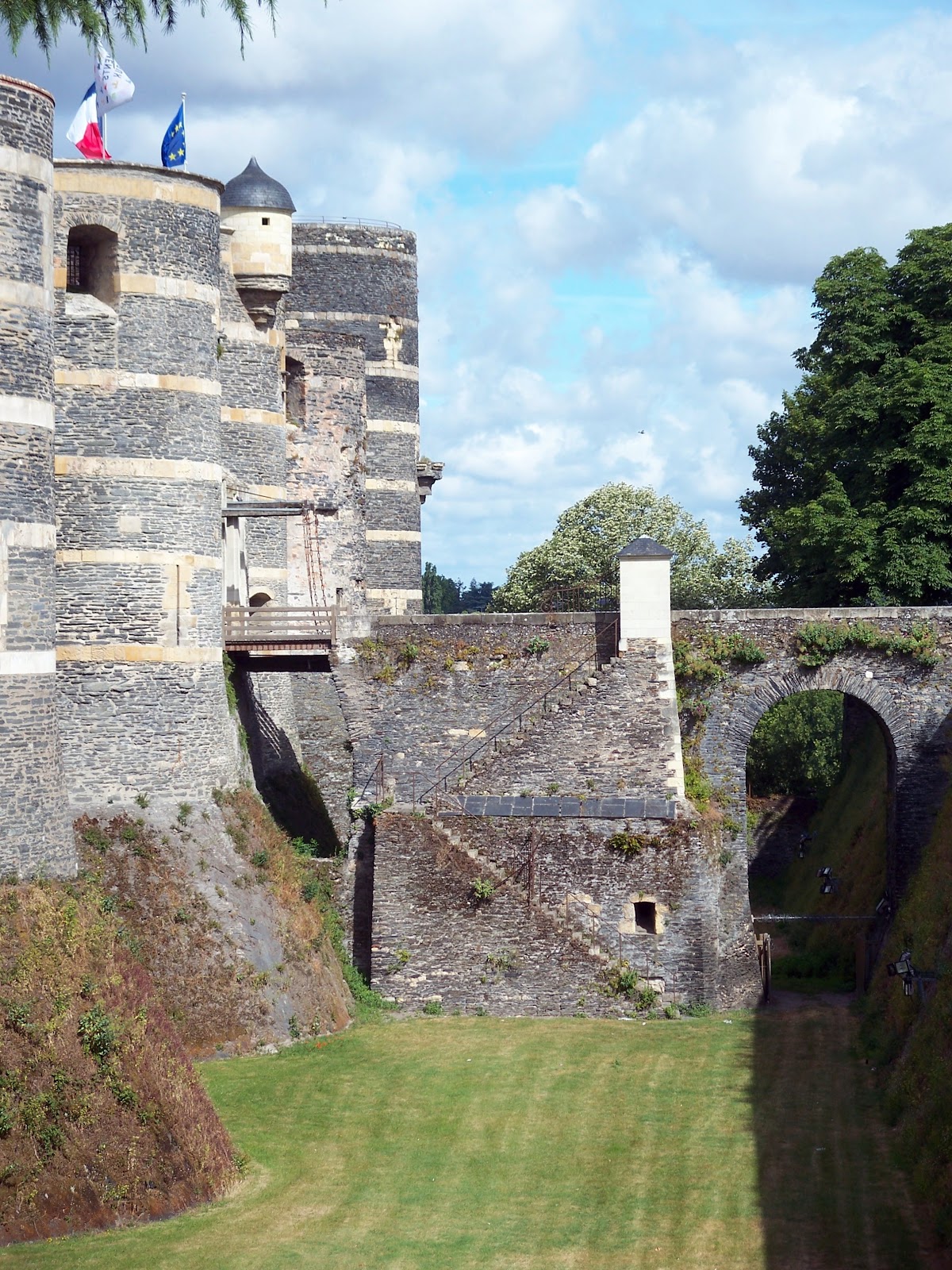
While certainly having undergone its share of reconstruction and repurposing over the centuries, Angers still looks like a serious fortification not to be trifled with. It was re-fortified for military purposes during the Revolution, when it came under major attack but suffered little damage. The château's last military purpose was when it served as a munitions dump for occupying German forces during WWII. The inner grounds sustained considerable damage from an explosion. Restoration began in the 1950s and continues today.

Tour Moulin (the last, darkest tower in the photo to the left, in focus to the right) is the only tower that retains its original height. But it, too, was stripped of its pointy little pepperpot turret by the deconstruction efforts of Henri III.


Once inside, visitors are greeted by the formal gardens in the centre of the château grounds.


I suspect the gardener went on his break in the middle of trimming this archway.


These gardens seem unchanged since my previous visit twenty years ago. I have fond memories of wandering around here one evening during a son et lumière show.


Judging from the photos below, apparently this château is guarded by a chivalrous order of height-challenged knights. They have eschewed armor in favor of cardboard helmets, shorts, and sandals but are ever-vigilant to defend the castle against ubiquitous hordes of Japanese tourists.


(My elementary-school-aged son, having seen these photos, has yet to forgive me for not bringing him home a cardboard helmet).

We spent some time wandering the grounds and walls, though I passed on the rampart wall walk in favor of sitting in the garden and remembering my previous visit.

Random photos of a guard pigeon and a Green Man carving on an interior wall.


Portcullis envy, I mean entry.


Long narrow stairway, with modern steps.

Photo by Nicole Benkert

We paid a requisite visit to the sainte chapelle, so-called because it once enshrined a Passion relic (in this case, a splinter from the True Cross).

A fire caused by a malfunctioning portable electric heater resulted in extensive damage to the roof of the royal apartments -- the Logis Royal -- on January 10, 2009. Damage to the collections housed within was minimal and the adjacent Chapelle Sainte-Geneviève was spared. However, the fire truck couldn't pass through the narrow drawbridge entryway, so the roof was destroyed. Repairs were still on-going at the time of this visit, as can be seen by the scaffolding and crane in the photo below.

As of March 2011 the new curator of Château d'Angers is American-born Patricia Corbett, lauded for her work at Carcassonne.

Photo by Sue O'Dee

Of course, no visit to Angers is complete without viewing the Tapisseries de l’Apocalypse.

Photo by Nicole Benkert

Created between 1375 and 1382 in Paris for Duke Louis I of Anjou, these allegorical tapestries portray scenes from the Revelation of St John, but they also include commentary on 14th century politics and the Hundred Years War. There were once 105 individual tapestries measuring 551 feet long by 19 feet high, a woven surface of 10,764 square feet. The tapestries would have adorned the château for special occasions. They were eventually passed to the Cathedral of Angers, and then suffered during the Revolution. After that, their history is fragmented -- used as blankets to protect orange groves from the frost, as wall insulation, saddle covers, and floor rugs. Gradually recollected between 1843 and 1870, a total of 67 panels and 9 fragments were restored.

This modern L-shaped room, built circa 1952, is dimly lit to protect the already-fading vegetable dyes on woolen threads. That ill-conceived wall of windows is now completely covered over inside to keep out the damaging effects of sunlight.

To create what we know as the Apocalypse Tapestries, weavers copied illustrations from a manuscript, working horizontally from the back of the tapestry (checking position via a mirror set below the loom). The tapestry was designed to be viewed from both sides and could thus be used as a partition, which was common in the Middle Ages.

This is one of my favorite depictions, that of The Great Whore of Babylon: "Come hither, I will shew thee the judgment of the great harlot that sitteth upon many waters." (Revelations 17:1).

Photo by Nicole Benkert

Just before leaving the room housing the tapestries, we looked down through this window to see the ruins of this chapel from the original Plantagenet-era palace. At last, something Eleanor would have found familiar! How I would have loved to have seen more of the original dwellings.

Photo by John  Phillips


More from Eleanor's day, much to our delight, was the original Plantagenet aula or Great Hall. These ruins likely predate Eleanor, since we know that Geoffrey and Maude also lived in Angers.


Classic Norman arch. Obviously the interior is a ruin, but it must have once commanded a great view over the Maine River.

Henry established l'hôpital Saint-Jean d'Angers in 1180 across the river from the château in the Doutre district. The royal charter says it was "founded of his own alms in honour of God, for care of the destitute and to relieve their want." Much of this 12th century hospital still exists, and is today the site of the Jean-Lurçat Museum of contemporary tapestry. We unfortunately did not get to visit there but it is likely that Eleanor would have, in the way of royal benefactors inspecting and showing favor to a pet project.

Photo by Sue O'Dee

I love the above photo because even though I suspect this is a modern reproduction, the chevron or zigzag moldings typical of Norman architecture of the 11th century can clearly be seen. Eleanor would have seen a great deal of this kind of ornamentation, all most likely painted.

Here's our merry band of medievalphiles gathered around this architectural witness to Plantagenet history.


I finally had the chance to peer through the great archway to see what remains of the aula: walls, a staircase, hints of a fireplace. Perhaps someday there will be restoration to evoke the structure in Plantagenet times.


The diorama below from Angers shows what the site likely looked like during Eleanor's time. The Plantagenet aula is toward the front.

Photo by John Phillips


Having finished our tour, we were funneled into the gift shop...was oddly situated in the middle of the château grounds so that visitors had to pay to enter before even buying anything -- not the best marketing plan. I had to take a photo of this replica helmet and hauberk for my knight-obsessed son.


We exited the château and walked down the charming Rue Saint-Aignan, heading toward Cathédrale Saint-Maurice d'Angers.


Below is the tall, narrow west front of St-Maurice. At one time there was also a porch, but that was destroyed in 1806. The lowest part of the cathedral dates to 1170 (and is thus something Eleanor would recognize); the twin towers are 15th century; the central tower is 16th century. Right now there is wooden scaffolding over the entrance portal at the bottom. The portal dates to the mid-12th-century and was inspired by Chartres Cathedral.


Because of the construction we didn't get to see the famous portal, so Wikipedia Commons to the rescue here:

Source: Wikipedia Commons


Statues flank either side, including one of the Queen of Sheba on the right. That statue has been claimed by some as having Eleanor for its model. That's possible, but not probable, since there's never been anything to substantiate the claim. To adjust perspective, keep in mind that the inset door to the bottom right is people-sized; that's how we entered the church.


These stained glass windows on the north side of the nave date to the 12th century and portray the Dormition of the Virgin Mary and the Martyrdom of St. Catherine of Alexandria.


In this town so associated with the Plantagenets, one of the east choir windows dating to the 13th century is dedicated to Thomas Becket, that great frenemy of Henry Plantagenet. Unfortunately I didn't get a photo of it but detailed views can be seen HERE on the Kenyon College site.


Photo by Tee McNeill


St-Maurice has a grandiose Baroque high altar that dates to 1758, designed by Henri Gervais. Legend has it that Gervais was carried to the altar while he lay dying so that he could give final construction instructions. I like how this gaudy altar contrasts with the simple lines of the Plantagenet-style vaulting.

It was time for lunch so we wandered into the heart of town. Below is a lovely example of a half-timbered house which greeted us in the square outside the east end of the cathedral. This is Maison d'Adam, at the intersection of la Rue Montault and Place Sainte-Croix. A shop called La Maison des Artisans is on the bottom floor, a kind of artist consortium.


I love this fish-eye view of Place St-Croix, with Maison d'Adam to the far left.

Source: Google Earth

Several of us had a counter lunch at La Gourmandise, then wandered back along Rue Toussaint, ogling closed antique store windows along the way. I'm pretty sure that Wendy left nose-marks as she lusted with heavy breaths after the full set of Quimper pottery she saw inside.

We were originally meant to stay overnight in Angers but in order to cut travel time for our last day of touring tomorrow we had to press on to the city of Orléans. I would have welcomed a longer stay in Angers but was also pleased to visit the city that New Orleans was named for!

So next stop: Orléans.

Thursday, November 29, 2012

Fontevraud Abbaye, Saumur and Chinon

Friday, June 10, 2011

Breakfast was risky business today. I cracked open what I thought was a hard boiled egg only to find a raw one, then nearly choked to death on a kiwi. Between the Kiwi of Doom and my Cheneyesque leper apparition the other night, I am beginning to wonder if there's a malicious presence at Fontevraud. Tonight will be our last night at Fontevraud and I hope to make it out all in one piece, if perhaps not entirely peacefully!

The abbey of Fontevraud was a double monastery for monks and nuns and originally consisted of several self-contained priories:

  • Sainte Marie accommodated the choir nuns and the contemplatives.
  • La Madeleine was for lay sisters and was comprised of married and widowed women who chose to withdraw from the world (the name reflects its origins as the priory of Robert d'Abrissel's prostitute groupies).
  • St-Benoît was an infirmary for the crippled and the sick.
  • Saint-Lazare was for lepers and, later, convalescent nuns.
  • Saint Jean de l'Habit accommodated priests, monks and lay brothers. 

During their time, patronage of the Plantagenets allowed reconstruction at St-Lazare, St-Jean de l'Habit and La Madeleine.  Today there is nothing left of St-Jean-de-l’Habit and only parts of La Madeleine remain.


The original chapel of the priory we are staying at, St-Lazare, was built around 1160. Much was destroyed or transformed during Fontevraud's prison years, when the chapel (to the left in the photo above) was divided into two levels and its stained glass windows were removed and replaced with barred windows. A dentist's office was installed on the second floor. The building to the back is our hotel, and was added in 1828 as part of the prison. So, no real lepers ever stayed there! 

St-Lazare was actually the first Fontevraud priory to be restored, and it took 8 years to complete the work begun in 1958 with prison labor. At one point during the reconstruction, the skeletal remains of six nuns were discovered and re-interred beneath some paving stones in the choir of the chapel. That's about where the restaurant is, where we ate breakfast! Perhaps their vengeful spirits, unhappy at being interred below a restaurant, were responsible for my Kiwi of Doom incident this morning....

St-Lazare was described by France's Architect for Historical Monuments Henri Enguehard thusly "....for six centuries, it was a house of prayer; for two centuries, a house of thieves; and now, for the future, a house of culture under the direction of the Cultural Center of the West."

The hotel at St-Lazare is scheduled for major refurbishment in 2012. These grounds are alive with history, and it is good to know that the abbey is the focus of continued preservation efforts.

Our first destination was the near-by town of Saumur, familiar to me since I stayed at a near-by youth hostel some twenty years ago. The castle on a hill greeted me like an old friend.


Photo by John Phillips

The original fortress was built in the 10th century as an important stronghold against marauding Normans, and Eleanor's Henry II rebuilt the chateau during his time. It supposedly looks much the same now as it did then. Unfortunately, our time was short in the town and a castle tour didn't fit with our schedule. Our tour was meant to visit Market Day but alas, Market Day in Saumur is Saturday, not Friday!  All was not lost, however, as it was a pretty town to wander about for the brief time we had there. 


Hôtel de Ville on Rue Molière. Photo by John Phillips.


Not much was open so early in the morning, but the butcher shop on Rue St Jean was doing a brisk business.  I went treasure-hunting and bought a few lovely little things at La Dentellière on Rue de la Tonnelle. You can check out that shop at LINK.

I must also admit to buying an item of what is probably of somewhat questionable taste when I stopped in the Office de Tourisme de Saumur: a ten inch resin replica of Eleanor's gisant. Questionable or not, it was the source of several covetous glances back on the tour bus!

We stayed for barely an hour in Saumur before crossing the bridge over the Loire to our next destination. Adieu, Saumur. Another day, perhaps, I will finally get to tour Henry's castle!

 
Photo by John Phillips

As we traveled around the area, we kept passing this little church below. I wish I knew what it was. You can see how overcast the sky is getting...this does not bode well.


We arrived at Chinon, our main destination for the day.  


The town of Chinon dates to Roman times and has a most strategic position along the Vienne River. The chateau we are about to visit can be traced to 5th century fortifications above the old town. Subsequent owners included the Counts of Tours, Blois, and Anjou. Henry Plantagenet dearly loved Chinon and it loomed large in his history. He added impressive and massive fortifications, initially imprisoned Eleanor here following the rebellion of 1173, and died here in 1189 having been betrayed by his sons and vowing in his despair to withhold his soul from God after the firing of Le Mans.


The section of wall shown above was likely built during the reign of Eleanor and Henry's son Richard I. His arch-nemesis, Philippe Auguste, later won Chinon from the youngest and least-able Plantagenet, John. 

Several centuries later, King Charles VII and Jeanne d'Arc began their dance of fate here. The castle fell into ruins beginning in the 1600s. When I visited the town in 1991, we were warned away from exploring its grounds. Fortunately, Chateau Chinon underwent considerable refurbishment from 2003-10.

There are three parts to the chateau. We entered through the remains of Le Fort Saint Georges. We then passed through the 13th century Tour de l'Horloge to the central part called Le Château du Milieu, and ended up at Fort du Coudray.

Photo by John Phillips

Fort St-Georges underwent extensive archaeological explorations from 2003 to 2008. It appears that it was in fact less a fort than a palace, constructed by Henry in 1160 and used by him as a residence and his center of administrative power when he was based in Chinon. The area was private property until 1994 and the Plantagenet ruins were covered by vineyards and orchards (one of the reasons we were warned away when visiting in 1991).  I found an archeological report online that shows the excavated foundations from the work done in 2003-04; you can view that report HERE.

From the Visitor's Center we crossed this bridge across the centuries to begin our tour. The bridge dates to the 19th century and replaced a drawbridge and portcullis gate.


At one time, the three floored Tour de l'Horloge we passed under housed a museum devoted to Jeanne d'Arc. I believe that museum may be permanently closed or repurposed, given the move of some of its displays to elsewhere within the Chinon complex. The tower owes its name to the clock it houses, which dates to 1399. The original bell is called Marie Javelle by the inhabitants of Chinon and has a rather threatening associated rhyme:
Marie Javelle / Je m’appelle / Celui qui m’a mis / M’a bien mis; / Celui qui m’ôtera s’en repentira.
Which translates (more or less, with some embellishments) to:
Mary-Javelle is my name. Whoever set me set me well. Who may remove me the day will rue in Hell.
Moral of the story: don't mess with the clock.


We next walked along the ramparts with the above view of the Vienne and the coutnryside to our left.

The ruins of Château du Milieu constitute the central part of Chinon as we know it today. The U-shaped Logis Royal was built in the 1400s, of which only the southern portion now remains.


Photo by John Phillips
Above is the first floor chimney from Le Grande Salle that was built by Charles VII, whose arms are displayed. It was in this building in 1429 that Jeanne d'Arc identified Charles and inspired him to reclaim his kingdom.

A tent had been set up outside Le Grande Salle for an event and we made use of it to escape the now-relentless drizzle. These grounds were once the site of the priory of Saint-Mélaine, where Henry Plantagenet drew his last breath as he muttered "Shame, shame upon a conquered king." 


We wandered around the atmospheric ruins of the royal lodgings of Château du Milieu.

Maybe it was a sense of unease from my near brushes with death at Fontevraud (for that Cheneysque apparition and the Kiwi of Doom surely could not be coincidental). Perhaps it was the dreary weather and the strain of navigating wet cobblestones with bad knees. Perhaps it was the menacing presence of the immovable Marie-Javelle bell. Or perhaps it was Henry's restless soul, denied to God and too angry for the Devil to handle, doomed to eternal wandering at Chinon, poking me between the shoulder blades.  Causality undetermined, I nevertheless felt a sense of weariness and sadness at Chinon that I could not wait to escape.


It wasn't all gloomy, though. To the right is Tour des Chiens, built by Philippe Auguste to serve as the royal kennel. I must never show this photo to mine own dogs lest they demand such a fine house for themselves.  Fine, aside from being in ruins, that is. Then again, let's face it, dogs aren't bothered by ruins.  

We crossed another stone bridge, itself a replacement for an earlier drawbridge. Here is La Tour de Boissy, an impressive 49 feet long and 10 feet high built into the hillside, with walls that are 9 feet thick in places!


This marks the edge of the section known as Fort Coudray, largely reconstructed and added to in the 13th century by Philippe Auguste.


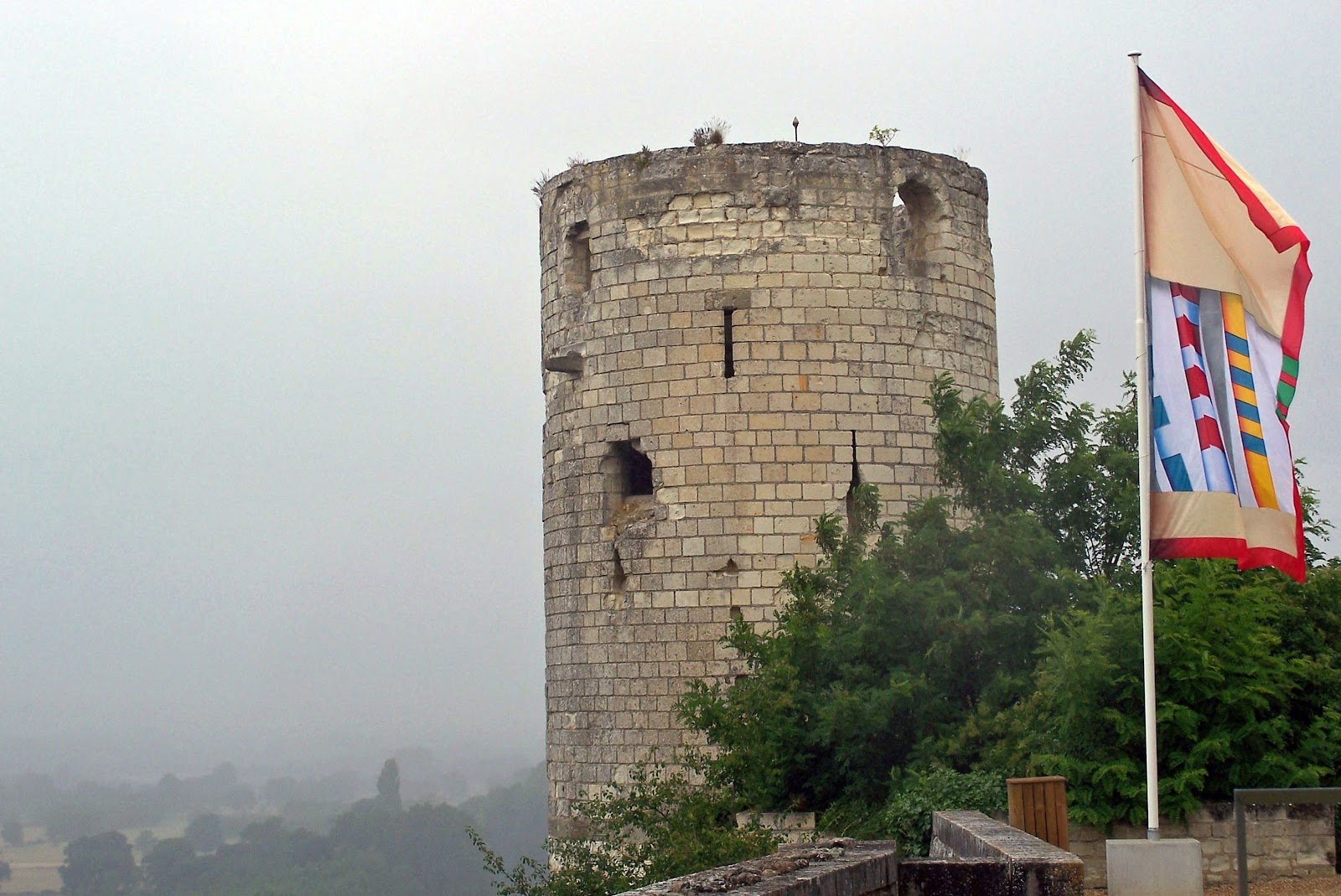
The tower below is Tour de Moulin, the oldest of the surviving towers. In Henry's time this was a powerful defensive tower. It is here that author Sharon Kay Penman placed Eleanor at the start of her imprisonment, where she remained until Henry moved her to Falaise and then the long years in England.


Photo by Julia Markovitz
I did not venture much into Tour Coudray, where Jeanne d'Arc was once lodged and where 140 Templar knights were imprisoned for three years when that order was suppressed in 1307. They left behind graffiti in parts of the tower.

I was less concerned with graffiti and more with preserving my buckling knees on the wet cobblestones. I decided that having survived the Flaming Dessert Omelette of Doom at Mont St-Michel, a Dick Cheneyesque leper apparition and near Death by Kiwi, I was not about to be done in by Chinon's oppressive spirit and slippery pathways. I decided to visit the (hopefully more easily navigated) town and sit out the rain with a café au lait, so skipped the Templar graffiti and some multi-media exhibits and headed to the Visitor's Centre and the off-limits ruins of Fort St-Georges.

Remains of Fort St-George before Visitor's Centre was built. Source: Wikipedia Commons
 
The St-Georges area was irrevocably demolished in the 17th century when Cardinal Richelieu dismantled the walls and transported the stones for construction in his town of Richelieu, allowing the grounds to decay.  The ruins of a chapel with a crypt were extant until covered over with farming and vegetation.

Once the archaeological excavations were completed in 2008, the ruins were reburied for preservation purposes.  A new building was added to this section in 2010 to house the gift shop  and tourism office, to restore the original role of St-Georges as the entryway into Château de Chinon.


Photo by John Phillips
Oppression literally hovered over Chinon in form of heavy grey sky.


After warming up and drying off in the gift shop, I met some other  friends who had decided to escape the tour. We rode the spiffy glass elevator to the town of Chinon and found ourselves drawn to a boutique called Jadis, located at 23 Place Général de Gaulle. We wandered in, found wonderful treasures, bought things, wandered back out, then came back for lunch.  Our host, Sébastien Vallon, found us 'adorable' and we thought he and his boutique and his little Bouledogue Français were absolutely enchanting.  

Refreshed, with sunlight peeking through the clouds, we walked along the Quay Jeanne d'Arc and enjoyed this view of boats on the Vienne.


Photo by Sue O'Dee


I was briefly separated from the group because I was distracted by this incongruous palm tree in a park along Rue Descartes. One of these trees is not like the other....


Next:  Chapelle Sainte-Radegonde de Chinon