Showing posts with label Catherine de Medici. Show all posts

Wednesday, February 20, 2013

Angers

Saturday, June 11, 2011

Next to welcome us was the city of Angers, capital of the historic province of Anjou. That province is now wholly subsumed by the modern region of Pays de la Loire. The earliest known inhabitants of Angers were the Andecavi, a Gallic tribe. Angers was called Juliomagus when it came under Roman rule in 80 BC, and came into the possession of the Counts of Anjou in the 10th century. Angers remained the Plantagenet stronghold in Anjou until John lost the region to Philippe Auguste in 1204.

The town has prospered over the years primarily due to the region's productive slate quarries. Another interesting (and tasty) industry is that of liqueur distillation from fruit; the liqueur Cointreau comes from here. My friend Tee was kind enough to acquire some and share to make the bus ride go more smoothly. Blame any blurry photos from this entry on her.

Photo by Sue O'Dee

We're going to spend most of our time at the château, which fronts the Maine river. The seventeen picturesque towers we see today were built of shale and limestone during the reign of Saint Louis (Eleanor's great-grandson) between 1230 and 1240 to surround the buildings and structures within. The castle was built on his behalf by his mother, the redoubtable Blanche of Castille, when she served as Regent of France. The towers were topped with pepperpot or conical turrets, now gone. The walls themselves are nearly 10 feet thick and cover a total distance of almost a third of a mile.

In 1562, Catherine de Medici undertook restoration of this château. During the Wars of Religion when the Huguenots threatened to take it over, her son King Henri III stripped the ramparts so the château was a less attractive prize. Each tower was once 131 feet high, but Henri III had all but one cut down by 32 feet by removing the charming pepperpot turrets. For a time he maintained the fortress' defensive capabilities by placing artillery on the upper terraces, but decided in 1585 that the château should be completely demolished. Fortunately for history, he died in 1589 and his successor Henri IV (the Bourbon who reputedly said "Paris is well worth a Mass") halted that destruction.

So what we are looking at is nothing like the Angers that Eleanor would have known.

While very little remains of the original Plantagenet dwellings, Angers was nonetheless important to Henry and Eleanor, both politically and personally. Their youngest daughter Joanna was born here in October 1165.

The ruins and remnants of the buildings Eleanor would have known are to the far upper right of this diagram, which can be found on the grounds.

Photo by John Phillips


Legend has it that once upon a time, wild lions and antelope lived in the dry moat to deter interlopers. If so, seems to me to have been a poor deal for the antelope.

The moat itself dates to 1485. Today, a herd of deer roams these formal moat gardens. No lions.


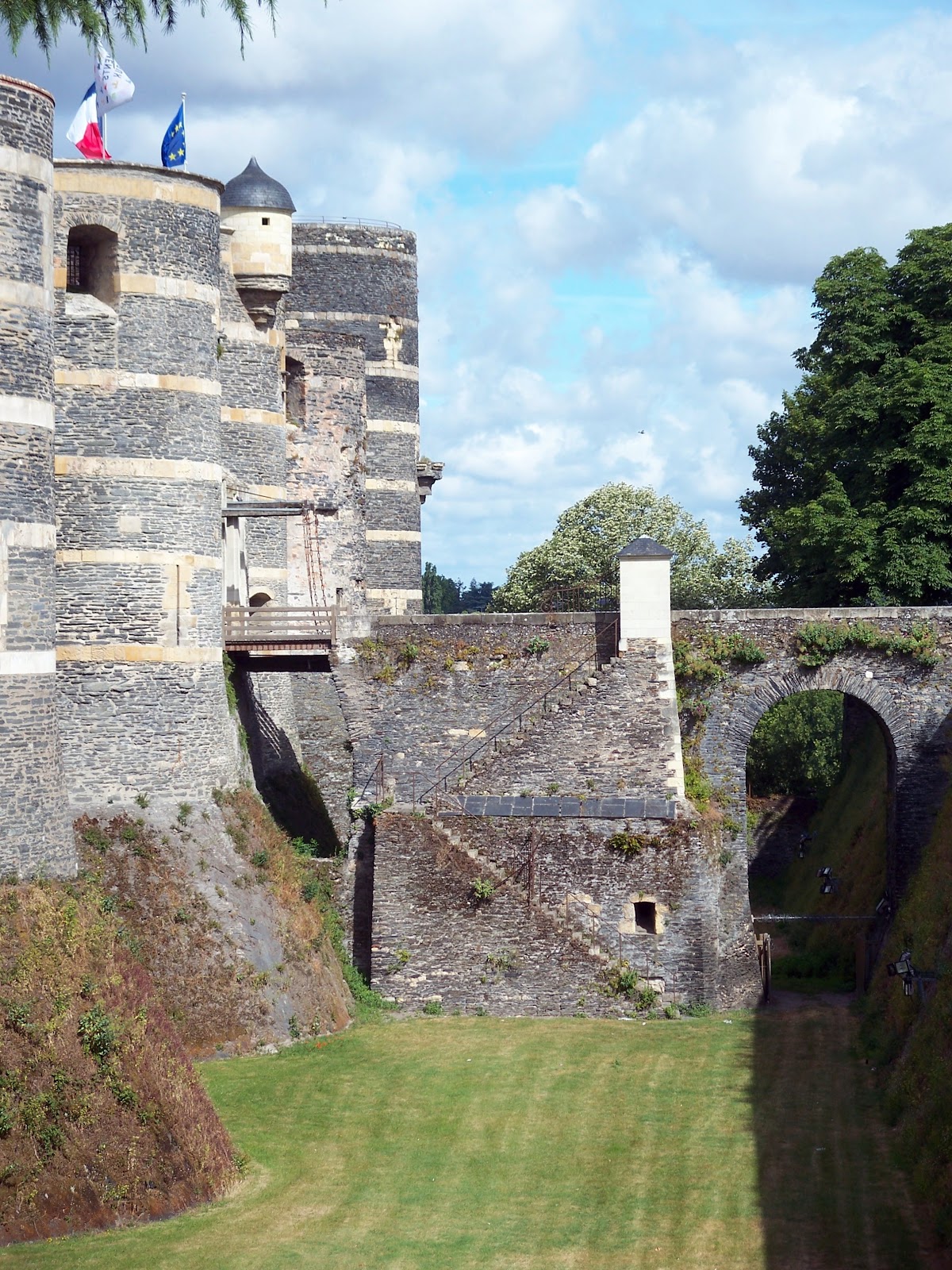
While certainly having undergone its share of reconstruction and repurposing over the centuries, Angers still looks like a serious fortification not to be trifled with. It was re-fortified for military purposes during the Revolution, when it came under major attack but suffered little damage. The château's last military purpose was when it served as a munitions dump for occupying German forces during WWII. The inner grounds sustained considerable damage from an explosion. Restoration began in the 1950s and continues today.

Tour Moulin (the last, darkest tower in the photo to the left, in focus to the right) is the only tower that retains its original height. But it, too, was stripped of its pointy little pepperpot turret by the deconstruction efforts of Henri III.


Once inside, visitors are greeted by the formal gardens in the centre of the château grounds.


I suspect the gardener went on his break in the middle of trimming this archway.


These gardens seem unchanged since my previous visit twenty years ago. I have fond memories of wandering around here one evening during a son et lumière show.


Judging from the photos below, apparently this château is guarded by a chivalrous order of height-challenged knights. They have eschewed armor in favor of cardboard helmets, shorts, and sandals but are ever-vigilant to defend the castle against ubiquitous hordes of Japanese tourists.


(My elementary-school-aged son, having seen these photos, has yet to forgive me for not bringing him home a cardboard helmet).

We spent some time wandering the grounds and walls, though I passed on the rampart wall walk in favor of sitting in the garden and remembering my previous visit.

Random photos of a guard pigeon and a Green Man carving on an interior wall.


Portcullis envy, I mean entry.


Long narrow stairway, with modern steps.

Photo by Nicole Benkert

We paid a requisite visit to the sainte chapelle, so-called because it once enshrined a Passion relic (in this case, a splinter from the True Cross).

A fire caused by a malfunctioning portable electric heater resulted in extensive damage to the roof of the royal apartments -- the Logis Royal -- on January 10, 2009. Damage to the collections housed within was minimal and the adjacent Chapelle Sainte-Geneviève was spared. However, the fire truck couldn't pass through the narrow drawbridge entryway, so the roof was destroyed. Repairs were still on-going at the time of this visit, as can be seen by the scaffolding and crane in the photo below.

As of March 2011 the new curator of Château d'Angers is American-born Patricia Corbett, lauded for her work at Carcassonne.

Photo by Sue O'Dee

Of course, no visit to Angers is complete without viewing the Tapisseries de l’Apocalypse.

Photo by Nicole Benkert

Created between 1375 and 1382 in Paris for Duke Louis I of Anjou, these allegorical tapestries portray scenes from the Revelation of St John, but they also include commentary on 14th century politics and the Hundred Years War. There were once 105 individual tapestries measuring 551 feet long by 19 feet high, a woven surface of 10,764 square feet. The tapestries would have adorned the château for special occasions. They were eventually passed to the Cathedral of Angers, and then suffered during the Revolution. After that, their history is fragmented -- used as blankets to protect orange groves from the frost, as wall insulation, saddle covers, and floor rugs. Gradually recollected between 1843 and 1870, a total of 67 panels and 9 fragments were restored.

This modern L-shaped room, built circa 1952, is dimly lit to protect the already-fading vegetable dyes on woolen threads. That ill-conceived wall of windows is now completely covered over inside to keep out the damaging effects of sunlight.

To create what we know as the Apocalypse Tapestries, weavers copied illustrations from a manuscript, working horizontally from the back of the tapestry (checking position via a mirror set below the loom). The tapestry was designed to be viewed from both sides and could thus be used as a partition, which was common in the Middle Ages.

This is one of my favorite depictions, that of The Great Whore of Babylon: "Come hither, I will shew thee the judgment of the great harlot that sitteth upon many waters." (Revelations 17:1).

Photo by Nicole Benkert

Just before leaving the room housing the tapestries, we looked down through this window to see the ruins of this chapel from the original Plantagenet-era palace. At last, something Eleanor would have found familiar! How I would have loved to have seen more of the original dwellings.

Photo by John  Phillips


More from Eleanor's day, much to our delight, was the original Plantagenet aula or Great Hall. These ruins likely predate Eleanor, since we know that Geoffrey and Maude also lived in Angers.


Classic Norman arch. Obviously the interior is a ruin, but it must have once commanded a great view over the Maine River.

Henry established l'hôpital Saint-Jean d'Angers in 1180 across the river from the château in the Doutre district. The royal charter says it was "founded of his own alms in honour of God, for care of the destitute and to relieve their want." Much of this 12th century hospital still exists, and is today the site of the Jean-Lurçat Museum of contemporary tapestry. We unfortunately did not get to visit there but it is likely that Eleanor would have, in the way of royal benefactors inspecting and showing favor to a pet project.

Photo by Sue O'Dee

I love the above photo because even though I suspect this is a modern reproduction, the chevron or zigzag moldings typical of Norman architecture of the 11th century can clearly be seen. Eleanor would have seen a great deal of this kind of ornamentation, all most likely painted.

Here's our merry band of medievalphiles gathered around this architectural witness to Plantagenet history.


I finally had the chance to peer through the great archway to see what remains of the aula: walls, a staircase, hints of a fireplace. Perhaps someday there will be restoration to evoke the structure in Plantagenet times.


The diorama below from Angers shows what the site likely looked like during Eleanor's time. The Plantagenet aula is toward the front.

Photo by John Phillips


Having finished our tour, we were funneled into the gift shop...was oddly situated in the middle of the château grounds so that visitors had to pay to enter before even buying anything -- not the best marketing plan. I had to take a photo of this replica helmet and hauberk for my knight-obsessed son.


We exited the château and walked down the charming Rue Saint-Aignan, heading toward Cathédrale Saint-Maurice d'Angers.


Below is the tall, narrow west front of St-Maurice. At one time there was also a porch, but that was destroyed in 1806. The lowest part of the cathedral dates to 1170 (and is thus something Eleanor would recognize); the twin towers are 15th century; the central tower is 16th century. Right now there is wooden scaffolding over the entrance portal at the bottom. The portal dates to the mid-12th-century and was inspired by Chartres Cathedral.


Because of the construction we didn't get to see the famous portal, so Wikipedia Commons to the rescue here:

Source: Wikipedia Commons


Statues flank either side, including one of the Queen of Sheba on the right. That statue has been claimed by some as having Eleanor for its model. That's possible, but not probable, since there's never been anything to substantiate the claim. To adjust perspective, keep in mind that the inset door to the bottom right is people-sized; that's how we entered the church.


These stained glass windows on the north side of the nave date to the 12th century and portray the Dormition of the Virgin Mary and the Martyrdom of St. Catherine of Alexandria.


In this town so associated with the Plantagenets, one of the east choir windows dating to the 13th century is dedicated to Thomas Becket, that great frenemy of Henry Plantagenet. Unfortunately I didn't get a photo of it but detailed views can be seen HERE on the Kenyon College site.


Photo by Tee McNeill


St-Maurice has a grandiose Baroque high altar that dates to 1758, designed by Henri Gervais. Legend has it that Gervais was carried to the altar while he lay dying so that he could give final construction instructions. I like how this gaudy altar contrasts with the simple lines of the Plantagenet-style vaulting.

It was time for lunch so we wandered into the heart of town. Below is a lovely example of a half-timbered house which greeted us in the square outside the east end of the cathedral. This is Maison d'Adam, at the intersection of la Rue Montault and Place Sainte-Croix. A shop called La Maison des Artisans is on the bottom floor, a kind of artist consortium.


I love this fish-eye view of Place St-Croix, with Maison d'Adam to the far left.

Source: Google Earth

Several of us had a counter lunch at La Gourmandise, then wandered back along Rue Toussaint, ogling closed antique store windows along the way. I'm pretty sure that Wendy left nose-marks as she lusted with heavy breaths after the full set of Quimper pottery she saw inside.

We were originally meant to stay overnight in Angers but in order to cut travel time for our last day of touring tomorrow we had to press on to the city of Orléans. I would have welcomed a longer stay in Angers but was also pleased to visit the city that New Orleans was named for!

So next stop: Orléans.

Tuesday, June 5, 2012

Paris: Cathédrale royale de Saint-Denis

Saturday 4 June 2011

It was with a jangly mixture of excitement and nerves that I left my husband and kids and departed for this trip. I had decided to add one extra day at the beginning to do some private sight-seeing. My flight was uneventful and the worst thing that happened was that I managed to spray Sprite all over myself at the airport. My lemon-lime fresh scent was no doubt preferable to the V-8 smell that permeates an airline cabin three hours into an international flight. 
 
Getting through Roissy Passport Control at 8:30 AM was a breeze; my luggage looked no worse for the wear; and I got a ride into Paris immediately. My driver spoke not a word of English and I was too tired to get creative with my phrasebook French so the ride was a quiet one....or as quiet as it could be with a French rap station to keep us company.  I groggily watched the outskirts of Paris transform into the glamorous city...sniggered at Madame walking a posh little dog resembling a leashed rat...tried to read shop signs...and then -- voilà! we were driving through Place de la Concorde! Obélisque de Louxor! L'église de la Madeleine behind me! Palais Bourbon straight ahead, La Tour Eiffel off to the right!  Everything was suffused with the most brilliant early morning light. I was suddenly wide awake and even more jangly with nerves and excitement. 

The cab made its way to the Rive Gauche and as the streets narrowed I looked for gates to Jardin du Luxembourg, which I knew was close to my hotel.  We finally pulled onto the right street but the driver got confused, passed the hotel, and kept going at what seemed to me to be a manic rate of speed. I cried out in English "Where are you going? Go back, go back!" and gesticulated wildly; I am sure my look of alarm conveyed what my words couldn't.  We eventually got Sorted.

I had arrived.

Trianon Rive Gauche, 1 bis et 3, rue de Vaugirard

~~~~


My room wasn't ready so early in the morning, but I was able to stow my bag and freshen up in the hotel powder room before embarking on my free day in Paris. I had grand plans for sightseeing but hadn't counted on being so physically tired. I don't know why this hadn't occurred to me; seems logical enough to take that into consideration and it was after all about 4 AM to my body. Nonetheless, I was determined to visit the royal necropolis at Basilique Saint-Denis, so off I set in search of a Metro station.  

Simple metal balustrade entrance

Art nouveau style entrance. Photos by Nicole Benkert

I wandered Boulevard Saint-Michel, stumbled down to the RER, and got directions to the proper stops. The hotel staff had directed me in a very round-about way and I knew the RER would be more direct, plus the stationmaster spoke just enough English and I had just enough pleading polite French to get my needs met. I do believe I lost track of time on the train, but eventually arrived at the St-Denis station. The area around the station was under construction and there were no helpful signs, so I wandered about some more trying to get my bearings, found a street map, and eventually got myself here:

Cathédrale royale de Saint-Denis

Before I toured the church I thought it best to get some lunch.  The neighborhood of St-Denis was primarily Algerian, and I noticed that none of the bistros I passed along the way had solo women customers. But I found a little cafe with women proprietors, took my lunch to a bench and enjoyed this view of the church while eating.  

It was a pleasant sunny Saturday to watch families and couples strolling by. I was tickled when a gentleman wished me 'Bon appétit!'  There's simply no cultural equivalent to such a greeting in the US; being hailed with "Hey lady, have a nice lunch!" doesn't cut it.

I later learned that my lunchroom was Le Jardin de Pierre-de-Montreuil and was actually sacred ground. The garden had been laid out in 1998 over what had been a burial area from the Merovingian era up to time of the French Revolution. In order to maintain the solemnity of the place, the architect designated the former burial areas for flower beds, watering systems, and lighting and drainage areas. He used patterns of plants and stones to reveal the circular layout of the now-vanished Valois Rotunda (the mausoleum that Catherine de Medici built for herself and Henri II) and the three churches that had been part of the complex. An aerial photo is below.

From: Saint-Denis: A Town in the Middle Ages.


I picked up an audio tour for the Basilica and spent the next two hours wandering around in exhausted awe, gazing at the amazing gisants and tombs of France's royal families. 

The first church on this spot is attributed to Saint Geneviève in the 5th century and was built upon the reputed burial spot of Saint Denis, Bishop of Paris from the second century. Denis walked 6 miles after being beheaded for his Christian faith (hardy fellow, that Denis). The Abbey of Saint-Denis has been associated with the French monarchy since the Merovingian era, and the first monarch buried at Saint-Denis was Dagobert in 638 AD.  

The monastery at St-Denis had become a major power-broker by the time a 13 year old Eleanor of Aquitaine married young Louis and came to Paris as his queen in 1137. St-Denis was under the administration of the venerable Abbot Suger, a politically astute religious statesman, historian, and scholar who wielded considerable influence with the monarchs he served (Louis VI and VII). Eleanor's Louis trusted Suger enough to make him regent of the realm during Louis' absence for the Second Crusade.  In fact, Louis VII was educated at cathedral schools, and spent much time in his youth at St-Denis with Abbot Suger. As a younger son Louis was raised to follow an ecclesiastical path, and he unexpectedly became heir to the throne of France upon the accidental death of his older brother. By training and temperament, Louis was probably far better suited for life as a priest than as a monarch -- as Eleanor would learn.  

About the time Eleanor married Louis, Abbot Suger had begun rebuilding St-Denis. His vision was so innovative that it is said that Suger alone is responsible for creating Gothic architecture by incorporating pointed arches, ribbed vaulting, flying buttresses and stained-glass into one building.

That's an exaggeration, but the influence of Suger's church on sacred architecture cannot be underestimated. I have to admit that even my Romanesque heart was lifted by the airiness and light in Suger's creation. Truth must be told, however: it is unlikely that Abbot Suger was the actual architect of St-Denis, although the cathedral certainly transmits his vision. He was, however, its staunchest patron.  

St-Denis became the French royal necropolis and was the scene of many coronations. Forty-two kings, 32 queens, 63 princes and princesses and 10 nobles were laid to rest at St-Denis.


Eternal life. (Photo from Wikipedia Commons)
In repose.
I was particularly drawn to the tombs of Catherine de Medici and Henri II, having visited so many Loire chateau and even Diane de Poitiers' mausoleum at Anet on my first trip to France some twenty years ago. It seemed right to tarry a while in respect for Catherine at St-Denis (even though I am admittedly more drawn to her rival, Diane). I thought it remarkable and rather brave of Catherine to have herself portrayed in this manner in her transi, appearing aged and naked in death, when she had been so vulnerable and defensive throughout her lifetime.

Inscribed on the western facade of the main entrance to St-Denis, Suger had written:  
All you who seek to honor these doors, marvel not at the gold and expense but at the craftsmanship of the work. The noble work is bright, but, being nobly bright, the work should brighten the minds, allowing them to travel through the lights to the true light, where Christ is the true door. The golden door defines how it is imminent in these things. The dull mind rises to the truth through material things, and is resurrected from its former submersion when the light is seen.
The facade was originally topped with two towers (only one remains) and the portal carvings have long since either been destroyed or heavily reconstructed to the point of having lost their original imagery. In fact, restoration in the 18th century removed a series of statue-columns representing the kings and queen of the Old Testament. Many of these are currently on display at the Cluny Museum in Paris (which we'll visit later). 

Suger opposed the dissolution of the marriage of Eleanor and Louis while he lived and exercised considerable church authority against it. Their divorce had to wait until Suger died in 1152.

Another reconstruction campaign at St-Denis occurred in the 13th century at the instigation of young Louis IX (later canonized and known as Saint Louis....more about him tomorrow) and his mother Blanche of Castile (aka the White Queen), who were granddaughter and great-grandson of Eleanor.

Eleanor herself would have recognized only the barest outlines of the cathedral we see today, but she certainly would have visited the compound of St-Denis during her time as Queen of France. It would have been a journey of several hours from Paris. 

Saint Denis himself lost popularity as a rallying patron for France during the late Middle Ages and the Hundred Years War. Not only were his countrymen no longer crying "Montjoie saint Denis" to announce his patronage, but his namesake church suffered as well. The cathedral was plundered many times during the next several centuries. It suffered its final indignity when the monk's community was disbanded during the French Revolution and the building re-purposed as a storehouse for wheat and flour.

During the Revolution the royal graves were desecrated by a mob and the remains exhumed, brutally tossed about, and then dumped into a common pit with quicklime to hasten decomposition. In 1805 Napoleon I ordered the restoration of the building, and Louis XVIII later exhumed the royal remains from their common grave and placed them in a vault in the Basilica’s crypt.

I stood for a while deep below the church, gazing at the wall of the royal vault and reading plaques commemorating the names of those whose remains were reburied at St-Denis. I felt the weight of history all above and around me. 

Ironically for my Eleanor obsession, her former husband Louis is one of the few monarchs not originally buried at St-Denis,and thus he does not have a gisant representation there. Louis got the last laugh on everyone, though. Having originally been buried at the Cisterian Abbaye de Barbeau he founded at Fontaine-le-Port in the Île-de-France, his was one of the very few French monarchical tombs that escaped desecration by Revolutionaries. Louis was re-interred with dignity in 1817 at St-Denis.

At the time of this visit, the last royal ceremony in France in more than a century had occurred at the Basilica in 2004 when a formal funeral was held for the child Louis XVII. Young Louis died of tuberculosis in prison and his heart was removed secretly the next day by the chief surgeon. It was placed in a crystal vase, passed along over the centuries, and resided at the Basilica since 1975. By comparing its DNA with that from strands Marie Antoinette's hair, it was established that this truly was the heart of the son of Louis XVI and Marie Antoinette. That finding forever laid to rest rumors that the child had survived imprisonment. The heart was placed in this display under a medallion portrait of the child.


A second French royal ceremony for this century is anticipated when the skull of Henri IV, authenticated in time for the 400th anniversary of his assassination, will someday be laid to final rest at St-Denis: LINK to ARTICLE. 

The famous (or infamous, depending on your opinion of his work) architect Eugène Emmanuel Viollet-le-Duc took charge of the restoration of St-Denis in the 19th century. I'm assuming the metal supports to the buttresses as seen below were added during that time. But considering that the original vaults of Suger's choir collapsed and were replaced within a hundred years, this has always been a high maintenance building!


I am so glad I made the effort to visit the Basillica, since the history represented there would underpin everything that I planned to see on this trip. It was a fine starting place for a tour focused on elements of medieval history. 

My photos of this visit are minimal due to camera problems, but some wonderful photos can be found on this site originating from the University of Pittsburgh (hometown shout-out!) at LINK.  You can also learn more about the Basilica in preparation for your own visit by checking out this website: Seine-Saint-Denis, Paris off the beaten track.

~~~~

I managed to navigate my way back to the Rive Gauche without incident, although I did nod off briefly and awoke startled to find myself sitting in a nearly empty stopped train in the Gare du Nord. I realized at that point that I was too tired to continue sight-seeing, so scratched my plans to visit Le Madeleine and Palais Garnier. One can only do so much. I made my tired way back up Boulevard St-Michel but had to stop along the way to admire Fontaine Saint-Michel at the Place Saint-Michel, which marks a border between 5th and 6th arrondissements. Created during the French Second Empire by a team of sculptors, Mike and the Devil were done by Francisque-Joseph Duret and the rock was created by Félix Saupin. That's right, the rock had its own sculptor. I like how the Devil is glaring at the pigeon flying by Mike's knee in this picture:


I particularly liked the winged dragon by Henri Alfred Jacquemart. He's cute, in a spewing dragon kind of way.

Checked into the hotel and was pleased to learn that I'd been given a room on the top floor with a lovely view...except the tiny little elevator only went to the floor below. Alas, I had to lug my suitcase up a flight of stairs. It was a miserably and uncharacteristically hot early June day in Paris, and after my long trip to St-Denis I was quite worn out. Below are the flowers sent by my beloved husband and children, which I was thrilled to find waiting for me in my hotel room once I finally got checked in. This photo says "LOVE" and "Paris" to me.


I felt much better after a shower and brief rest so decided to venture forth once more. I desperately needed to replace my camera's memory card, as I'd mistakenly brought along the wrong size. I was directed by the hotel staff to a FNAC electronics store around the corner on Boulevard St-Germain.


Unfortunately due to my fatigue and French-plus-electronics fail, this turned into a Quest. I came to know everyone at this FNAC on St Germaine quite well and they were very kind to me in my extremity.


By this point I was nothing less than completely knackered. I abandoned my goal of having a nice dinner in Paris on a Saturday night in favor of grabbing something from the nearest Monoprix and collapsing in a heap back in the hotel room.

Monoprix on Blvd St-Michel; photo from Google Earth

Quel dommage!