Showing posts with label Basilica St-Denis. Show all posts

Thursday, October 25, 2012

Fontevraud Abbaye


Thursday, June 9, 2011
Source: John Phillips
 
We had free time that evening to explore Fontevraud. We'd all made advance arrangements through our fabulous tour manager for dinner so as to avoid last night's mealtime fiascos.  After all, it wasn't like we could cook up a meal in the abbey kitchen for ourselves.

Why not? It's a little, uhm, rustic. 

Behold: the ancient abbey kitchen at Fontevraud:


Source: John Phillips
Source: Julia Markovitz


The Romanesque kitchen of Fontevraud sports Byzantine  cupolas and that fish-scaled, pine cone roof characteristic of Plantagenet architecture. It dates to 1105-60 CE and is thus as old as the abbey church. It contains five of its original eight apsides. At one time there were 20 chimneys in all, but the building has been altered and some have been lost.


After Fontevraud Abbey was dissolved, the original function of this building was lost to history. It was variously thought to have been a baptistery, funeral chapel, or round church. The designation of it as a kitchen or smokehouse was based on comparisons with similar structures elsewhere, including in near-by Poitou. Credit has been given to that ubiquitous restoration architect Viollet-le-Duc for identifying it in 1865 as a smokehouse. 


The kitchen was restored in the early 20th century by Lucien Magne (who added a lantern to each chimney for that homey decorator touch).


We had time to wander the grounds before dinner and our late evening tour. The main draw was of course Église Abbatiale, the abbey church dedicated to the Virgin Mary.

 
The first church here was started in 1104 and largely completed in terms of structure by 1115, enough so that Fontevraud community founder Robert d'Arbrissel could be buried there the following year.

This church, like most antique buildings, has seen its share of revisions, but has had a more brutal history than most. When Fontevraud was a prison, between 1804-21 five floors were added within the church to house prisoner workshops and dormitories. Heritage and cultural preservation came into vogue by 1840, so Fontevraud accordingly was officially deemed a national monument. However, restoration on the church was delayed until 1903-10. Architect Lucien Magne supervised the removal of those dormitory floors, replacement of the roof domes (five of six of the abbey church domes had been destroyed), and other restoration.

Work was still being done in 1990 when I first visited. I remember that the church had no floor and that archaeological investigations were on-going. It looks vastly different now than it did even 20 years ago. We can only imagine how it might have appeared in Eleanor's time.

Source: John Phillips

Source: John Phillips
This church has not always been a peaceful place, especially not in the aftermath of the destruction of the religious houses during the Revolution, and most definitely not between 1804 to 1963 when Fontevraud operated as France's second largest maximum security prison. The religious and historical character of the abbey was lost for a long time, causing one of the prison chaplains to recall:
"And in this place where Faith was so strong for so many centuries....not one inmate seems to perceive, through the architecture or the still-visible traces of the former abbey, the smallest sign of faith or of prayer. It's as if the abbey didn't exist any longer."
The bones of those buried here have never been allowed to lie unmolested. Never content with only knowing part of a story, after returning from this trip I felt compelled to read more about the full history of Fontevraud beyond its Planatagent necropolis connections. Learning that thousands of prisoners despaired in this place was humbling. Fontevraud is undoubtedly beautiful and while it will forever be associated with the glory of the Plantagenets, for me there is much sadness about the place.

I suppose some tourists might come here and think they've seen everything exactly as Eleanor of Aquitaine would have known it. But everything has been reconstructed to create a cultural center par excellence, and reflects many centuries of history.

Here, for instance, is the Renaissance-era gallery of the Grand-Moutier cloister. The cloister, constructed over the tenure of two different abbesses between 1519-1560, was later found to be built over Roman remains. It was restored in 1860 by prison labor.

Source: Sue O'Dee

The buildings that surround this outer courtyard were actually barracks built in the 19th century for the garrison in charge of the prison.

Source: John Phillips
We Bastard Babes headed out the main entrance into town for a lovely dinner at Restaurant Brasserie - La Fontaine d'Evraud. 

Later that evening, our entire tour group embarked on a guided visit of the abbey around 10 PM. I'm still not sure why we were scheduled to do this so late....perhaps to add atmospheric flourishes? It was certainly lovely to see the grounds by night.


The area next to the church was an early cemetery for the abbey.
  We entered via Salle Capitulaire in the Chapter House, which was the central meeting place of the abbey built between 1543-62.

Source: John Phillips

Source: Julia Markovitz
In the forefront of the above photo is one of two huge pillars which support the vault and divide the space into six bays. The walls of the chapter house were painted by Thomas Pot, an artist from Anjou, in 1563. The paintings represent scenes from the Gospels: Washing of the Feet; Betrayal of Judas; Flagellation; Crowning with Thorns; Crucifixion; Burial; Resurrection; Ascension; Pentecost; and Assumption of Mary. Contemporary portraits of two of the abbesses were included in the Crucifixion painting, and later abbesses decided they might as well have their portraits added into the other scenes. Some of them should have thought better of that decision, because I'm not sure this abbess' memory is well-served by having a bare foot sticking out of her rump:

All of these paintings were covered over when Fontevraud functioned as a prison. (In the above case, that was probably just as well).

So much of the abbey that we know today had its origins in Renaissance times. For instance, the tiled floors in the Salle Capitulaire showcase the initials of the two abbesses who rebuilt the cloister and chapter house: RB (Renee de Bourbon) and L (Louise de Bourbon), arms of the Bourbon family (crowned wings) and those of Francis I (salamander).

Source: John Phillips

We next entered the church, which has become known as the Plantagenet family necropolis. Their  mortal remains were deliberately disinterred and were either lost or destroyed during the Revolution. Here are coats of arms of various family members who once were buried there.


One source I read stated that fifteen Plantagenets in all were buried at Fontevraud, but so far I can only account for twelve. In addition to Eleanor and Henry, Richard I, and John's wife/Queen Consort Isabella d'Angoulême there are:
  • The second abbess and Henry's aunt, Matilda of Anjou, who died in 1154. 
  • Joanna and her sons, the infant Richard and Raymond VII of Toulouse.
  • John, whose heart was buried here at Fontevraud where he and sister Joanna spent much of their childhood. His body is interred at Worcester Cathedral in England.
  • Henry III, son of John and Isabella, was represented here by his heart.
  • Eleanor 's grand-daughter Alix by her daughter Alix, second child of the marriage to Louis VII. This Alix was an abbess,
  • Another Eleanor, a grand-daughter of Henry III and abbess of Fontevraud, was buried here in 1329. 

The exact location of the Plantagenet graves remains unknown, but excavations from 1985-1991 have pinpointed the crypt more decisively.  

It was the discovery of this period painting of Raymond VII on a column, along with comparisons with his will and chronicles of the time that led archaeologists to conclude that his burial place was near this pillar. That narrowed the location of the Plantagenet family crypt to the eastern bay of the nave, where the stone effigies rest today.

It is impossible to determine anything more specific, since construction of a 1638 burial vault for the abbesses obliterated traces of anything built before then, royal or otherwise.

Other medieval stonework and even an effigy thought perhaps to be that of Eleanor's grandson Raymond VII of Toulouse were discovered in the nave. These items are not on display and presumably have not been authenticated.

I think that the selection of Fontevraud as the Plantagenet family necropolis was Eleanor's doing. It was a conscious choice made to establish dynastic continuity, albeit one influenced by circumstances, necessity, and even a medieval equivalent of the desire to 'keep up with the Jones'   -- in this case, the Capets.

It is interesting to look at the historical precedents and influences for Eleanor's decisions related to Fontevraud. There was no centralized English royal necropolis as we know Westminster Abbey to be today. And while Basilica St-Denis in Paris is the final resting place for most French royals, it was not always so. During Eleanor's time queens were not buried at St-Denis, plus there were restrictions on the types of memorials for the kings who were interred there.

It was expected that an English or French royal woman would be buried at the monastic house she was most closely associated with, either as a founder or significant donor. Since it existed within her domains and had as additional cachet its historical respect for female leaders, we can imagine that Fontevraud was high on the list for Eleanor's choice as final resting place.

But Henry? He ended up at Fontevraud largely by accident. His sudden death at near-by Chinon during the exceptionally hot summer in 1189 made it impractical to transport his remains to Grandmont, his preferred burial place and a house he'd actively patronized.  It was the serially-monarchially-monogamously-loyal Greatest Knight William Marshall who is said to have decided on Henry's final journey to Fontevraud. Eleanor likely had no say at all since she was still imprisoned in England at the time of Henry's death.

So, off to Fontevraud Henry went. The chronicler Gerald of Wales opined that there was perhaps divine retribution at play, what with Henry buried at the same abbey he'd 'invited' Eleanor to permanently enter as a nun following the Revolt of 1173. I rather like that idea and I'd prefer to think it wryly amused Eleanor, she who always made the best of her circumstances!   

Ten years later, Eleanor's favorite son Richard requested burial at Fontevraud as he lay dying his wasted death in 1199. Later that same year, her youngest daughter Joanna died in childbirth, taking the veil on her deathbed and thus assuring her burial at Fontevraud.  And after a long life well-lived, Eleanor's own mortality surely loomed large.

So what to do with all these bodies? Well, if you are Eleanor of Aquitaine, you've got lots of examples to fall back on. You've traveled to Byzantium, The Holy Land and Sicily and have seen their examples of Christian dynastic burial traditions. Your daughter Leonora and son-in-law Alphonso of Castile have founded Las Huelgas, a Cistercian convent near Burgos, and established it as their family's royal necropolis; that's a fine example to emulate. The first formidable mother-in-law of the pair you've had, Adelaide of Maurienne, set the bar high with a pre-planned burial site that combined the necessary prayerful devotion in perpetuity by a religious house with a striking personal grave monument.  Your second formidable mother-in-law, the Empress Maude, didn't shrink at sending a message beyond the grave in the form of an emphatic epitaph about the legitimacy of her lineage and that of the royal line you married into and expanded. And perhaps most galling of all, your ex-husband Louis VII was lying beneath the grandest tomb his third wife could give him, a striking life-sized painted and bejeweled stone gisant of his pious self in coronation splendor. That funeral art was the first of its kind, and I think it probably begged to be outdone at Eleanor's hands.

And so it was. She eclipsed them all.

Source: John Phillips

Richard I. Source: John Phillips
Henry II. Source: John Phillips
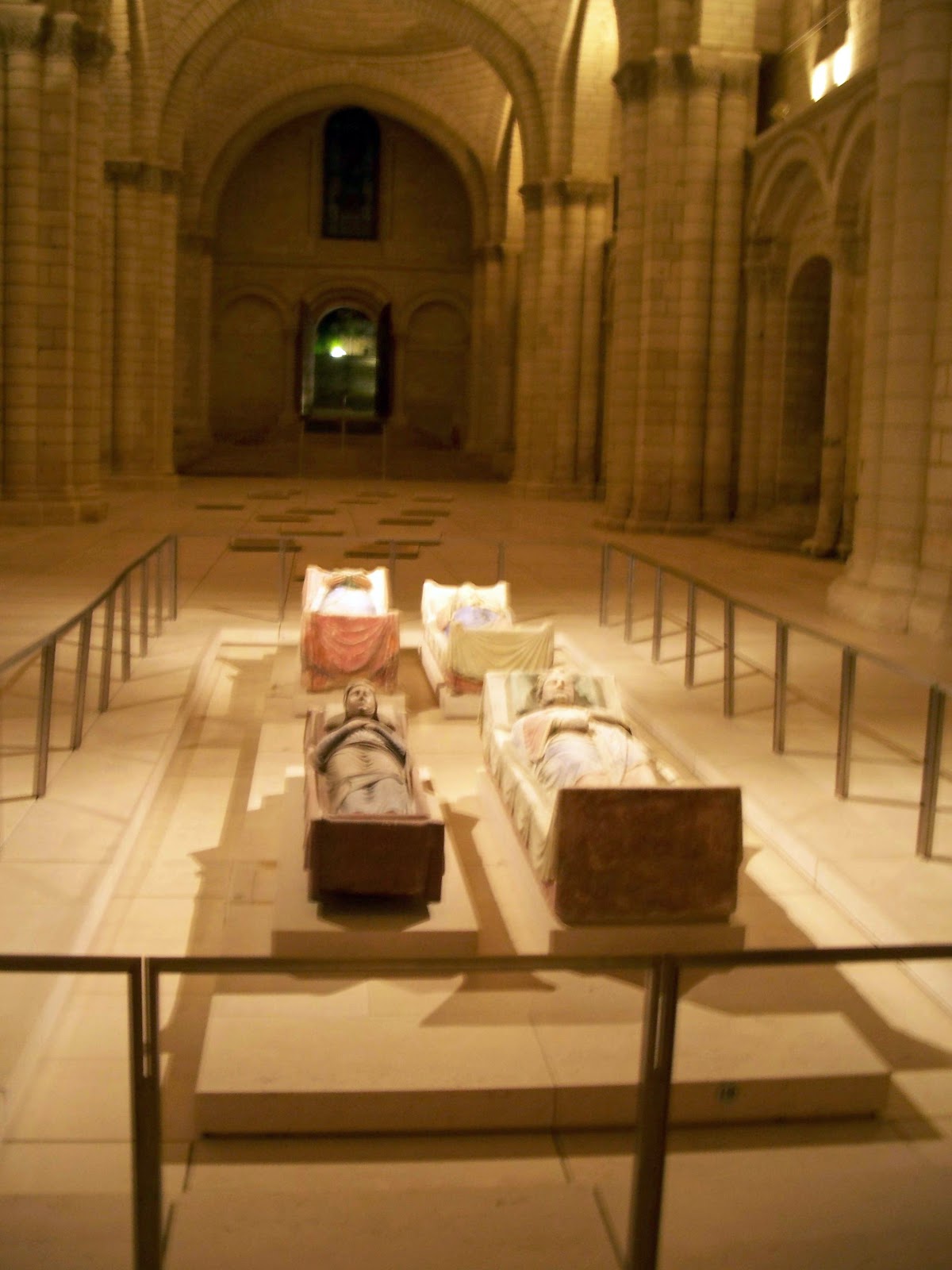
The gisants of Henry, Richard, and Eleanor are believed to have been carved circa 1200 by the same artist/group of artists, who used the ubiquitous tuffeau of the region. Henry and Richard are both shown lying in state, dressed in recreation of their coronation splendor. These gisants are a nod to the new French iconographic style of presenting an image of the eternally splendid king and his authority that stretches beyond the grave.  

Although she was 80 when she died in 1204, Eleanor's gisant shows her to be a dignified woman of middle age. She is thus forever young -- and very much alive. Eleanor likely never had a coronation per se of her own and therefore was not entitled to the same kind of imagery that she had designed for her son and husband. But her funeral sculpture choice is even more interesting. 

Eleanor's recumbent form is slightly elevated. She is crowned, a symbol of her secular role. But she is reading, not just holding a devotional book in repose like many other high-born woman would portray themselves (including her daughter-in-law Berengaria). She's actively reading what is most likely a psalter. Through this choice, scholars posit that she chose to move beyond a funereal show of secular authority to instead portray herself as very much alive, and clearly forever devoted to matters of a higher realm.


Eleanor of Aquitaine. Source: John Phillips


In other words, Eleanor got the last laugh over both of her husbands, who are forever tied in imagery to their royal roles....even pious Louis.


We can't know exactly how these gisants were arranged, although there are hints as to their relationships to one another in the abbey. Richard asked to be buried at his father's feet, we know that much. Joanna very likely had a monument, perhaps like those of her parents and brother since she died in that same period of time, but perhaps simpler given her final role as a nun. Joanna's son Raymond requested in his will that his tomb be placed at his mother's feet, although archaeological evidence indicates that this wish was not honored. We know from chronicles that when the community decided to make different use of the nave in 1504, the positions of the gisants of the immediate family members were rearranged in a single line, with Raymond's gisant and that of Isabelle d'Angoulême off to the side. 

Work done on the nave in 1638 resulted in the loss of the memorials for Joanna and Raymond. Kneeling figures replaced them for a time, but those have also been lost. In 1810 it was proposed that the gisants, presumably in the way at the new Fontevraud prison, be stored in Tour d'Evrault, which is what we now know were the Romanesque kitchens! The gisants ended up getting shipped to Paris to be repainted between 1846 and 1849. The British government tried to repatriate them to Westminster Abbey, and supposedly in 1866 Napoleon III even offered them to Queen Victoria, but the outcry from the French public caused him to rescind his offer. 

And thus it was that after wandering about throughout the mid/late 1800s, these gisants were returned to the centre of the nave in 1930.


We wandered around a bit more of the abbey and ended the night outside the Tour d'Evrault.  No one provided us with a midnight snack from the kitchens, alas.


The gisant of Louis VII is known to us now only by descriptions and drawings,  since it was lost during the Revolution. But the gisants that Eleanor designed for Henry, Richard and herself remain as powerful reminders of their dynasty. Fontevraud Abbaye itself was dissolved, so there are no more perpetual prayers for these royal departed souls.  Even their royal mortal remains are long gone. But I think there is an eternal respect and historical reverence paid by the tourists who come to gaze upon these stone gisants. 

Certainly there was in our group, as we gathered near midnight to pay our respects. We spent an evening in rarefied company that night.

Sharon Kay Penman's blog entry about our night tour of the abbey can be found HERE.

Tuesday, June 5, 2012

Paris: Cathédrale royale de Saint-Denis

Saturday 4 June 2011

It was with a jangly mixture of excitement and nerves that I left my husband and kids and departed for this trip. I had decided to add one extra day at the beginning to do some private sight-seeing. My flight was uneventful and the worst thing that happened was that I managed to spray Sprite all over myself at the airport. My lemon-lime fresh scent was no doubt preferable to the V-8 smell that permeates an airline cabin three hours into an international flight. 
 
Getting through Roissy Passport Control at 8:30 AM was a breeze; my luggage looked no worse for the wear; and I got a ride into Paris immediately. My driver spoke not a word of English and I was too tired to get creative with my phrasebook French so the ride was a quiet one....or as quiet as it could be with a French rap station to keep us company.  I groggily watched the outskirts of Paris transform into the glamorous city...sniggered at Madame walking a posh little dog resembling a leashed rat...tried to read shop signs...and then -- voilà! we were driving through Place de la Concorde! Obélisque de Louxor! L'église de la Madeleine behind me! Palais Bourbon straight ahead, La Tour Eiffel off to the right!  Everything was suffused with the most brilliant early morning light. I was suddenly wide awake and even more jangly with nerves and excitement. 

The cab made its way to the Rive Gauche and as the streets narrowed I looked for gates to Jardin du Luxembourg, which I knew was close to my hotel.  We finally pulled onto the right street but the driver got confused, passed the hotel, and kept going at what seemed to me to be a manic rate of speed. I cried out in English "Where are you going? Go back, go back!" and gesticulated wildly; I am sure my look of alarm conveyed what my words couldn't.  We eventually got Sorted.

I had arrived.

Trianon Rive Gauche, 1 bis et 3, rue de Vaugirard

~~~~


My room wasn't ready so early in the morning, but I was able to stow my bag and freshen up in the hotel powder room before embarking on my free day in Paris. I had grand plans for sightseeing but hadn't counted on being so physically tired. I don't know why this hadn't occurred to me; seems logical enough to take that into consideration and it was after all about 4 AM to my body. Nonetheless, I was determined to visit the royal necropolis at Basilique Saint-Denis, so off I set in search of a Metro station.  

Simple metal balustrade entrance

Art nouveau style entrance. Photos by Nicole Benkert

I wandered Boulevard Saint-Michel, stumbled down to the RER, and got directions to the proper stops. The hotel staff had directed me in a very round-about way and I knew the RER would be more direct, plus the stationmaster spoke just enough English and I had just enough pleading polite French to get my needs met. I do believe I lost track of time on the train, but eventually arrived at the St-Denis station. The area around the station was under construction and there were no helpful signs, so I wandered about some more trying to get my bearings, found a street map, and eventually got myself here:

Cathédrale royale de Saint-Denis

Before I toured the church I thought it best to get some lunch.  The neighborhood of St-Denis was primarily Algerian, and I noticed that none of the bistros I passed along the way had solo women customers. But I found a little cafe with women proprietors, took my lunch to a bench and enjoyed this view of the church while eating.  

It was a pleasant sunny Saturday to watch families and couples strolling by. I was tickled when a gentleman wished me 'Bon appétit!'  There's simply no cultural equivalent to such a greeting in the US; being hailed with "Hey lady, have a nice lunch!" doesn't cut it.

I later learned that my lunchroom was Le Jardin de Pierre-de-Montreuil and was actually sacred ground. The garden had been laid out in 1998 over what had been a burial area from the Merovingian era up to time of the French Revolution. In order to maintain the solemnity of the place, the architect designated the former burial areas for flower beds, watering systems, and lighting and drainage areas. He used patterns of plants and stones to reveal the circular layout of the now-vanished Valois Rotunda (the mausoleum that Catherine de Medici built for herself and Henri II) and the three churches that had been part of the complex. An aerial photo is below.

From: Saint-Denis: A Town in the Middle Ages.


I picked up an audio tour for the Basilica and spent the next two hours wandering around in exhausted awe, gazing at the amazing gisants and tombs of France's royal families. 

The first church on this spot is attributed to Saint Geneviève in the 5th century and was built upon the reputed burial spot of Saint Denis, Bishop of Paris from the second century. Denis walked 6 miles after being beheaded for his Christian faith (hardy fellow, that Denis). The Abbey of Saint-Denis has been associated with the French monarchy since the Merovingian era, and the first monarch buried at Saint-Denis was Dagobert in 638 AD.  

The monastery at St-Denis had become a major power-broker by the time a 13 year old Eleanor of Aquitaine married young Louis and came to Paris as his queen in 1137. St-Denis was under the administration of the venerable Abbot Suger, a politically astute religious statesman, historian, and scholar who wielded considerable influence with the monarchs he served (Louis VI and VII). Eleanor's Louis trusted Suger enough to make him regent of the realm during Louis' absence for the Second Crusade.  In fact, Louis VII was educated at cathedral schools, and spent much time in his youth at St-Denis with Abbot Suger. As a younger son Louis was raised to follow an ecclesiastical path, and he unexpectedly became heir to the throne of France upon the accidental death of his older brother. By training and temperament, Louis was probably far better suited for life as a priest than as a monarch -- as Eleanor would learn.  

About the time Eleanor married Louis, Abbot Suger had begun rebuilding St-Denis. His vision was so innovative that it is said that Suger alone is responsible for creating Gothic architecture by incorporating pointed arches, ribbed vaulting, flying buttresses and stained-glass into one building.

That's an exaggeration, but the influence of Suger's church on sacred architecture cannot be underestimated. I have to admit that even my Romanesque heart was lifted by the airiness and light in Suger's creation. Truth must be told, however: it is unlikely that Abbot Suger was the actual architect of St-Denis, although the cathedral certainly transmits his vision. He was, however, its staunchest patron.  

St-Denis became the French royal necropolis and was the scene of many coronations. Forty-two kings, 32 queens, 63 princes and princesses and 10 nobles were laid to rest at St-Denis.


Eternal life. (Photo from Wikipedia Commons)
In repose.
I was particularly drawn to the tombs of Catherine de Medici and Henri II, having visited so many Loire chateau and even Diane de Poitiers' mausoleum at Anet on my first trip to France some twenty years ago. It seemed right to tarry a while in respect for Catherine at St-Denis (even though I am admittedly more drawn to her rival, Diane). I thought it remarkable and rather brave of Catherine to have herself portrayed in this manner in her transi, appearing aged and naked in death, when she had been so vulnerable and defensive throughout her lifetime.

Inscribed on the western facade of the main entrance to St-Denis, Suger had written:  
All you who seek to honor these doors, marvel not at the gold and expense but at the craftsmanship of the work. The noble work is bright, but, being nobly bright, the work should brighten the minds, allowing them to travel through the lights to the true light, where Christ is the true door. The golden door defines how it is imminent in these things. The dull mind rises to the truth through material things, and is resurrected from its former submersion when the light is seen.
The facade was originally topped with two towers (only one remains) and the portal carvings have long since either been destroyed or heavily reconstructed to the point of having lost their original imagery. In fact, restoration in the 18th century removed a series of statue-columns representing the kings and queen of the Old Testament. Many of these are currently on display at the Cluny Museum in Paris (which we'll visit later). 

Suger opposed the dissolution of the marriage of Eleanor and Louis while he lived and exercised considerable church authority against it. Their divorce had to wait until Suger died in 1152.

Another reconstruction campaign at St-Denis occurred in the 13th century at the instigation of young Louis IX (later canonized and known as Saint Louis....more about him tomorrow) and his mother Blanche of Castile (aka the White Queen), who were granddaughter and great-grandson of Eleanor.

Eleanor herself would have recognized only the barest outlines of the cathedral we see today, but she certainly would have visited the compound of St-Denis during her time as Queen of France. It would have been a journey of several hours from Paris. 

Saint Denis himself lost popularity as a rallying patron for France during the late Middle Ages and the Hundred Years War. Not only were his countrymen no longer crying "Montjoie saint Denis" to announce his patronage, but his namesake church suffered as well. The cathedral was plundered many times during the next several centuries. It suffered its final indignity when the monk's community was disbanded during the French Revolution and the building re-purposed as a storehouse for wheat and flour.

During the Revolution the royal graves were desecrated by a mob and the remains exhumed, brutally tossed about, and then dumped into a common pit with quicklime to hasten decomposition. In 1805 Napoleon I ordered the restoration of the building, and Louis XVIII later exhumed the royal remains from their common grave and placed them in a vault in the Basilica’s crypt.

I stood for a while deep below the church, gazing at the wall of the royal vault and reading plaques commemorating the names of those whose remains were reburied at St-Denis. I felt the weight of history all above and around me. 

Ironically for my Eleanor obsession, her former husband Louis is one of the few monarchs not originally buried at St-Denis,and thus he does not have a gisant representation there. Louis got the last laugh on everyone, though. Having originally been buried at the Cisterian Abbaye de Barbeau he founded at Fontaine-le-Port in the Île-de-France, his was one of the very few French monarchical tombs that escaped desecration by Revolutionaries. Louis was re-interred with dignity in 1817 at St-Denis.

At the time of this visit, the last royal ceremony in France in more than a century had occurred at the Basilica in 2004 when a formal funeral was held for the child Louis XVII. Young Louis died of tuberculosis in prison and his heart was removed secretly the next day by the chief surgeon. It was placed in a crystal vase, passed along over the centuries, and resided at the Basilica since 1975. By comparing its DNA with that from strands Marie Antoinette's hair, it was established that this truly was the heart of the son of Louis XVI and Marie Antoinette. That finding forever laid to rest rumors that the child had survived imprisonment. The heart was placed in this display under a medallion portrait of the child.


A second French royal ceremony for this century is anticipated when the skull of Henri IV, authenticated in time for the 400th anniversary of his assassination, will someday be laid to final rest at St-Denis: LINK to ARTICLE. 

The famous (or infamous, depending on your opinion of his work) architect Eugène Emmanuel Viollet-le-Duc took charge of the restoration of St-Denis in the 19th century. I'm assuming the metal supports to the buttresses as seen below were added during that time. But considering that the original vaults of Suger's choir collapsed and were replaced within a hundred years, this has always been a high maintenance building!


I am so glad I made the effort to visit the Basillica, since the history represented there would underpin everything that I planned to see on this trip. It was a fine starting place for a tour focused on elements of medieval history. 

My photos of this visit are minimal due to camera problems, but some wonderful photos can be found on this site originating from the University of Pittsburgh (hometown shout-out!) at LINK.  You can also learn more about the Basilica in preparation for your own visit by checking out this website: Seine-Saint-Denis, Paris off the beaten track.

~~~~

I managed to navigate my way back to the Rive Gauche without incident, although I did nod off briefly and awoke startled to find myself sitting in a nearly empty stopped train in the Gare du Nord. I realized at that point that I was too tired to continue sight-seeing, so scratched my plans to visit Le Madeleine and Palais Garnier. One can only do so much. I made my tired way back up Boulevard St-Michel but had to stop along the way to admire Fontaine Saint-Michel at the Place Saint-Michel, which marks a border between 5th and 6th arrondissements. Created during the French Second Empire by a team of sculptors, Mike and the Devil were done by Francisque-Joseph Duret and the rock was created by Félix Saupin. That's right, the rock had its own sculptor. I like how the Devil is glaring at the pigeon flying by Mike's knee in this picture:


I particularly liked the winged dragon by Henri Alfred Jacquemart. He's cute, in a spewing dragon kind of way.

Checked into the hotel and was pleased to learn that I'd been given a room on the top floor with a lovely view...except the tiny little elevator only went to the floor below. Alas, I had to lug my suitcase up a flight of stairs. It was a miserably and uncharacteristically hot early June day in Paris, and after my long trip to St-Denis I was quite worn out. Below are the flowers sent by my beloved husband and children, which I was thrilled to find waiting for me in my hotel room once I finally got checked in. This photo says "LOVE" and "Paris" to me.


I felt much better after a shower and brief rest so decided to venture forth once more. I desperately needed to replace my camera's memory card, as I'd mistakenly brought along the wrong size. I was directed by the hotel staff to a FNAC electronics store around the corner on Boulevard St-Germain.


Unfortunately due to my fatigue and French-plus-electronics fail, this turned into a Quest. I came to know everyone at this FNAC on St Germaine quite well and they were very kind to me in my extremity.


By this point I was nothing less than completely knackered. I abandoned my goal of having a nice dinner in Paris on a Saturday night in favor of grabbing something from the nearest Monoprix and collapsing in a heap back in the hotel room.

Monoprix on Blvd St-Michel; photo from Google Earth

Quel dommage!