Showing posts with label Leonora. Show all posts

Tuesday, February 19, 2013

Chapelle Sainte-Radegonde de Chinon

Friday, June 10, 2011

Having lost my boutique innocence in Chinon, I cheerily boarded the bus. I was basking in a splash of sun like a well-contented cat when it was announced that we had more Plantagenet exploring to do. Off the bus, then, and out for a walk along some troglodyte dwellings high above the city.

Having studied Latin in my youth (or having pretended to), I was transported by the word 'troglodyte' to images of enchanted Hobbit-like creatures living in twee caves far from the soul-numbing influences of civilization. But of course in France, the word troglodyte refers to dwellings dug into the rock faces of the landscape, and to the residents thereof.

Troglodyte caves like the ones that housed the tasting rooms of Domaine Fillitreau maintain a fairly constant 53 degrees Fahrenheit. That sounds nippy to me, but means minimal effort gets expended to heat the home in winter and cool in summer. The soft shellstone that characterizes this region was easily worked, and thus very much in demand for building. Working the stone had a potential double benefit: income from selling the quarried product whilst simultaneously creating living spaces.

There are many examples of inhabited troglodyte caves to be found in the Loire Valley, particularly between Saumur and Angers. These caves, aside from being practical and charming, also provided the region with an underground defense system. The Norman invasions of the 9th and 10th centuries prompted people to create underground passageways as escape routes from the local chateau, so they could hide in caves and forest.


When wandering the town of Chinon, I'd seen winding streets with signs like this one, pointing the way to caves beneath the castle mound.

You can follow a steep path which will take you on a 20 minute walk to the caves which house the Chapelle Sainte-Radegonde de Chinon. Lucky us, our big old bus hauled up the hill. We thus had a short but pleasant walk to the chapel.

There really is something that stirs the inner Hobbit when visiting a cluster of these caves.  Tall people like me would have developed a permanent stoop from passing through the wee doors.


Photo by John Phillips

Knowing that troglodyte dwellings were ubiquitous in these parts, I was not surprised to learn that we'd be visiting the caves, but I didn't realize we were about to see something related to Eleanor. We found ourselves at the site of a 12th century chapel that had been built around the tomb of a hermit known as Jean Le Reclus, or St. John of Chinon. Jean had been spiritual advisor to Saint Radegonde, for whom this chapel was named. As we listened to the tour guide share Radegonde's story, my imaginary solar of favorite women from history shifted to allow a new person to enter the room. 

Born circa 520 CE the kingdom of Thuringia, in what we know now as central Germany, Princess Radegonde and her brother were taken hostage by their uncle who had killed their father to claim the crown of the kingdom. What goes around comes around: this power-hungry uncle refused to honor a treaty with the Merovingians, and so lost kingdom and life when the Franks invaded Thuringia. Without their uncle's protection, Radegonde and her brother were again captured. Radegonde was forced to marry Clothaire, a son of Clovis first King of the Franks.

Marriage did not suit Radegonde but piety did, and she soon assumed the life of an ascetic. Radegonde eventually learned that her brother had led a revolt against her husband's rule of their native lands and been assassinated by order of Clothaire. She repudiated her husband, took sanctuary, and eventually became a nun. Clothaire did not take kindly to his wife's abandonment and Radegonde sought spiritual direction from Jean Le Reclus in the face of obstacles Clothaire placed in her way. She founded L'Abbaye de Saint-Croix at Poitiers, and was revered by the women who joined her there. The convent declined following her death in 587, but Radegonde's personal legend strengthened. One part of her legend credits her with single-handedly killing a marauding, nun-killing dragon. You go, Radegonde! She was consecrated a saint in the 9th century. A number of towns, churches and chapels in both France and England were dedicated to her, including an abbey founded in Dover in her honor in 1191.

I can imagine that the legends surrounding this remarkable woman gave solace to medieval ladies who were betrayed by the men they had married, and that Radegonde's piety and strength of character must have proved inspirational.  Perhaps her story had special resonance for Eleanor of Aquitaine, who was married to a man she felt she no longer knew and whom she felt compelled to challenge on behalf of their sons. Certainly Eleanor would have been intimately familiar with Radegonde's legend given their shared city of Poitiers.

But we're in Chinon, not Poitiers. How does all this connect? Jean was supposedly a refugee from the Saxon raids on Britain, which would have made him a sympathetic figure to our Radegonde. She revered him for his wisdom and spiritual direction, so much so that legend has it that upon his death Radegonde had a chapel built here to honor his remains: 


If we can imagine that Eleanor of Aquitaine considered Radegonde to be a saint of particular personal devotion, then it is not a stretch to consider that Eleanor may have endowed this chapel and even visited it when in Chinon. Perhaps her personal favor was signified by a fresco upon the wall.  

This one:


This so-called Plantagenet mural in the chapel dates to the 12th century.  In The Rough Guide to The Loire, author James McConnachie wrote: 
High on one wall of the chapel, a captivating painting depicts a horseback cortege of regal figures, probably the Plantagenet royal family.  It's uncertain whether it celebrates the marriage of King John in 1200 or marks the end of Eleanor of Aquitaine's captivity in Chinon....The leading figure is probably Henry II...followed by his wife Eleanor (crowned, centre) and their daughter Jeanne....Dated to the end of the twelfth century, it may be the only contemporary portrait of Eleanor in the world - not counting the effigy on her tomb in Fontevraud.
Hmmm, not exactly. The Crucifiction window that we saw at Cathédrale Saint-Pierre de Poitiers is another likeness of Eleanor created during her lifetime. 

But this scene is quite different and intriguing.


Is it son John's wedding? Ha, not much to celebrate there, although I suppose if you had to commemorate that event a drawing on a cave in deepest France would do. 


Let's say the main figure is Henry. Then Richard and John must be in the rear. Or maybe it's Young Hal and Richard. But then where are Geoffrey and John?  We might presume Eleanor is in the center, but who's that beside her? Joanna?  Seems strange to exclude Matilda and Leanora, but they were married and far away, so perhaps we're only seeing the kids who are at home. But wait, are Hal and Geoffrey deceased at the time of the mural? Is that maybe a servant beside Eleanor? What if that's Richard in the lead? Eleanor could be riding with Berengaria, but the latter ought to have a crown, right? And who's in the rear -- John and, uhm, Arthur? Nah, not Arthur. Hey, maybe that's Henry in the lead with his four sons on a hunt; Henry the Young King is crowned, then followed by Richard, Geoffrey and John.


Such was the gist of our group's discussion. We wanted to believe that the figure in the green cape was Eleanor. We really wanted to believe that.

Granted, there's plenty of room for doubt. The walls can't talk, after all. For all we know, this mural has nothing Plantagenet to do at all and instead portrays a scene from the cycle of Radegonde.

Our group stood around staring at that section of wall, debating the royal cortege portrayed in the fresco. I'll tell you what, the world could have ended in that moment and we'd not have noticed. 

This chapel had apparently been inhabited as a private residence from the time of the Revolution until 1959, when the Chinon town council took control. The mural was discovered when a bit of plaster fell down during clean-up in 1964.  

After finally tearing ourselves away from the mural, we wandered around inside the caves. The site has been converted to a regional life museum, Musée des Arts et Traditions Populaires. 


There is still a working well dug 15 feet into the cave walls.  Things were rather haphazardly strewn about the walls but it all had a charming effect. The stone head below is wearing the hat I bought in Poitiers. I don't know how that happened. *whistles innocently*

Photo by Nicole Benkert


There is an altar in the chapel nave, which is itself the reputed site of the cell of the hermit Jean.


 Some more 12th century mural work.


 And lastly, here is a 19th century gisant that commemorates Jean.


Photo by Sherill Roberts

We headed back to Fontevraud for our last night in the leper quarters. Outside of St-Lazare are medicinal gardens, such as might have existed near an infirmary.


 Also, there were bees. Lots of bees.  I liked this fellow.


That evening before dinner, our group was treated to a private reading by Sharon Kay Penman from Lionheart, which was due out the coming October. We then had a lovely meal in the former St-Lazare refectory, provided by the hotel restaurant. I later spent some quality iPad time in this room, checking in with my family.

Photo by Nicole Benkert

We leave on the morrow. Next stop: Angers. 

Thursday, October 25, 2012

Fontevraud Abbaye


Thursday, June 9, 2011
Source: John Phillips
 
We had free time that evening to explore Fontevraud. We'd all made advance arrangements through our fabulous tour manager for dinner so as to avoid last night's mealtime fiascos.  After all, it wasn't like we could cook up a meal in the abbey kitchen for ourselves.

Why not? It's a little, uhm, rustic. 

Behold: the ancient abbey kitchen at Fontevraud:


Source: John Phillips
Source: Julia Markovitz


The Romanesque kitchen of Fontevraud sports Byzantine  cupolas and that fish-scaled, pine cone roof characteristic of Plantagenet architecture. It dates to 1105-60 CE and is thus as old as the abbey church. It contains five of its original eight apsides. At one time there were 20 chimneys in all, but the building has been altered and some have been lost.


After Fontevraud Abbey was dissolved, the original function of this building was lost to history. It was variously thought to have been a baptistery, funeral chapel, or round church. The designation of it as a kitchen or smokehouse was based on comparisons with similar structures elsewhere, including in near-by Poitou. Credit has been given to that ubiquitous restoration architect Viollet-le-Duc for identifying it in 1865 as a smokehouse. 


The kitchen was restored in the early 20th century by Lucien Magne (who added a lantern to each chimney for that homey decorator touch).


We had time to wander the grounds before dinner and our late evening tour. The main draw was of course Église Abbatiale, the abbey church dedicated to the Virgin Mary.

 
The first church here was started in 1104 and largely completed in terms of structure by 1115, enough so that Fontevraud community founder Robert d'Arbrissel could be buried there the following year.

This church, like most antique buildings, has seen its share of revisions, but has had a more brutal history than most. When Fontevraud was a prison, between 1804-21 five floors were added within the church to house prisoner workshops and dormitories. Heritage and cultural preservation came into vogue by 1840, so Fontevraud accordingly was officially deemed a national monument. However, restoration on the church was delayed until 1903-10. Architect Lucien Magne supervised the removal of those dormitory floors, replacement of the roof domes (five of six of the abbey church domes had been destroyed), and other restoration.

Work was still being done in 1990 when I first visited. I remember that the church had no floor and that archaeological investigations were on-going. It looks vastly different now than it did even 20 years ago. We can only imagine how it might have appeared in Eleanor's time.

Source: John Phillips

Source: John Phillips
This church has not always been a peaceful place, especially not in the aftermath of the destruction of the religious houses during the Revolution, and most definitely not between 1804 to 1963 when Fontevraud operated as France's second largest maximum security prison. The religious and historical character of the abbey was lost for a long time, causing one of the prison chaplains to recall:
"And in this place where Faith was so strong for so many centuries....not one inmate seems to perceive, through the architecture or the still-visible traces of the former abbey, the smallest sign of faith or of prayer. It's as if the abbey didn't exist any longer."
The bones of those buried here have never been allowed to lie unmolested. Never content with only knowing part of a story, after returning from this trip I felt compelled to read more about the full history of Fontevraud beyond its Planatagent necropolis connections. Learning that thousands of prisoners despaired in this place was humbling. Fontevraud is undoubtedly beautiful and while it will forever be associated with the glory of the Plantagenets, for me there is much sadness about the place.

I suppose some tourists might come here and think they've seen everything exactly as Eleanor of Aquitaine would have known it. But everything has been reconstructed to create a cultural center par excellence, and reflects many centuries of history.

Here, for instance, is the Renaissance-era gallery of the Grand-Moutier cloister. The cloister, constructed over the tenure of two different abbesses between 1519-1560, was later found to be built over Roman remains. It was restored in 1860 by prison labor.

Source: Sue O'Dee

The buildings that surround this outer courtyard were actually barracks built in the 19th century for the garrison in charge of the prison.

Source: John Phillips
We Bastard Babes headed out the main entrance into town for a lovely dinner at Restaurant Brasserie - La Fontaine d'Evraud. 

Later that evening, our entire tour group embarked on a guided visit of the abbey around 10 PM. I'm still not sure why we were scheduled to do this so late....perhaps to add atmospheric flourishes? It was certainly lovely to see the grounds by night.


The area next to the church was an early cemetery for the abbey.
  We entered via Salle Capitulaire in the Chapter House, which was the central meeting place of the abbey built between 1543-62.

Source: John Phillips

Source: Julia Markovitz
In the forefront of the above photo is one of two huge pillars which support the vault and divide the space into six bays. The walls of the chapter house were painted by Thomas Pot, an artist from Anjou, in 1563. The paintings represent scenes from the Gospels: Washing of the Feet; Betrayal of Judas; Flagellation; Crowning with Thorns; Crucifixion; Burial; Resurrection; Ascension; Pentecost; and Assumption of Mary. Contemporary portraits of two of the abbesses were included in the Crucifixion painting, and later abbesses decided they might as well have their portraits added into the other scenes. Some of them should have thought better of that decision, because I'm not sure this abbess' memory is well-served by having a bare foot sticking out of her rump:

All of these paintings were covered over when Fontevraud functioned as a prison. (In the above case, that was probably just as well).

So much of the abbey that we know today had its origins in Renaissance times. For instance, the tiled floors in the Salle Capitulaire showcase the initials of the two abbesses who rebuilt the cloister and chapter house: RB (Renee de Bourbon) and L (Louise de Bourbon), arms of the Bourbon family (crowned wings) and those of Francis I (salamander).

Source: John Phillips

We next entered the church, which has become known as the Plantagenet family necropolis. Their  mortal remains were deliberately disinterred and were either lost or destroyed during the Revolution. Here are coats of arms of various family members who once were buried there.


One source I read stated that fifteen Plantagenets in all were buried at Fontevraud, but so far I can only account for twelve. In addition to Eleanor and Henry, Richard I, and John's wife/Queen Consort Isabella d'Angoulême there are:
  • The second abbess and Henry's aunt, Matilda of Anjou, who died in 1154. 
  • Joanna and her sons, the infant Richard and Raymond VII of Toulouse.
  • John, whose heart was buried here at Fontevraud where he and sister Joanna spent much of their childhood. His body is interred at Worcester Cathedral in England.
  • Henry III, son of John and Isabella, was represented here by his heart.
  • Eleanor 's grand-daughter Alix by her daughter Alix, second child of the marriage to Louis VII. This Alix was an abbess,
  • Another Eleanor, a grand-daughter of Henry III and abbess of Fontevraud, was buried here in 1329. 

The exact location of the Plantagenet graves remains unknown, but excavations from 1985-1991 have pinpointed the crypt more decisively.  

It was the discovery of this period painting of Raymond VII on a column, along with comparisons with his will and chronicles of the time that led archaeologists to conclude that his burial place was near this pillar. That narrowed the location of the Plantagenet family crypt to the eastern bay of the nave, where the stone effigies rest today.

It is impossible to determine anything more specific, since construction of a 1638 burial vault for the abbesses obliterated traces of anything built before then, royal or otherwise.

Other medieval stonework and even an effigy thought perhaps to be that of Eleanor's grandson Raymond VII of Toulouse were discovered in the nave. These items are not on display and presumably have not been authenticated.

I think that the selection of Fontevraud as the Plantagenet family necropolis was Eleanor's doing. It was a conscious choice made to establish dynastic continuity, albeit one influenced by circumstances, necessity, and even a medieval equivalent of the desire to 'keep up with the Jones'   -- in this case, the Capets.

It is interesting to look at the historical precedents and influences for Eleanor's decisions related to Fontevraud. There was no centralized English royal necropolis as we know Westminster Abbey to be today. And while Basilica St-Denis in Paris is the final resting place for most French royals, it was not always so. During Eleanor's time queens were not buried at St-Denis, plus there were restrictions on the types of memorials for the kings who were interred there.

It was expected that an English or French royal woman would be buried at the monastic house she was most closely associated with, either as a founder or significant donor. Since it existed within her domains and had as additional cachet its historical respect for female leaders, we can imagine that Fontevraud was high on the list for Eleanor's choice as final resting place.

But Henry? He ended up at Fontevraud largely by accident. His sudden death at near-by Chinon during the exceptionally hot summer in 1189 made it impractical to transport his remains to Grandmont, his preferred burial place and a house he'd actively patronized.  It was the serially-monarchially-monogamously-loyal Greatest Knight William Marshall who is said to have decided on Henry's final journey to Fontevraud. Eleanor likely had no say at all since she was still imprisoned in England at the time of Henry's death.

So, off to Fontevraud Henry went. The chronicler Gerald of Wales opined that there was perhaps divine retribution at play, what with Henry buried at the same abbey he'd 'invited' Eleanor to permanently enter as a nun following the Revolt of 1173. I rather like that idea and I'd prefer to think it wryly amused Eleanor, she who always made the best of her circumstances!   

Ten years later, Eleanor's favorite son Richard requested burial at Fontevraud as he lay dying his wasted death in 1199. Later that same year, her youngest daughter Joanna died in childbirth, taking the veil on her deathbed and thus assuring her burial at Fontevraud.  And after a long life well-lived, Eleanor's own mortality surely loomed large.

So what to do with all these bodies? Well, if you are Eleanor of Aquitaine, you've got lots of examples to fall back on. You've traveled to Byzantium, The Holy Land and Sicily and have seen their examples of Christian dynastic burial traditions. Your daughter Leonora and son-in-law Alphonso of Castile have founded Las Huelgas, a Cistercian convent near Burgos, and established it as their family's royal necropolis; that's a fine example to emulate. The first formidable mother-in-law of the pair you've had, Adelaide of Maurienne, set the bar high with a pre-planned burial site that combined the necessary prayerful devotion in perpetuity by a religious house with a striking personal grave monument.  Your second formidable mother-in-law, the Empress Maude, didn't shrink at sending a message beyond the grave in the form of an emphatic epitaph about the legitimacy of her lineage and that of the royal line you married into and expanded. And perhaps most galling of all, your ex-husband Louis VII was lying beneath the grandest tomb his third wife could give him, a striking life-sized painted and bejeweled stone gisant of his pious self in coronation splendor. That funeral art was the first of its kind, and I think it probably begged to be outdone at Eleanor's hands.

And so it was. She eclipsed them all.

Source: John Phillips

Richard I. Source: John Phillips
Henry II. Source: John Phillips
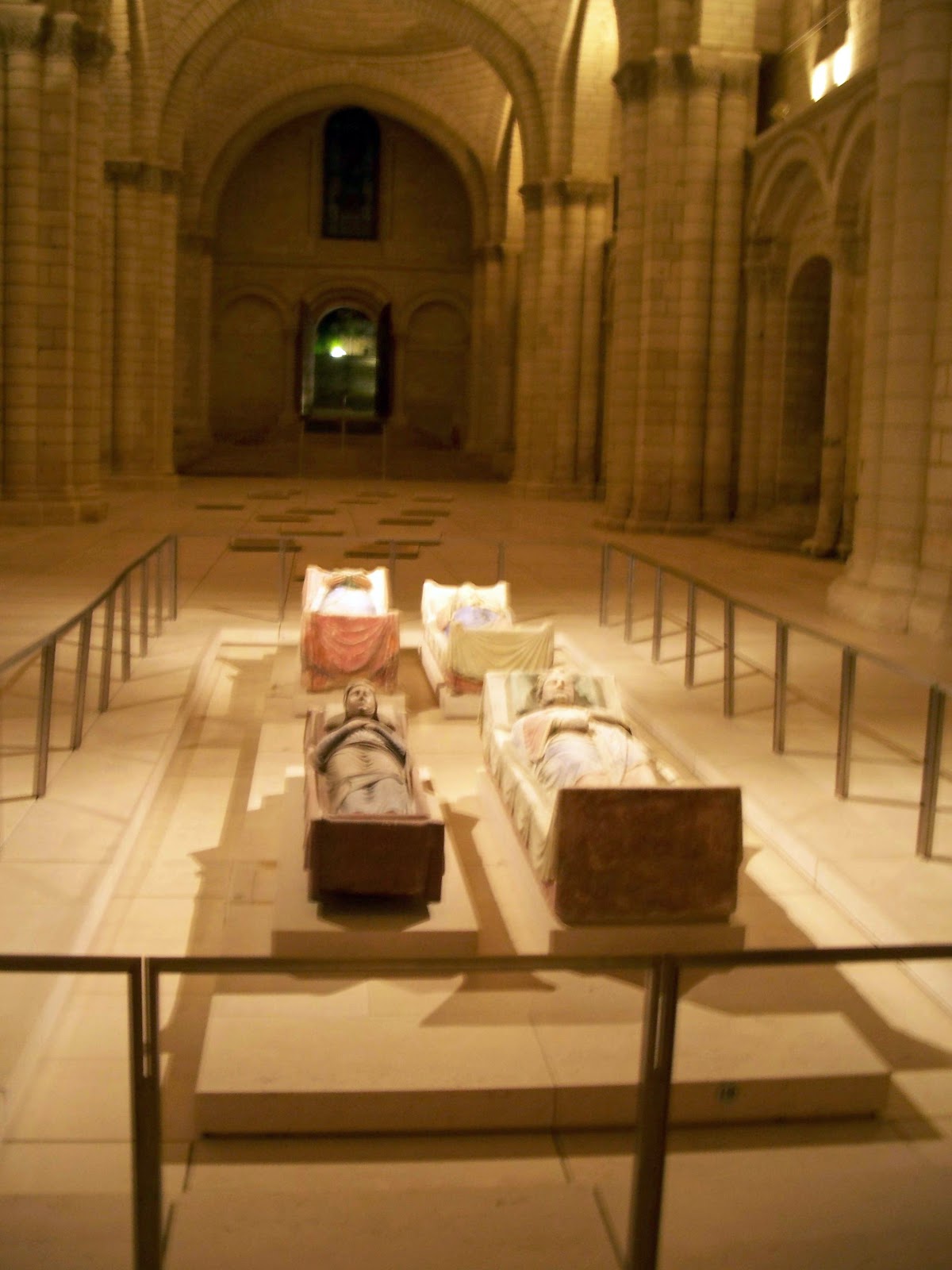
The gisants of Henry, Richard, and Eleanor are believed to have been carved circa 1200 by the same artist/group of artists, who used the ubiquitous tuffeau of the region. Henry and Richard are both shown lying in state, dressed in recreation of their coronation splendor. These gisants are a nod to the new French iconographic style of presenting an image of the eternally splendid king and his authority that stretches beyond the grave.  

Although she was 80 when she died in 1204, Eleanor's gisant shows her to be a dignified woman of middle age. She is thus forever young -- and very much alive. Eleanor likely never had a coronation per se of her own and therefore was not entitled to the same kind of imagery that she had designed for her son and husband. But her funeral sculpture choice is even more interesting. 

Eleanor's recumbent form is slightly elevated. She is crowned, a symbol of her secular role. But she is reading, not just holding a devotional book in repose like many other high-born woman would portray themselves (including her daughter-in-law Berengaria). She's actively reading what is most likely a psalter. Through this choice, scholars posit that she chose to move beyond a funereal show of secular authority to instead portray herself as very much alive, and clearly forever devoted to matters of a higher realm.


Eleanor of Aquitaine. Source: John Phillips


In other words, Eleanor got the last laugh over both of her husbands, who are forever tied in imagery to their royal roles....even pious Louis.


We can't know exactly how these gisants were arranged, although there are hints as to their relationships to one another in the abbey. Richard asked to be buried at his father's feet, we know that much. Joanna very likely had a monument, perhaps like those of her parents and brother since she died in that same period of time, but perhaps simpler given her final role as a nun. Joanna's son Raymond requested in his will that his tomb be placed at his mother's feet, although archaeological evidence indicates that this wish was not honored. We know from chronicles that when the community decided to make different use of the nave in 1504, the positions of the gisants of the immediate family members were rearranged in a single line, with Raymond's gisant and that of Isabelle d'Angoulême off to the side. 

Work done on the nave in 1638 resulted in the loss of the memorials for Joanna and Raymond. Kneeling figures replaced them for a time, but those have also been lost. In 1810 it was proposed that the gisants, presumably in the way at the new Fontevraud prison, be stored in Tour d'Evrault, which is what we now know were the Romanesque kitchens! The gisants ended up getting shipped to Paris to be repainted between 1846 and 1849. The British government tried to repatriate them to Westminster Abbey, and supposedly in 1866 Napoleon III even offered them to Queen Victoria, but the outcry from the French public caused him to rescind his offer. 

And thus it was that after wandering about throughout the mid/late 1800s, these gisants were returned to the centre of the nave in 1930.


We wandered around a bit more of the abbey and ended the night outside the Tour d'Evrault.  No one provided us with a midnight snack from the kitchens, alas.


The gisant of Louis VII is known to us now only by descriptions and drawings,  since it was lost during the Revolution. But the gisants that Eleanor designed for Henry, Richard and herself remain as powerful reminders of their dynasty. Fontevraud Abbaye itself was dissolved, so there are no more perpetual prayers for these royal departed souls.  Even their royal mortal remains are long gone. But I think there is an eternal respect and historical reverence paid by the tourists who come to gaze upon these stone gisants. 

Certainly there was in our group, as we gathered near midnight to pay our respects. We spent an evening in rarefied company that night.

Sharon Kay Penman's blog entry about our night tour of the abbey can be found HERE.

Wednesday, June 6, 2012

Paris: Rive Gauche

Sunday 5 June 2011

The oppressive backsweaty heat had vanished overnight and left grey Parisian skies in its wake. That didn't prevent me from admiring the view out my hotel window as soon as I awoke:


I headed downstairs to the hotel dining room for breakfast, feeling oh-so-very-continental.

Dining room, Hotel Rive Gauche. Photo by Lisa Williams Adair

I was fortunate to meet up with fellow traveler Paula, and we got along from the start, a harbinger of things to come! None of us knew what to expect from this tour given that we were people from many different places brought together by our shared love of history and enjoyment of Sharon Kay Penman's story-telling. We didn't know what else (if anything) we'd have in common, but we needn't have worried. This was an amazing group of travelers who would soon discover many things to share with one another!

I had an ambitious list of things that I wanted to see today and was afraid that would put Paula off. But she graciously agreed to accompany me, so we set off after breakfast.  My goal for this part of the trip was to continue visiting key points in medieval Paris.

We walked Rue de Vaugirard along the Jardins du Luxembourg, passing Luxembourg Palace (now the home of the French Senate, one of the two houses of the bicameral Parliament of France under the Fifth Republic; the other is the French National Assembly). I have to admit that we were so busy talking that I took very few photos, but here's a quick street-view of the north front of the palace.

Built for Marie de Médicis around 1612 on the site of a hotel belonging to the Duke of Piney-Luxembourg, the building and gardens retain his name. Marie was the widow of Henri IV (whose skull I mentioned yesterday) and the mother of Louis XIII. A line of descent from Les Bourbons to the Capétians of Eleanor's era can be traced, but we don't need that tangent right now! The accompanying garden is the largest pub­lic park in France, and very beautiful.

Photo from Wikipedia Commons
We turned right down Rue Bonaparte, window shopping along the way. My intended destination was the second largest church in Paris, Église Saint-Sulpice, dedicated to Mérovingien bishop Sulpitious the Pious. Granted, I knew nothing about Sulpitious. And this church had nothing to do with Eleanor's time, for even its Romanesque predecessor was originally constructed during the 13th century. But it was on my list to visit because of the famous 1862 Clicquot/Cavaillé-Coll organ, which I'd hoped to hear being played. Unfortunately the scantily-attended Mass that morning merited only the choir organ, so a recital will require a return visit. Paula was kind to humor me as I wandered around the nave admiring the Great Organ and sneaked a peak at the marble gnomon built in 1720's. A gnomon is a measurement device that casts a shadow on the ground to determine the position of the sun in the sky, which in turn helps determine the equinoxes and church holy days such as Easter. This gnomon was made famous in Dan Brown's The DaVinci Code and has brought hordes of tourists to the church. It's tucked off to the side and rather lost in the cavernous church, certainly not appearing to have the kinds of sinister associations popularized in the book (Full disclosure: never read Brown's book myself).

Porch tower, Église de Saint-Germain-des-Prés
My next must-see did date from Eleanor's era and even earlier: the site of the 6th century Benedictine Abbey of Saint-Germain-des-Prés. The medieval city of Paris was prone to Seine flooding on the Left Bank (actually, Paris is still prone to floods) and this abbey was thus safely situated some distance from the banks in a meadow, or prés in French. While much of the abbey itself was destroyed during the French Revolution, the church remains as Église de Saint-Germain-des-Prés.

In the nineteenth century extensive repairs were carried out but there remain some elements that Eleanor would have recognized from her time in Paris as Louis' wife, such as the marble columns in the triforium from the early 6th century church; the Romanesque portions of the early 11th century nave; and the porch tower that dates to the 10-11th centuries, one of the oldest bell towers in Paris.

For sure Eleanor would not have recognized the iconic cafes in the adjacent square! Les Deux Magots, Café de Flore, and Brasserie Lipp were just starting to come alive on this lazy Sunday morning. Paula and I continued our stroll along Rue Bonaparte, with a brief detour into Ladurée Bonaparte where I squee'd at all the pretties like a shameless American girly-girl tourist. We next crossed Pont du Carrousel, sometimes called the Pont du Louvre, from which we could see the Pont des Arts next bridge over and the towers of Notre-Dame in the distance.


We continued our walk through the Louvre courtyard, gaping in wonder at the enormous lines queueing for entry and feeling grateful to be part of a tour tomorrow. My ultimate destination on the Île de la Cité was Sainte-Chapelle, one of the few surviving remnants of a royal palace associated with the Capétians.  

This was the site of the Palais de la Cité, built during Philippe Auguste's era (Phillippe being the longed-for son of Eleanor's first husband Louis by his third wife..got that?). That palace was cosntructed on the site of the original Roman prefect residence and the later Merovingian Palace, which Eleanor lived in during her time in Paris. What we see today of the Palais de la Cité is known as the Conciergerie. The Palais de la Cité served as a residence of the kings of France until Charles V abandoned it in 1358, moving across the river to the Louvre. Shown below in an illustration from a guidebook, the complex was much altered by subsequent royal residents before being largely destroyed by fire in 1776. Sainte-Chapelle can be seen in the center:


Visiting Sainte-Chapelle was important to me because of its connection with Eleanor's descendants, and the fact that she'd resided in the Merovingian era royal palace that formerly occupied this site. But also the building itself is such a treasure, a true must-see when visiting Paris! 

Sainte-Chapelle was built by Louis IX, better known as Saint Louis, a great-grandson of Eleanor of Aquitaine. Only 12 years old when he succeeded his father, his Regency was ensured by his mother Blanche of Castille, whose own mother was Leonora Queen of Castille, second daughter of Eleanor and Henry Plantagenet.  

Louis IX amassed many relics, chief among them the Crown of Thorns worn by Christ during the Passion and a fragment of the True Cross. Louis saw the collecting of such relics as an important political act. Lucky for us, he also thought it was important to build a suitable awe-inspiring reliquary for such precious items. And so it was that the jewel box of Sainte-Chapelle was created to house his Passion Relics. The original chapel in radiant Gothic style was completed in 1248 after only two years of construction.

The photo to the left shows the western facade and exterior of the upper chapel with its tympanum on the porch representing the Last Judgment. Because it was the Royal chapel, only the royal entourage and palace staff were allowed to worship at Sainte-Chapelle; the lower chapel served as the parish church for those who lived around the Palais de la Cité. Over 6,400 square feet of stained glass are inside, two-thirds of which are originals representing the finest examples of 12th century craftsmanship.  

The chapel we see today has undergone many renovations in subsequent centuries due to the ravages of time, fire, floods, and vandalism. Seen as a symbol of royalty and religion, Sainte-Chapelle especially suffered during the Revolution when the original spire was pulled down. The current spire is a reconstruction from 1853, supervised by that handy 19th century architect Viollet-le-Duc. Following the Revolution, many stained-glass windows were removed or walled up when the building was used as an archive. The windows were restored in the 19th century. They were ever- so-carefully removed during WWII in anticipation of the German occupation, and every piece was meticulously replaced after the war.


The interior height of the main chapel is almost twice its width, making it seem even taller due to forced perspective.

Photo by Tee McNeill

 
After soaking up the beauty of Saint-Chapelle, we wandered into some souvenir shops and grabbed a quick lunch. Paula headed back to the hotel to greet folks arriving from our tour, while I decided to continue my walking itinerary for the day. I headed back to Place St-Michel and turned left onto Rue de la Huchette, one of the oldest streets of the Rive Gauche. I tried to squint and imagine the ancient buildings from centuries ago, but it was hard for my mind's eye to see past the hordes of tourists and Greek restaurants.

I peeked down the charmingly named Rue du Chat-qui-Pêche, supposedly the shortest and narrowest street in Paris. Dating to 1540, this street ended at the banks of the Seine, which flooded into the street and reportedly allowed Parisian kitties a chance to fish with ease.


I grabbed a few souvenirs along the way, then headed around the corner to Église St Séverin, dedicated to a hermit monk who lived and worshiped on this spot at the end of the 5th century. A church constructed over his tomb was later destroyed by the Vikings, and the current building was begun in the 11th century. Eleanor might have visited an earlier chapel on this site when living in Paris with Louis VII. 

During the Hundred Years War and under the English occupation in 1448, a massive fire destroyed 75% of the medieval church. Adding insult to injury, during the French Revolution it was closed to worship and used to store gunpowder and animal feed.

Photo by John Phillips
   
I wandered around the double ambulatory that surrounds the chancel and marveled at the carved columns. It was like wandering through a marble forest of palm trees!

From St Séverin, I wandered through Square René-Viviani and was treated to this great view of Cathédrale Notre-Dame de Paris:


In the Square René Viviani is a locust tree that is reputedly the oldest in Paris, planted in 1602. It's known as the "Lucky Tree of Paris" and is thought to bring good luck to those who touch its bark. I wanted to touch it, but the poor tree looked so tired and fragile that I decided I'd rather leave it in peace and let it preserve its luck for itself.

Photo by Julia Markovitz


Right behind the Lucky Tree was Église Saint-Julien-le-Pauvre. This church was built in stages from the 12th to the 19th centuries, starting in 1165. Eleanor might have known of it but as she did not return to Paris after her divorce from Louis in 1152, she would not have visited here. The church has a long, odd history as so many do; at one low point it was even used as a salt cellar! St-Julien's was granted to the Eastern Catholic Melkite community in 1889 and remains an active house of worship.  The church was closed to visitors when I was here, but a friend later snapped a photo of the interior:
 
Photo by John Phillips
My tired feet decided to head back to the hotel on their own volition. As I trudged up Boulevard-St-Michel I found myself trying to imagine the medieval vineyards that once covered this hill, which Eleanor would have seen during her time in Paris. After a brief rest I chanced on Paula in the hotel lobby where she introduced me to another tour member, John, who in turn volunteered to keep me company for some more sight-
seeing. 

Next on my agenda for the day: The Panthéon. Our hotel was situated at the end of Rue de Vaugirard, which emptied directly onto the picturesque Place de la Sorbonne:


It was a short walk to the Panthéon atop Mont St-Geneviève, a building with an interesting history. King Louis XV vowed in 1744 that if he recovered from an illness he would replace the ruined church of the Abbey of Saint Geneviève that stood on this site with a building to do the patron saint of Paris proud. The painting below by Pierre-Antoine Demachy shows the ceremonial laying of the first stone for Geneviève's new church on September 1764, with Louis XV examining plans for the edifice in front of an impressive model created especially for the ceremony.


Cérémonie de la pose de la première pierre de la nouvelle église Saint-Geneviève, le 6 septembre 1764 from the Musée Carnavalet


Geneviève might have been proud of this amazing structure, but she didn't get to keep it. The Church of Saint Geneviève was completed in 1790, coinciding with the early stages of the French Revolution. You can guess what happened, right? A church no more!  

Renamed the Panthéon, this famous building is described as a nonreligious temple of knowledge. It is a necropolis of wise and famous French citizens and as such is the final resting place of such distinguished figures as Hugo, Zola, Rousseau, Voltaire, and Marie Curie. Interment here is allowed only by special parliamentary action.


The use of space and light are over-whelming and magnificent. My eyes were constantly drawn upwards.


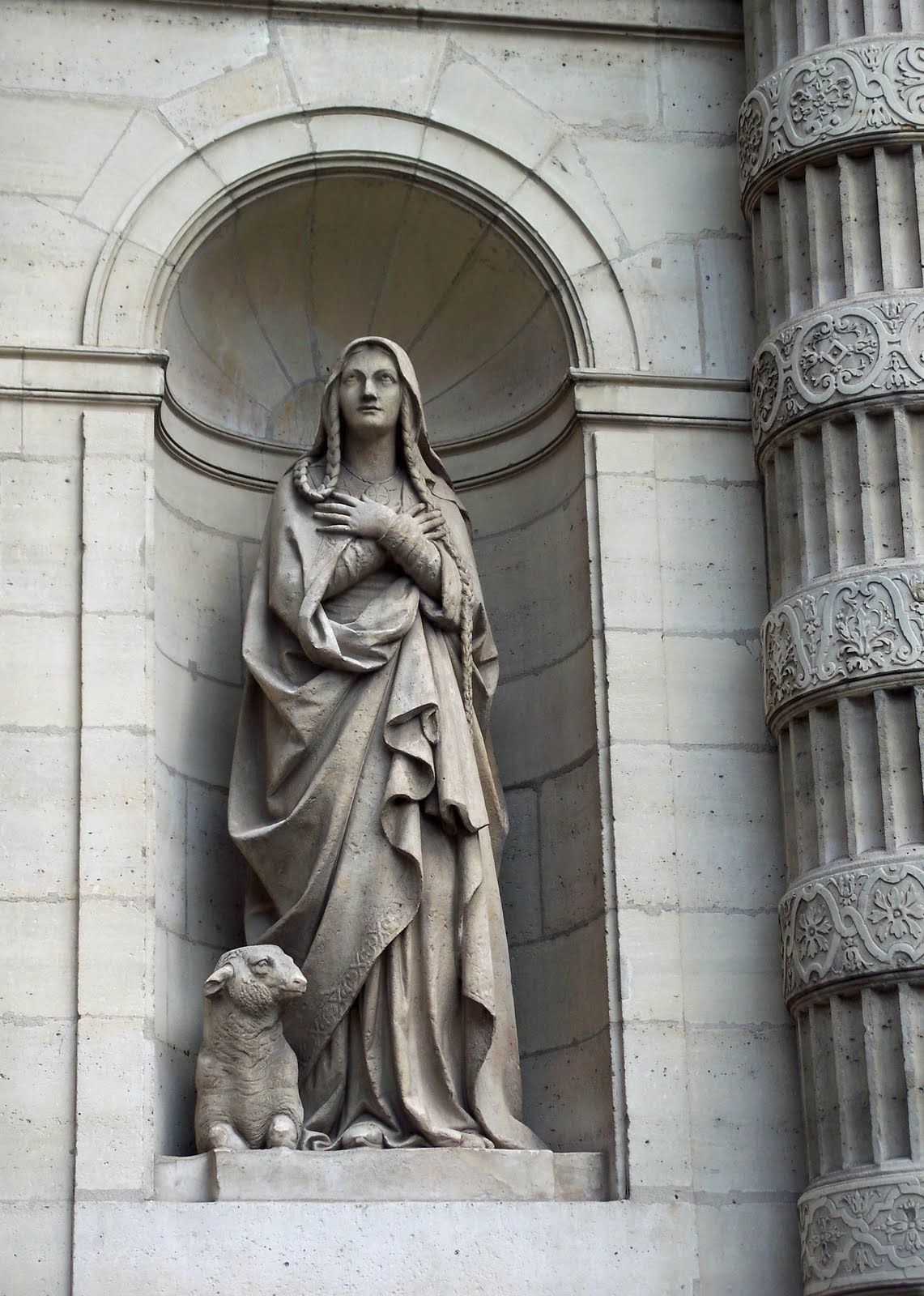
St. Geneviève was shown in various triptychs as a beautiful virginal woman who calmed the  Parisians upon the approach of Attila (because they were seriously freaking and needed to chillax), bringing fresh supplies to Paris after the siege. Helpful woman, that Geneviève.

This was one of my favorite sculptures, a portrayal of bare-breasted Truth, Philosophy, and Nature that is part of a monument to Jean-Jacques Rousseau by Albert Bartholomé:


It was also a thrill to see where Foucalt's pendulum hung. Foucault's initial experiment took place in his basement, then moved to a public exhibition at the Meridian of the Paris Observatory. It was such a sensation that Louis-Napoléon Bonaparte asked Foucault to step it up a notch. Accordingly in 1851 a 219-foot, 61-pound version of the pendulum was suspended from the dome of the Pantheon. That pendulum was moved in the 1990s to the Musée des Arts et Métiers. In 2010 disaster struck when the cable suspending the ball snapped, leaving a permanent dent in Foucault's pendulum and in the marble floor of the museum!

This reproduction pendulum hangs in the Pantheon. It wasn't working on this day, however, due to inexplicable "technical problems." I had to wonder if that was code for "the Earth has stopped spinning."

 
This scale model of the Panthèon was also impressive.  


I wanted to check to see if there was a little model of the model of the model inside, ad infinitum, but we had to move along.  

After paying our respects to the notables buried in the crypts (and getting scolded by a French gentleman who felt we were doing too much chatting and not enough walking to suit him), John suggested we visit near-by Église St-Etienne-du-Mont. 


St-Etienne-du-Mont stands on the site of an abbey founded by Clovis, King of the Franks (466-511) and later dedicated to St. Geneviève. All that remains of that abbey is the thin Tour de Clovis on the left side of the church. The pre-Panthèon abbey grounds are illustrated in this drawing: 


Photo by John Phillips


Construction on this church began in 1492 but wasn't completed until 1626. Although it was named for St. Stephen, the church is still devoted to St. Geneviève. It contains the only rood screen left in Paris, which I was very excited to see. That 16th century double-stair arch separates the choir (where the monks sat) from the body of the church (where the parishioners sat). A reader would carefully mount the screen by the steps to do the readings. The dark wooden pulpit dates to the mid-1600s.


To honor and invoke her protection, which was believed to have staved off disasters like plague and floods, Parisians regularly carried the shrine and relics of Geneviève in a solemn procession from here to Notre Dame and back again. 

Revolutionaries and Communard mobs burnt her remains, scattered them in the Seine and Paris sewers, and melted her relics. 

Only Geneviève's tomb slab survived, and the reliquary here preserves portions of her remains from other locations that survived the Revolution:

Photo by John Phillips


I was profoundly moved by 1600 years of reverence for a woman whose reputed courage and compassion had sustained early Parisians. Throughout the rest of the trip I found myself drawn to images of Geneviève, like this one outside Église St-Etienne-du-Mont:


~~~~


Our sight-seeing for the day had come to an end as it was time to gather for a formal group meet-up dinner at Au Bistrot de la Montagne, a restaurant at 38 rue de la Montagne Sainte Geneviève.  The restaurant looks so charming from the outside and yet...

Photo from Google Earth. 

We weren't able to get the private upper room so shared cramped quarters with two loudly enthusiastic German tour groups. The air conditioning leaked on us and the wiring taped up the wall had a sizzling aura to it. But there was the dinner music to distract us...a guitar and accordion duo who played '70s rock standards.


Author Sharon Kay Penman politely described this gentleman as 'exuberant' in her blog; he's exuberantly mugging here for his photo op and tips.

Noise, heat, and sizzling wiring notwithstanding, I enjoyed my Kir Royales, found the meal tasty, and even managed to eat Escargots de Bourgogne without inadvertently flinging snail shells across the room. The company was wonderful and it was exciting to finally meet people I'd been chatting with online up until that point. Afterwards I wandered back to the hotel with Tee, and soon gratefully collapsed into bed despite the sun not setting until 10 PM. The overcast day finally gave way to a ferocious thunderstorm that night.

Here is a link to Sharon Kay Penman's blog entry for the first day of our trip: LINK.