Showing posts with label Louvre. Show all posts

Monday, June 11, 2012

Paris: Musée du Louvre

Monday, 6 June, 2011

Destination #3: Musée du Louvre

Before there was I.M. Pei's pyramid, Mona Lisa, Venus de Milo, Winged Victory of Samothrace or the gift shop, there was the Palace of the Louvre:

Model of medieval palace in current Louvre

Eleanor's first husband Louis VII could acquit himself ably enough in battle, but he was never the military strategist that his son Philippe Auguste would prove himself to be. Nicknamed Dieudonné (God-Given) at birth, Louis' much longed-for son was born in 1165 (sharing a birth year with Joanna, the youngest daughter of Henry and Eleanor). Philippe was crowned at age 15 and took up where his father had left off sowing and cultivating seeds of discontent between Henry II and his sons Hal, Richard, Geoffrey and John (Eleanor was out of the picture due to her imprisonment by Henry). Philippe seemingly made it his life's work to destroy the Angevins. I can't help but wonder if father Louis' humiliation over the outcome of his marriage to Eleanor was transmitted to son Philippe, who took it upon himself to destroy as much of the Plantagenet legacy as he could by either might or manipulation for the glory of Les Capétiens.

Richard & Philippe quarreling after Messina. 14th century Illustration from Grandes Chroniques de France, Bibliothèque Nationale de France.

Philippe's interpersonal relationships were complicated, to say the least. It's beyond the scope of this blog to discuss Philippe's marital woes but they make for fascinating reading! Philippe spent most of his life fighting with someone, whether Pope or Plantagenet, vassal or wife. And yet, for all his presumed need for Plantagenet-based revenge, Philippe maintained what seems to have been a genuinely close friendship with the fourth son of Henry and Eleanor, Geoffrey Duke of Brittany. Philippe was allegedly so overcome with grief at Geoffrey's untimely death (which we saw memorialized earlier in a plaque at Notre Dame) that he had to be forcibly restrained from jumping into Geoffrey's coffin.

Let's just say that Philippe was never particularly subtle when it came to making grand gestures. Take the impressive Palais de Louvre, for example. Built in the late 1180s, it was intended to deter Henry Plantagenet should he consider casting covetous eyes upon Paris. It was considered an impregnable fortress the scale of which had not been seen to date, a fortified castle complete with water moat, drawbridge, crenelated towers 32 feet high, and thick walls. Philippe's cylindrical watch tower was known as Le Grosse Tour and was originally surrounded by a dry moat which was expanded. The complex eventually became home to Paris' archives and treasures of the kingdom. Philippe also kept his arsenal stored at this castle along with archives and treasure. The Louvre was never his residence.

Louvre in the time of Philippe Auguste by Louis-Pierre Baltard, circa 1803

The building was renovated and enlarged over subsequent centuries and in time it did became a lovely royal residence.


Illumination "Les très riches heures du duc de Berry" showing the much-enhanced Louvre in the time of Charles V, nearly 200 years later


The keep was razed in the 16th century by Francis I, but the foundations of Philippe Auguste's original Louvre fortress still remain in the bowels of the Old Louvre complex, which we'll visit a bit later in our tour today.

By this point most of us were limping along rather pathetically, having stomped through half the Rive Gauche, Notre-Dame, and the Cluny Museum by 1 PM. Time out for lunch on our own helped, but the Louvre is an intimidating stop even for the freshest of explorers and we were all rather wilted by this point!  Fortunately our guides took us directly to the only known artifact physically associated with Eleanor of Aquitaine.

Behold, the Eleanor Vase.


"Hoc vas sponsa dedit Anor Regi Ludovico, Mitadolus avo, mihi Rex, Sanctisque Sugerus."  

That is: "As a bride, Eleanor gave the vase to King Louis, Mitadolus to her grandfather, the King to me, and Suger to the Saints."

According to that inscription on the base that Abbot Suger added, Eleanor gave this vase to Louis as a
wedding gift. At some point Louis gave it to Abbot Suger for the Treasury at St-Denis.

Early Byzantine carvings of rock crystal often involved aquatic themes, which may be why later Europeans interpreted rock crystal as being petrified ice. Rock crystal was considered to be an allegory for the Fountain of Life....precious stuff, indeed. Its level of transparency and reflectivity was renowned and was popularly used in the Muslim world for the creation of precious lamps for shrines and drinking vessels. This leads to the intriguing speculation that perhaps the Eleanor Vase was never a vase at all, but instead was a drinking cup or lantern.

In Turner's collection of essays about Eleanor, historian George Birch believes that the piece was originally made in the Byzantine empire, possibly Persia, between 3 and 7 CE. He posits that Mitadolus was a Muslim emir from southern Spain, King Imad al-dawla of Saragossa, who gifted Eleanor's grandfather Duke William IX of Aquitaine with the vase in 1120 to win his support. This makes the vase all the more significant, not just as the lone surviving Eleanor artifact but as tangible evidence of Christian and Muslim collaboration from a unique era.

And yet Louis gave it away! The reason for Louis passing along a wedding gift (which is thought to have happened while the couple was still married) is unknown. It certainly seems to have been an awkward decision when looked at with modern sensibilities, and perhaps also from medieval ones! Perhaps it was an offering in hopes that the couple's barren marriage would be blessed by a child (two daughters, Marie and Alix, were eventually born to Louis and Eleanor).  Or was it a personal gift from Louis to his mentor Abbot Suger as thanks for rendering spiritual and state guidance?  Maybe it was the last remaining piece of a set and deemed not worth keeping around the palace! Whatever it once was, it remains an exquisite piece and visiting it set the bar high for finding further traces of Eleanor's world in the 21st century.

The original piece that Eleanor gave Louis was likely only rock crystal. What can't be seen due to the gilded silver setting Suger later added is the neck of vase, which according to the Louvre website extends upwards two centimeters. St-Denis Treasury inventories stated that the setting is of gold, jewels, and pearls, and mentioned two red jaspers "on one of which is engraved an idol, and on the other the head of a man." Those are long gone. The blue enamel medallions with fleurs-de-lis on the third band down are likely later substitutes for lost jewels. Suger believed that the beauty of precious objects such as this one helped worshipers transcend the material world, and he likely used the piece as a communion vessel (which again makes me wonder if it was contemporarily considered to be a drinking cup, not a vase). The crystal was reportedly in perfect condition until it was cracked in the 18th century (seriously not a good century for French artifacts).

The Louvre photo below shows the best detail so I am reproducing it here for discussion purposes. More details can be found on the Louvre website HERE.


Our group stood for a very long time at this display and we snapped many photos. My favorite shot is this one of author Sharon Kay Penman with the Eleanor Vase:


Photo by Lisa Williams Adair

We wandered around the Richelieu wing looking at other representatives from the Middle Ages decorative arts collection. There were a number of items from the Treasury of the Royal Abbey of St-Denis which resonated deeply with me, given the effort I'd made to visit this significant cathedral on my first day of the trip. The Eleanor Vase was displayed with two other pieces that Abbot Suger himself had a hand in designing:


Photo by Wendy Mehary

Suger found the middle piece, a vase from Egypt, and added the gilded silver eagle to transform it into a liturgical chalice. He explained:
And further we adapted for the service of the altar, with the aid of gold and silver material, a porphyry vase, made admirable by the hand of the sculptor and polisher, after it had lain idly in a chest for many years, converting it from a flagon into the shape of an eagle; and we had the following verses inscribed on this vase: "This stone deserves to be enclosed in gems and gold. It was marble, but in these settings it is more precious than marble." (Includi gemmis lapis iste meretur auro: Marmor set, sed in his marmore cavior est).
The other piece on display at far left was commissioned by Abbot Suger and is known as The Sardonyx Ewer. It was used for holding sacramental wine. Its inscription reads "Dum libare Deo gemmis debemus & auro Hoc ego Suggerius offero vas Domino" loosely translated as "Since we ought to offer to God with jewels and gold, I offer this, I make a vessel unto the Lord."

There is a fourth piece that is known to have been commissioned by Abbot Suger, currently in the collection of the National Gallery of Art in Washington DC.  Since visiting these medieval treasures in Paris and learning about their provenance, I've made it a point to stop in to pay my respect to Abbot Suger's aesthetic whenever touring the National Gallery. Here it is:


This cup is believed to be of Alexandrian origin in the last century BCE, although of course the mounting is circa 1137-1140. It is described as a "sardonyx cup with gilded silver mounting, set with stones, pearls, and glass" and was used as a liturgical chalice. The National Gallery catalogue claims that Abbot Suger
....took particular delight in the swirling bands of this stone cup in which the sard's red hue...so keenly vies with the darkness of the onyx that one essence seem to be bent on invading the other. The fluted carving, with deep channels cut into the sides, accentuates the sense of natural forces in surging motion...

The chalice may have been used in the re-consecration ceremony for the new altar chapels of St-Denis on 11 June 1144, an event that Eleanor very likely attended. Abbot Suger did not disclose the provenance of this sardonyx cup but is thought that it might have been brought to Saint-Denis by dealers who flocked there knowing of his love of pretty things or it may have been a pawn redeemed by a wealthy lenders from the Jewish community who'd settled in Saint-Denis and Paris. This is likely how other items in the St-Denis treasury were procured as well.

How did this piece make it to Washington DC? The National Gallery catalogue explains:
In fulfillment of the law ordering the nationalization of the monastic orders, on 30 September 1791, the chalice was taken away from Saint-Denis and deposited at the Cabinet National des Médailles et Antiques. On the night of 16-17 February 1804, it was stolen from the Cabinet National, forced into a plaster bust of Laocoön, and smuggled, presumably by way of Holland, to England, which was then at war with France. It was acquired 1804 by Charles Towneley [1737-1805], London; in the Towneley family, London, until possibly 1920. (Harry Harding, London), in 1920; (Goldschmidt Galleries, New York), by 1921; purchased 20 March 1922 by Joseph E. Widener, Lynnewood Hall, Elkins Park, Pennsylvania; inheritance from Estate of Peter A.B. Widener by gift through power of appointment of Joseph E. Widener, after purchase by funds of the Estate; gift 1942 to NGA.
Much detail about this piece and Abbot Suger's visionary commissions can be found in the chapter on Medieval Metalwork and Styles in the National Gallery publication Western Decorative Arts: medieval, Renaissance, and historicizing styles.

One last look at detail on the sardonyx cup. While alterations have occurred over the centuries, this medallion with solemn haloed Christ, flanked by the Greek letters signifying 'I am the Alpha and the Omega, the Beginning and the End'" dates to Suger's time. I think that the intricate spirals of gold filigree, so detailed and done with the naked eye without modern visual magnification, are absolutely breath-taking:


Somehow I doubt it will ever make its way back to France to rejoin the other three Suger commissions, but I'd like to see that happen. They belong together.

Anyway, back to the Louvre. There were many other objects there from the Treasury of St-Denis, albeit from later eras. One that I found particularly intriguing was this patène de serpentine, a saucer inlaid with gold, precious stones, pearls, and colored glass. The paten itself dates to the time of Christ and a Glasgow historian gained some press in 2007 by speculating that this plate may be the legendary Holy Grail. The gold mount likely dates to the reign of Charles the Bald in the late 9th century, and this paten was used along with the Cup of the Ptolemies at the coronation of French queens. It's been associated with Abbot Suger but was probably not used during his time. Still, it's an intriguing piece:


When we finally tore ourselves away from the medieval decorative arts, we did a blitzkrieg highlight tour of the Louvre. We visited the Appartements Napoléon III and Cour Marley (see details about that on my other blog, The Historical Dilettante). We also had the opportunity to stop and see specific works such as Goujon's famous Diana and the Stag (forever associated with the fascinating Diane d'Poitiers); Venus de Milo (I was amused to later learn that founding members of The American Society of Plastic Surgeons had chosen to reproduce a likeness of the statue as their organization's emblem. Apparently for enough money, anyone can look like a beautiful woman with no arms); Winged Victory of Samothrace; and various Renaissance paintings including La Joconde (I have to admit to spending more time watching and being amused by the hordes of people jockeying for prime photo spots than gazing at the painting). Highlight tours are not my thing and I really hate being rushed through a museum. Oh well, such are the drawbacks of touring with a group.

Our most significant visit after viewing the Treasures from St-Denis was to the foundations of Philippe-Auguste's Louvre Fortress, deep in the bowels of what is considered the Old Louvre. 


As noted previously, although Philippe's fortress was razed during the Renaissance, excavations for the underground visitor’s center beneath I.M. Pei's glass pyramid uncovered the foundations of the original castle in 1983. These foundations are remarkably well-preserved and we enjoyed walking where once the wet moat protected the keep, and seeing the massive pediments.


We wandered on the long wooden walkway through the middle of the moat, down what amounts now to a dark tunnel beside the massive exposed foundations, and ended up in a mysterious little room of unknown purpose that featured a carving of this creepy fellow:


We returned by tour bus to our hotel. Some of our group attended a medieval-inspired dinner at a restaurant that had been arranged in advance. Since the menu was not accommodating to my dietary choices, I declined and instead had dinner with Paula, Sue and Nicole, and Yvonne at one of the restaurants at the Place de la Sorbonne. Sue and Nicole and I then wandered down to Montebello Quay for an evening boat ride on the Seine. We laughed a lot and enjoyed the sights of Paris (including several young men who mooned our passing bateau from the docks).


So much packed into such a short time! I was glad this was not my first trip to Paris, as I'd have felt cheated by the fast pace. When I look at my personal photos of this time, I am struck by how radiantly happy and excited and completely exhausted I look!

Tomorrow we will leave Paris to track Eleanor's life in Normandy and beyond, so it was back to the hotel for a good night's sleep.

Bonne nuit et fais des beaux rêves, Paris!

Sharon Kay Penman's blog entry about our first full day of touring in Paris can be found here: LINK.

Wednesday, June 6, 2012

Paris: Rive Gauche

Sunday 5 June 2011

The oppressive backsweaty heat had vanished overnight and left grey Parisian skies in its wake. That didn't prevent me from admiring the view out my hotel window as soon as I awoke:


I headed downstairs to the hotel dining room for breakfast, feeling oh-so-very-continental.

Dining room, Hotel Rive Gauche. Photo by Lisa Williams Adair

I was fortunate to meet up with fellow traveler Paula, and we got along from the start, a harbinger of things to come! None of us knew what to expect from this tour given that we were people from many different places brought together by our shared love of history and enjoyment of Sharon Kay Penman's story-telling. We didn't know what else (if anything) we'd have in common, but we needn't have worried. This was an amazing group of travelers who would soon discover many things to share with one another!

I had an ambitious list of things that I wanted to see today and was afraid that would put Paula off. But she graciously agreed to accompany me, so we set off after breakfast.  My goal for this part of the trip was to continue visiting key points in medieval Paris.

We walked Rue de Vaugirard along the Jardins du Luxembourg, passing Luxembourg Palace (now the home of the French Senate, one of the two houses of the bicameral Parliament of France under the Fifth Republic; the other is the French National Assembly). I have to admit that we were so busy talking that I took very few photos, but here's a quick street-view of the north front of the palace.

Built for Marie de Médicis around 1612 on the site of a hotel belonging to the Duke of Piney-Luxembourg, the building and gardens retain his name. Marie was the widow of Henri IV (whose skull I mentioned yesterday) and the mother of Louis XIII. A line of descent from Les Bourbons to the Capétians of Eleanor's era can be traced, but we don't need that tangent right now! The accompanying garden is the largest pub­lic park in France, and very beautiful.

Photo from Wikipedia Commons
We turned right down Rue Bonaparte, window shopping along the way. My intended destination was the second largest church in Paris, Église Saint-Sulpice, dedicated to Mérovingien bishop Sulpitious the Pious. Granted, I knew nothing about Sulpitious. And this church had nothing to do with Eleanor's time, for even its Romanesque predecessor was originally constructed during the 13th century. But it was on my list to visit because of the famous 1862 Clicquot/Cavaillé-Coll organ, which I'd hoped to hear being played. Unfortunately the scantily-attended Mass that morning merited only the choir organ, so a recital will require a return visit. Paula was kind to humor me as I wandered around the nave admiring the Great Organ and sneaked a peak at the marble gnomon built in 1720's. A gnomon is a measurement device that casts a shadow on the ground to determine the position of the sun in the sky, which in turn helps determine the equinoxes and church holy days such as Easter. This gnomon was made famous in Dan Brown's The DaVinci Code and has brought hordes of tourists to the church. It's tucked off to the side and rather lost in the cavernous church, certainly not appearing to have the kinds of sinister associations popularized in the book (Full disclosure: never read Brown's book myself).

Porch tower, Église de Saint-Germain-des-Prés
My next must-see did date from Eleanor's era and even earlier: the site of the 6th century Benedictine Abbey of Saint-Germain-des-Prés. The medieval city of Paris was prone to Seine flooding on the Left Bank (actually, Paris is still prone to floods) and this abbey was thus safely situated some distance from the banks in a meadow, or prés in French. While much of the abbey itself was destroyed during the French Revolution, the church remains as Église de Saint-Germain-des-Prés.

In the nineteenth century extensive repairs were carried out but there remain some elements that Eleanor would have recognized from her time in Paris as Louis' wife, such as the marble columns in the triforium from the early 6th century church; the Romanesque portions of the early 11th century nave; and the porch tower that dates to the 10-11th centuries, one of the oldest bell towers in Paris.

For sure Eleanor would not have recognized the iconic cafes in the adjacent square! Les Deux Magots, Café de Flore, and Brasserie Lipp were just starting to come alive on this lazy Sunday morning. Paula and I continued our stroll along Rue Bonaparte, with a brief detour into Ladurée Bonaparte where I squee'd at all the pretties like a shameless American girly-girl tourist. We next crossed Pont du Carrousel, sometimes called the Pont du Louvre, from which we could see the Pont des Arts next bridge over and the towers of Notre-Dame in the distance.


We continued our walk through the Louvre courtyard, gaping in wonder at the enormous lines queueing for entry and feeling grateful to be part of a tour tomorrow. My ultimate destination on the Île de la Cité was Sainte-Chapelle, one of the few surviving remnants of a royal palace associated with the Capétians.  

This was the site of the Palais de la Cité, built during Philippe Auguste's era (Phillippe being the longed-for son of Eleanor's first husband Louis by his third wife..got that?). That palace was cosntructed on the site of the original Roman prefect residence and the later Merovingian Palace, which Eleanor lived in during her time in Paris. What we see today of the Palais de la Cité is known as the Conciergerie. The Palais de la Cité served as a residence of the kings of France until Charles V abandoned it in 1358, moving across the river to the Louvre. Shown below in an illustration from a guidebook, the complex was much altered by subsequent royal residents before being largely destroyed by fire in 1776. Sainte-Chapelle can be seen in the center:


Visiting Sainte-Chapelle was important to me because of its connection with Eleanor's descendants, and the fact that she'd resided in the Merovingian era royal palace that formerly occupied this site. But also the building itself is such a treasure, a true must-see when visiting Paris! 

Sainte-Chapelle was built by Louis IX, better known as Saint Louis, a great-grandson of Eleanor of Aquitaine. Only 12 years old when he succeeded his father, his Regency was ensured by his mother Blanche of Castille, whose own mother was Leonora Queen of Castille, second daughter of Eleanor and Henry Plantagenet.  

Louis IX amassed many relics, chief among them the Crown of Thorns worn by Christ during the Passion and a fragment of the True Cross. Louis saw the collecting of such relics as an important political act. Lucky for us, he also thought it was important to build a suitable awe-inspiring reliquary for such precious items. And so it was that the jewel box of Sainte-Chapelle was created to house his Passion Relics. The original chapel in radiant Gothic style was completed in 1248 after only two years of construction.

The photo to the left shows the western facade and exterior of the upper chapel with its tympanum on the porch representing the Last Judgment. Because it was the Royal chapel, only the royal entourage and palace staff were allowed to worship at Sainte-Chapelle; the lower chapel served as the parish church for those who lived around the Palais de la Cité. Over 6,400 square feet of stained glass are inside, two-thirds of which are originals representing the finest examples of 12th century craftsmanship.  

The chapel we see today has undergone many renovations in subsequent centuries due to the ravages of time, fire, floods, and vandalism. Seen as a symbol of royalty and religion, Sainte-Chapelle especially suffered during the Revolution when the original spire was pulled down. The current spire is a reconstruction from 1853, supervised by that handy 19th century architect Viollet-le-Duc. Following the Revolution, many stained-glass windows were removed or walled up when the building was used as an archive. The windows were restored in the 19th century. They were ever- so-carefully removed during WWII in anticipation of the German occupation, and every piece was meticulously replaced after the war.


The interior height of the main chapel is almost twice its width, making it seem even taller due to forced perspective.

Photo by Tee McNeill

 
After soaking up the beauty of Saint-Chapelle, we wandered into some souvenir shops and grabbed a quick lunch. Paula headed back to the hotel to greet folks arriving from our tour, while I decided to continue my walking itinerary for the day. I headed back to Place St-Michel and turned left onto Rue de la Huchette, one of the oldest streets of the Rive Gauche. I tried to squint and imagine the ancient buildings from centuries ago, but it was hard for my mind's eye to see past the hordes of tourists and Greek restaurants.

I peeked down the charmingly named Rue du Chat-qui-Pêche, supposedly the shortest and narrowest street in Paris. Dating to 1540, this street ended at the banks of the Seine, which flooded into the street and reportedly allowed Parisian kitties a chance to fish with ease.


I grabbed a few souvenirs along the way, then headed around the corner to Église St Séverin, dedicated to a hermit monk who lived and worshiped on this spot at the end of the 5th century. A church constructed over his tomb was later destroyed by the Vikings, and the current building was begun in the 11th century. Eleanor might have visited an earlier chapel on this site when living in Paris with Louis VII. 

During the Hundred Years War and under the English occupation in 1448, a massive fire destroyed 75% of the medieval church. Adding insult to injury, during the French Revolution it was closed to worship and used to store gunpowder and animal feed.

Photo by John Phillips
   
I wandered around the double ambulatory that surrounds the chancel and marveled at the carved columns. It was like wandering through a marble forest of palm trees!

From St Séverin, I wandered through Square René-Viviani and was treated to this great view of Cathédrale Notre-Dame de Paris:


In the Square René Viviani is a locust tree that is reputedly the oldest in Paris, planted in 1602. It's known as the "Lucky Tree of Paris" and is thought to bring good luck to those who touch its bark. I wanted to touch it, but the poor tree looked so tired and fragile that I decided I'd rather leave it in peace and let it preserve its luck for itself.

Photo by Julia Markovitz


Right behind the Lucky Tree was Église Saint-Julien-le-Pauvre. This church was built in stages from the 12th to the 19th centuries, starting in 1165. Eleanor might have known of it but as she did not return to Paris after her divorce from Louis in 1152, she would not have visited here. The church has a long, odd history as so many do; at one low point it was even used as a salt cellar! St-Julien's was granted to the Eastern Catholic Melkite community in 1889 and remains an active house of worship.  The church was closed to visitors when I was here, but a friend later snapped a photo of the interior:
 
Photo by John Phillips
My tired feet decided to head back to the hotel on their own volition. As I trudged up Boulevard-St-Michel I found myself trying to imagine the medieval vineyards that once covered this hill, which Eleanor would have seen during her time in Paris. After a brief rest I chanced on Paula in the hotel lobby where she introduced me to another tour member, John, who in turn volunteered to keep me company for some more sight-
seeing. 

Next on my agenda for the day: The Panthéon. Our hotel was situated at the end of Rue de Vaugirard, which emptied directly onto the picturesque Place de la Sorbonne:


It was a short walk to the Panthéon atop Mont St-Geneviève, a building with an interesting history. King Louis XV vowed in 1744 that if he recovered from an illness he would replace the ruined church of the Abbey of Saint Geneviève that stood on this site with a building to do the patron saint of Paris proud. The painting below by Pierre-Antoine Demachy shows the ceremonial laying of the first stone for Geneviève's new church on September 1764, with Louis XV examining plans for the edifice in front of an impressive model created especially for the ceremony.


Cérémonie de la pose de la première pierre de la nouvelle église Saint-Geneviève, le 6 septembre 1764 from the Musée Carnavalet


Geneviève might have been proud of this amazing structure, but she didn't get to keep it. The Church of Saint Geneviève was completed in 1790, coinciding with the early stages of the French Revolution. You can guess what happened, right? A church no more!  

Renamed the Panthéon, this famous building is described as a nonreligious temple of knowledge. It is a necropolis of wise and famous French citizens and as such is the final resting place of such distinguished figures as Hugo, Zola, Rousseau, Voltaire, and Marie Curie. Interment here is allowed only by special parliamentary action.


The use of space and light are over-whelming and magnificent. My eyes were constantly drawn upwards.


St. Geneviève was shown in various triptychs as a beautiful virginal woman who calmed the  Parisians upon the approach of Attila (because they were seriously freaking and needed to chillax), bringing fresh supplies to Paris after the siege. Helpful woman, that Geneviève.

This was one of my favorite sculptures, a portrayal of bare-breasted Truth, Philosophy, and Nature that is part of a monument to Jean-Jacques Rousseau by Albert Bartholomé:


It was also a thrill to see where Foucalt's pendulum hung. Foucault's initial experiment took place in his basement, then moved to a public exhibition at the Meridian of the Paris Observatory. It was such a sensation that Louis-Napoléon Bonaparte asked Foucault to step it up a notch. Accordingly in 1851 a 219-foot, 61-pound version of the pendulum was suspended from the dome of the Pantheon. That pendulum was moved in the 1990s to the Musée des Arts et Métiers. In 2010 disaster struck when the cable suspending the ball snapped, leaving a permanent dent in Foucault's pendulum and in the marble floor of the museum!

This reproduction pendulum hangs in the Pantheon. It wasn't working on this day, however, due to inexplicable "technical problems." I had to wonder if that was code for "the Earth has stopped spinning."

 
This scale model of the Panthèon was also impressive.  


I wanted to check to see if there was a little model of the model of the model inside, ad infinitum, but we had to move along.  

After paying our respects to the notables buried in the crypts (and getting scolded by a French gentleman who felt we were doing too much chatting and not enough walking to suit him), John suggested we visit near-by Église St-Etienne-du-Mont. 


St-Etienne-du-Mont stands on the site of an abbey founded by Clovis, King of the Franks (466-511) and later dedicated to St. Geneviève. All that remains of that abbey is the thin Tour de Clovis on the left side of the church. The pre-Panthèon abbey grounds are illustrated in this drawing: 


Photo by John Phillips


Construction on this church began in 1492 but wasn't completed until 1626. Although it was named for St. Stephen, the church is still devoted to St. Geneviève. It contains the only rood screen left in Paris, which I was very excited to see. That 16th century double-stair arch separates the choir (where the monks sat) from the body of the church (where the parishioners sat). A reader would carefully mount the screen by the steps to do the readings. The dark wooden pulpit dates to the mid-1600s.


To honor and invoke her protection, which was believed to have staved off disasters like plague and floods, Parisians regularly carried the shrine and relics of Geneviève in a solemn procession from here to Notre Dame and back again. 

Revolutionaries and Communard mobs burnt her remains, scattered them in the Seine and Paris sewers, and melted her relics. 

Only Geneviève's tomb slab survived, and the reliquary here preserves portions of her remains from other locations that survived the Revolution:

Photo by John Phillips


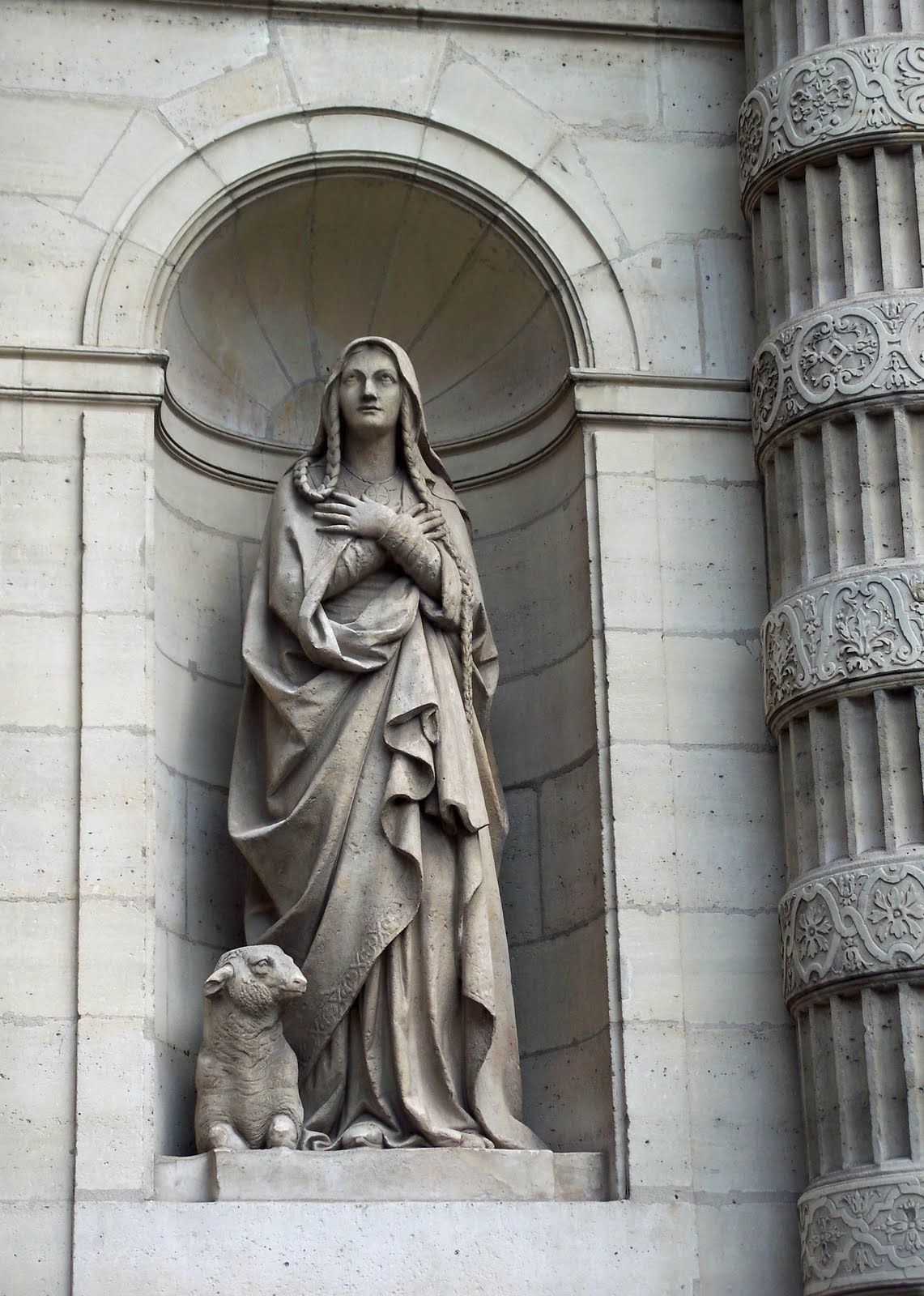
I was profoundly moved by 1600 years of reverence for a woman whose reputed courage and compassion had sustained early Parisians. Throughout the rest of the trip I found myself drawn to images of Geneviève, like this one outside Église St-Etienne-du-Mont:


~~~~


Our sight-seeing for the day had come to an end as it was time to gather for a formal group meet-up dinner at Au Bistrot de la Montagne, a restaurant at 38 rue de la Montagne Sainte Geneviève.  The restaurant looks so charming from the outside and yet...

Photo from Google Earth. 

We weren't able to get the private upper room so shared cramped quarters with two loudly enthusiastic German tour groups. The air conditioning leaked on us and the wiring taped up the wall had a sizzling aura to it. But there was the dinner music to distract us...a guitar and accordion duo who played '70s rock standards.


Author Sharon Kay Penman politely described this gentleman as 'exuberant' in her blog; he's exuberantly mugging here for his photo op and tips.

Noise, heat, and sizzling wiring notwithstanding, I enjoyed my Kir Royales, found the meal tasty, and even managed to eat Escargots de Bourgogne without inadvertently flinging snail shells across the room. The company was wonderful and it was exciting to finally meet people I'd been chatting with online up until that point. Afterwards I wandered back to the hotel with Tee, and soon gratefully collapsed into bed despite the sun not setting until 10 PM. The overcast day finally gave way to a ferocious thunderstorm that night.

Here is a link to Sharon Kay Penman's blog entry for the first day of our trip: LINK.