Showing posts with label Thomas Becket. Show all posts

Tuesday, March 26, 2013

Chartres


Sunday, June 12, 2011

I didn't want to get up this morning. I could blame my comfy bed or the knowledge that this was our last day of touring.

Still, we all got up early. I sat in the modern parklet across from our hotel surrounded by rose bushes and watched as the bus was loaded. Rue de la République with its statue of Jeanne d'Arc in the distance was deserted. Church bells were ringing, and I imagined tongues of blinding sunlight blessing us on this Pentecost Sunday.


Touring with this group had become fairly routine. We piled onto the bus and sorted ourselves. While nothing was assigned, we'd each by now gravitated by habit to certain sections of the bus. Hoping to stretch out my weary legs, I inadvertently rocked some worlds by sitting in the last row today. Damn me for being unpredictable; I can still feel the glares of those whose seats I usurped! Dealing with the wrathful gazes of those I displaced was the only tense moment I experienced this entire week so really, I can't complain. Still feel like I have holes bored into my head, though...  Mea culpa.


Photo by Sherill Roberts
We rolled into Chartres and immediately found the public restrooms. (Like I said, we had established tour routines). The four gentlemen on our tour were able to get their business attended to quickly, but we ladies did our usual queuing. Once that was settled, we posed for a series of group photos. Then we scattered to explore, poke our heads into the Office de Tourisme de Chartres at Place de la Cathédral, trip around some souvenir shops and eat lunch. I ate with some companions at a brasserie rather improbably named for La Reine de Saba. Sheba is already depicted on the north entrance of the Cathedral, but I suppose naming a restaurant after her here is an extra honor.

Brasserie La Reine de Saba had a model of the Hindenburg hanging from its ceiling. There was surely a story behind this, but I never did find out what it was. Took a picture of it, though, because Hindenburg.

Also I have a thing for hydrangeas, which were everywhere outside the Office de Tourisme, so I got even more distracted taking pictures. 


Enough randomness. Isn't there an architectural wonder we're supposed to be appreciating? Get a clue from the folks on this mural:


What are they looking at? Oh, right. Cathédrale Notre-Dame de Chartres.

Photo by Wendy Mehary

This is the west side and the Royal Portal, through which most people enter the cathedral. When I was here 20 years ago, this entire plaza was torn up for an archaeological dig. Below it are remains of a large Roman public building dating to the 1st century AD.

I don't think you can escape taking a photo of scaffolding when visiting Europe, which is a minor annoyance in the larger scheme of things since it's proof positive of the on-going preservation of architectural witnesses to history. And what history here! A school was established at Chartres in 990 that cemented the city's reputation as one of Europe’s leading scholastic institutions in the High Middle Ages. Chartres has also been a major Marian pilgrimage destination and has housed a cloak/tunic/veil belonging to the Blessed Virgin Mary (Sancta Camisia) since 876 (photo of that a bit further down).

Source: Wikipedia Commons
 
I'm including the above photo from Wikipedia Commons to show the details of the Portail Royale entrance that we didn't get to see. Constructed in the mid 12th century, it reflects the period's transition from Romanesque to Gothic styles. I missed seeing my favorites from this entrance, the seven Liberal Arts (Grammar, Logic, Rhetoric, Arithmetic, Music, Geometry, and Astronomy) personified by women. The subjects that made up the medieval Liberal Arts were considered to be expressions of the soul, which demanded harmonious development. The goal in medieval education was less about compartmentalized expertise than about having a "whole" understanding of existence, about establishing a gestalt or big picture understanding comprised of various but related disciplines. And THAT right there is the crux of why I am drawn to the medieval era, for it so mirrors my personal philosophy of learning. For a further explanation of the significance of the liberal arts: LINK.

While we ate lunch and pondered the significance of the Hindenburg and the Queen of Sheba, the view out the restaurant window beckoned. Behold, the South transept of Chartres Cathedral, with its many sculptural representations of martyrs and apostles, Last Judgement, and the legends of Saint Martin and Saint Nicolas in the three portals.

Photo by John Phillips

Above are the south Rose and lancet windows portraying the Glorification of Christ. 

The bells began pealing as mid-day Mass ended. Just like last night in Orléans, children streamed out of the church in their Confirmation robes. Tourists were not permitted in the church during Mass, hence the opportunity for a leisurely lunch and poking around. There was plenty to admire while we waited.

Like, say, this fierce little dude. I'd not advise messing with him, even if he does have only one leg and arm.

Photo by Nicole Benkert
This lovely lady was categorized as a "miscellaneous sculpture" on the exterior of the Vendôme Chapel, a Lady chapel on the south aisle of the nave that was constructed in the early 1500's. Louis de Bourbon, Count of Vendôme, promised the Virgin that he would sponsor a chapel in her honor at Chartres if he was released from capture. Gotta love how folks bargain with the divine, then as now. Anyway, I am enchanted with this lady's headdress and crespines. This is one of my favorite statues, even if it is from a later medieval period.

Le bon Dieu est dans le détail! Below is the Gallery of Kings and a gable between the mismatched spires of the western front, above the great west Rose window of the Last Judgment and the Portail Royale. The Gallery of Kings is meant to suggest continuity between the biblical Kings of Judah and the Kings of France. The gable was rebuilt in the 14th century, but most of the statues date from the early 13th century.


Part of the charms of Chartres are its mismatched spires. In the foreground below left is Le Clocher Vieux, the southwest tower. It is a 349 foot Romanesque styled tower which was constructed circa 1145–65.
Photo by John Phillips
Eleanor would have seen this tower in its earliest stages of construction, if she visited Chartres with Louis during their marriage. There are no bells remaining in le Clocher Vieux though at one time there were three.


To the right is the north-west steeple, Le Clocher Neuf, aka Tour Nord, Tour Jehan de Beauce,. It was constructed in Flamboyant Gothic style by architect and mason Jean Texier (Jehan de Beauce). It progressively narrows to a crown of pinnacles and gables. Completely built of stone and yet I can't help but think of lace. The spire was built in 1507-13 after a wooden one burned, then raised by 4 feet in 1690. It was topped by a cross in 1854 and a sun weather vane symbolizing Jesus as Light of the World. A spiral staircase behind the cathedral bookshop leads to a tower viewing platform, but the bookshop was crowded enough without me risking my luck on a narrow spiral staircase!

I'd have liked to have seen the 7 tower bells, though, which are named Mary, Joseph, The Bell, Anne, Elizabeth, Piat, and Fulbert (who established the aforementioned school at Chartres).


Some stone tracery caught my eye and I tried to imagine it brightly painted as it would have been back in its day. We think of the medieval world in terms of stone and grayness but it was truly a colorful time. Even relatively monochromatic as it is today, Chartres was a feast for the eyes with such amazing architectural details like this iron rose.


I was excited to find this memorial to Jean de Salisbury, a cleric whom Eleanor certainly knew! As
Photo by Sherill Roberts
his name indicates, John was born near Salisbury England but traveled to Paris in his youth to study arts and philosophy under Peter Abelard (among others). Eventually taking vows, John worked as a diplomat and later zealously fought for the rights of the Church alongside Thomas à Becket (thereby incurring Henry's wrath). John tried to reconcile Henry and Becket, but we all know how that turned out. John was one of the witnesses to Becket's murder at Canterbury Cathedral. He became Bishop of Chartres six years later, a position he held for four years until his death in 1180. He is considered one of the most cultured scholars of his time.

Another of my favorite authors of medieval fiction, Sharan Newman, features a young John of Salisbury in her Catherine LeVendeur series.

Finally, time to go inside!

Photo by John Phillips
 
Below can be seen portions of the famous Chartres pavement labyrinth, which stretches the width of the nave between the 3rd and 4th bays. Traditionally the chairs are removed to allow it to be walked on midsummer day June 21st (Litha in the Saxon tradition), and also on Fridays. No contemporary documentation of its construction exists but historians have postulated that its installation dates to sometime between 1200 and 1240. There are all sorts of legends about this labyrinth, most of which are debunked on this FAQ about all things labyrinthine: LINK.

Photo by John Phillips

Photo by Wendy Mehary


Here is the Sancta Camisia I mentioned earlier.

Photo by Tammie Maloney

Sharon Kay Penman wrote a scene in which a grubby-handed 5 year old Stephen of Blois, circa 1101, reached out to touch the Camisia at the beginning of When Christ and His Saints Slept. For shame, King Stephen!

Did Eleanor visit Chartres? Like Orléans, it fell within Louis' desmesnes. We know that the entire town except for the Cathedral was burned to the ground in a fire in 1134, when Eleanor was only ten years old.  In 1137, Abbot Suger, Bishop Geoffrey of Chartres, and Peter the Venerable accompanied a young Louis to meet his bride-to-be, Eleanor, in her lands. Louis returned to Paris with Abbot Suger to take the throne upon learning of his father's sudden death, and Eleanor followed shortly thereafter accompanied by Bishop Geoffrey. Given the prominence of the cult of Marian devotion that Chartres epitomized, and Eleanor's known Marian devotion later in life, I would think it strange if Eleanor didn't at the very least pay a visit to the Cathedral with its Bishop on her way to becoming Louis' consort and mother of his someday heirs. The last bit didn't turn out so well, but we can't blame Chartres for that.

The dark interior of Chartres envelopes the visitor first, and then one is drawn forward by the light from the stained glass windows and prayer candles.

Photo by Tammie Maloney

Photo by Nicole Benkert

Photo by John Phillips
Our guide for this tour was renowned Chartres expert Malcolm Miller, who has been giving tours here for more than fifty years. His expertise and irascible personality are legendary and I found his lecture spellbinding. Miller describes the cathedral as an inexhaustible library of information and says he is still learning its secrets.

If you look on YouTube, you can find some clips of Mr. Miller giving tours and explaining the mechanics of buttressing. He's a good deal older now and so wasn't quite this animated on our visit, but still incredibly passionate and knowledgeable about his subject.

Due to restoration, the famous west Rose was covered by a canvas, so Mr. Miller did not dwell on it but discussed other famous windows and aspects of the cathedral in detail. We were so lucky to have him as a guide.

Nearly 80% of the church has been hidden beneath centuries of grime but a major cleaning and stained glass window treatment program has been on-going since 1972, currently led by Patrice Calvel, architect-in-chief of the Historical Monuments in France. This campaign uncovered polychrome heraldic decorations painted on the five choir keystones, and the colors have been reproduced on each.


Scholar Michel Pastoureau has written that the decorations date to 1257-1261 and belong to Louis IX (aka Saint Louis), Alfonso X King of Castile, Hugh IV Duke of Burgundy, Charles Count of Anjou & Maine, and Henry III Duke of Brabant. I'm guessing the one I photographed above belonged to Louis IX, Eleanor's great-grandson.

To date, of the 175 windows in Nôtre-Dame de Chartres, only 20% have been restored. More info about the restoration of Chartres can be found here: LINK. And if you'd like to contribute to restoration of the lancets below the south Rose window, the American Friends of Chartres will take your money: LINK. Each of the four bays of the transept clerestory has two lancet windows and above those is a smaller Rose window. Lots of work to be done!

We spent some time talking about the north clerestory choir windows, which were amazing in their clarity and bright after restoration. Identifying from left to right, 5 of the 7 windows, which depict the stories of David, Ezekiel, and cherubim; Aaron and the Angel; Annunciation and Visitation of Mary; Moses with burning bush; Daniel, Jeremiah and cherubim.


Photo by John Phillips


To the left are the triforium and clerestory windows behind the altar in the restored part of the ambulatory. Identifying the stained glass windows from left: Virgin and Child, Jesus seated between candlesticks in the Rose above, two groups of pilgrims, King Ferdinand of Castile in the second Rose, and 20th century grissaille relacements. Grissaile designs are almost exclusively of uncolored glass in which the designs are created by either black leads alone or by adding paint and silver stain to the windows.

There are more than 170 Chartres windows covering 21,000 square feet, most of which are original and have survived intact. During World War II, all of the stained glass was removed and safely stored for the duration.


Unfortunately for our group's focus, a window portraying the story of Thomas à Becket in the lower ambulatory was blocked by reconstruction canvas.  You can read about the Becket window HERE.


Photo by Nicole Benkert
This is the famous Notre Dame de la Belle Verrière, commonly known as the Blue Virgin window, circa 1150. I'd like to think Eleanor once gazed upon this window. It is (arguably) the single most beautiful stained glass window ever made, and the blues have reportedly never been exactly reproduced. The face of the Virgin is a modern replacement, but the rest of this window is original to 1150.

In his 1904 book Mont St. Michel and Chartres, Henry Adams wrote thusly about Chartres:
Other churches have glass,--quantities of it, and very fine,--but we have been trying to catch a glimpse of the glory which stands behind the glass of Chartres, and gives it quality and feeling of its own. One becomes, sometimes, a little incoherent in talking about it; one is ashamed to be as extravagant as one wants to be; one has no business to labour painfully to explain and prove to one's self what is as clear as the sun in the sky; one loses temper in reasoning about what can only be felt, and what ought to be felt instantly, as it was in the twelfth century....
The windows speak for themselves, if only we can be still long enough to listen to their stories.


Windows framed by a fragile-seeming skeleton, the Cathedral invites wandering and wondering.

Photos by John Phillips


We wandered out to look at the North porch, which was constructed mostly between 1200 and 1225.

Photo by John Phillips

It has been beautifully restored. Now just imagine how beautiful it would have been with its polychrome painting! This is one of the lateral doors, and it features Judith (middle figure on left) and our friend Sheba (torso not seen to the right).

Here is John the Baptist with the Agnus Dei. You can see a hint of residual paint in his halo, and on the dragon who's busy nipping at his feet.


As we came back in to say our farewells to Chartres, I was struck by how worn and bowed the paving stones were. Nearly a thousand years of soul-weary pilgrim feet have passed this way.


A few last images of Chartres:

Photo by John Phillips


Photo by John Phillips


Photo by John Phillips

_________________________________________________________________________________

We took our final bus ride to Paris, and checked back into Trianon Rive Gauche. I only had to lug my luggage up one flight of stairs to my 7th floor aerie, but it was definitely heavier than it was a week ago!


We headed out to our last group dinner. I was struck by how nice it is of the Parisians to try to save us from the dangers of gaucheness.


Kidding, I'm kidding.

Our farewell dinner was filled with memories, bittersweet farewells, and promises to keep in touch and reunite. I headed back to my room since I had an early departure the next morning. One long flight home later on June 13th, and I was happily greeted by my favorite people at the Pittsburgh airport: my husband and children.

I've seen countless treasures on this trip but this is my favorite photo, blurry though it may be. For this is what love looks like.

Wednesday, February 20, 2013

Angers

Saturday, June 11, 2011

Next to welcome us was the city of Angers, capital of the historic province of Anjou. That province is now wholly subsumed by the modern region of Pays de la Loire. The earliest known inhabitants of Angers were the Andecavi, a Gallic tribe. Angers was called Juliomagus when it came under Roman rule in 80 BC, and came into the possession of the Counts of Anjou in the 10th century. Angers remained the Plantagenet stronghold in Anjou until John lost the region to Philippe Auguste in 1204.

The town has prospered over the years primarily due to the region's productive slate quarries. Another interesting (and tasty) industry is that of liqueur distillation from fruit; the liqueur Cointreau comes from here. My friend Tee was kind enough to acquire some and share to make the bus ride go more smoothly. Blame any blurry photos from this entry on her.

Photo by Sue O'Dee

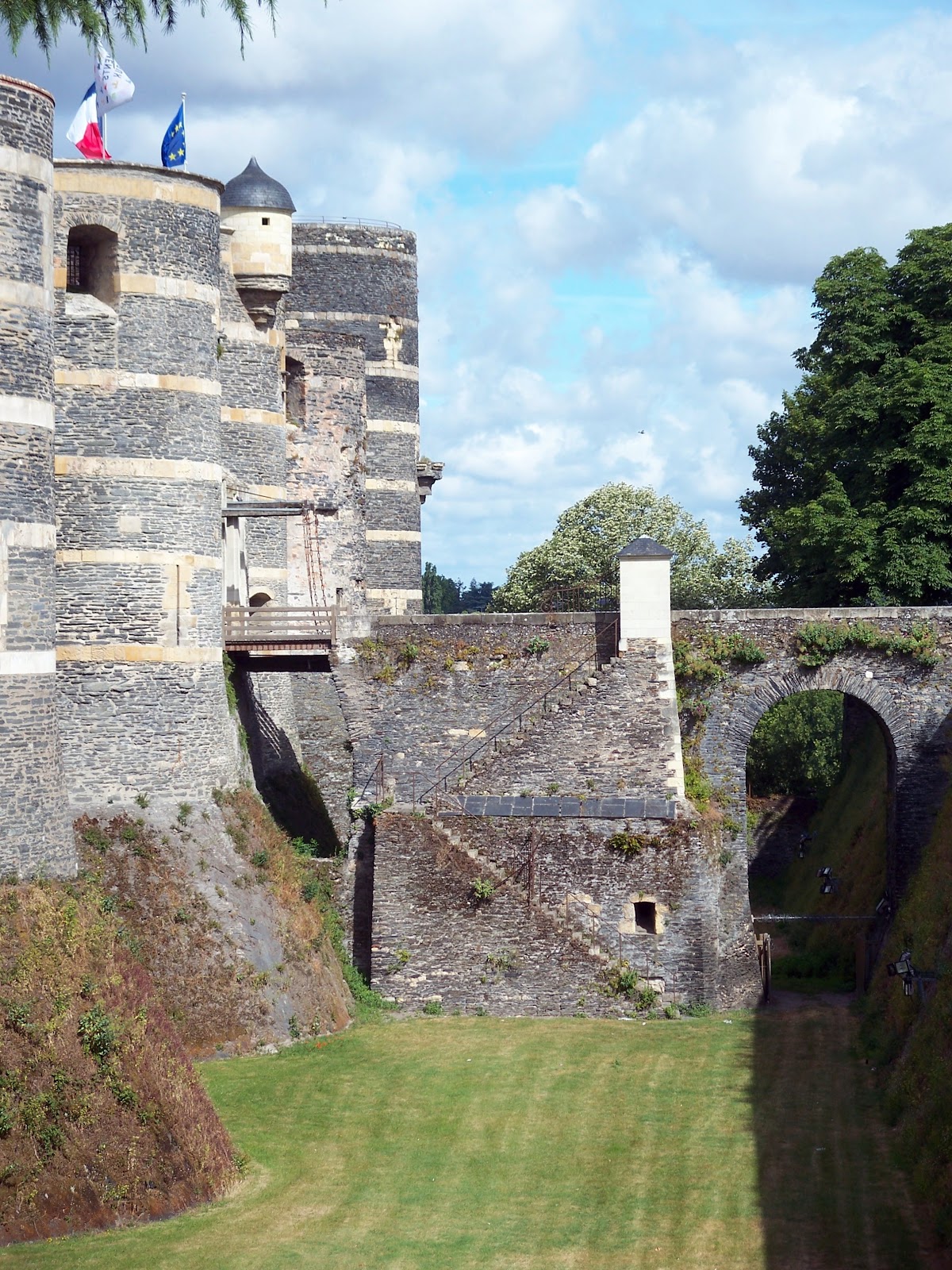
We're going to spend most of our time at the château, which fronts the Maine river. The seventeen picturesque towers we see today were built of shale and limestone during the reign of Saint Louis (Eleanor's great-grandson) between 1230 and 1240 to surround the buildings and structures within. The castle was built on his behalf by his mother, the redoubtable Blanche of Castille, when she served as Regent of France. The towers were topped with pepperpot or conical turrets, now gone. The walls themselves are nearly 10 feet thick and cover a total distance of almost a third of a mile.

In 1562, Catherine de Medici undertook restoration of this château. During the Wars of Religion when the Huguenots threatened to take it over, her son King Henri III stripped the ramparts so the château was a less attractive prize. Each tower was once 131 feet high, but Henri III had all but one cut down by 32 feet by removing the charming pepperpot turrets. For a time he maintained the fortress' defensive capabilities by placing artillery on the upper terraces, but decided in 1585 that the château should be completely demolished. Fortunately for history, he died in 1589 and his successor Henri IV (the Bourbon who reputedly said "Paris is well worth a Mass") halted that destruction.

So what we are looking at is nothing like the Angers that Eleanor would have known.

While very little remains of the original Plantagenet dwellings, Angers was nonetheless important to Henry and Eleanor, both politically and personally. Their youngest daughter Joanna was born here in October 1165.

The ruins and remnants of the buildings Eleanor would have known are to the far upper right of this diagram, which can be found on the grounds.

Photo by John Phillips


Legend has it that once upon a time, wild lions and antelope lived in the dry moat to deter interlopers. If so, seems to me to have been a poor deal for the antelope.

The moat itself dates to 1485. Today, a herd of deer roams these formal moat gardens. No lions.


While certainly having undergone its share of reconstruction and repurposing over the centuries, Angers still looks like a serious fortification not to be trifled with. It was re-fortified for military purposes during the Revolution, when it came under major attack but suffered little damage. The château's last military purpose was when it served as a munitions dump for occupying German forces during WWII. The inner grounds sustained considerable damage from an explosion. Restoration began in the 1950s and continues today.

Tour Moulin (the last, darkest tower in the photo to the left, in focus to the right) is the only tower that retains its original height. But it, too, was stripped of its pointy little pepperpot turret by the deconstruction efforts of Henri III.


Once inside, visitors are greeted by the formal gardens in the centre of the château grounds.


I suspect the gardener went on his break in the middle of trimming this archway.


These gardens seem unchanged since my previous visit twenty years ago. I have fond memories of wandering around here one evening during a son et lumière show.


Judging from the photos below, apparently this château is guarded by a chivalrous order of height-challenged knights. They have eschewed armor in favor of cardboard helmets, shorts, and sandals but are ever-vigilant to defend the castle against ubiquitous hordes of Japanese tourists.


(My elementary-school-aged son, having seen these photos, has yet to forgive me for not bringing him home a cardboard helmet).

We spent some time wandering the grounds and walls, though I passed on the rampart wall walk in favor of sitting in the garden and remembering my previous visit.

Random photos of a guard pigeon and a Green Man carving on an interior wall.


Portcullis envy, I mean entry.


Long narrow stairway, with modern steps.

Photo by Nicole Benkert

We paid a requisite visit to the sainte chapelle, so-called because it once enshrined a Passion relic (in this case, a splinter from the True Cross).

A fire caused by a malfunctioning portable electric heater resulted in extensive damage to the roof of the royal apartments -- the Logis Royal -- on January 10, 2009. Damage to the collections housed within was minimal and the adjacent Chapelle Sainte-Geneviève was spared. However, the fire truck couldn't pass through the narrow drawbridge entryway, so the roof was destroyed. Repairs were still on-going at the time of this visit, as can be seen by the scaffolding and crane in the photo below.

As of March 2011 the new curator of Château d'Angers is American-born Patricia Corbett, lauded for her work at Carcassonne.

Photo by Sue O'Dee

Of course, no visit to Angers is complete without viewing the Tapisseries de l’Apocalypse.

Photo by Nicole Benkert

Created between 1375 and 1382 in Paris for Duke Louis I of Anjou, these allegorical tapestries portray scenes from the Revelation of St John, but they also include commentary on 14th century politics and the Hundred Years War. There were once 105 individual tapestries measuring 551 feet long by 19 feet high, a woven surface of 10,764 square feet. The tapestries would have adorned the château for special occasions. They were eventually passed to the Cathedral of Angers, and then suffered during the Revolution. After that, their history is fragmented -- used as blankets to protect orange groves from the frost, as wall insulation, saddle covers, and floor rugs. Gradually recollected between 1843 and 1870, a total of 67 panels and 9 fragments were restored.

This modern L-shaped room, built circa 1952, is dimly lit to protect the already-fading vegetable dyes on woolen threads. That ill-conceived wall of windows is now completely covered over inside to keep out the damaging effects of sunlight.

To create what we know as the Apocalypse Tapestries, weavers copied illustrations from a manuscript, working horizontally from the back of the tapestry (checking position via a mirror set below the loom). The tapestry was designed to be viewed from both sides and could thus be used as a partition, which was common in the Middle Ages.

This is one of my favorite depictions, that of The Great Whore of Babylon: "Come hither, I will shew thee the judgment of the great harlot that sitteth upon many waters." (Revelations 17:1).

Photo by Nicole Benkert

Just before leaving the room housing the tapestries, we looked down through this window to see the ruins of this chapel from the original Plantagenet-era palace. At last, something Eleanor would have found familiar! How I would have loved to have seen more of the original dwellings.

Photo by John  Phillips


More from Eleanor's day, much to our delight, was the original Plantagenet aula or Great Hall. These ruins likely predate Eleanor, since we know that Geoffrey and Maude also lived in Angers.


Classic Norman arch. Obviously the interior is a ruin, but it must have once commanded a great view over the Maine River.

Henry established l'hôpital Saint-Jean d'Angers in 1180 across the river from the château in the Doutre district. The royal charter says it was "founded of his own alms in honour of God, for care of the destitute and to relieve their want." Much of this 12th century hospital still exists, and is today the site of the Jean-Lurçat Museum of contemporary tapestry. We unfortunately did not get to visit there but it is likely that Eleanor would have, in the way of royal benefactors inspecting and showing favor to a pet project.

Photo by Sue O'Dee

I love the above photo because even though I suspect this is a modern reproduction, the chevron or zigzag moldings typical of Norman architecture of the 11th century can clearly be seen. Eleanor would have seen a great deal of this kind of ornamentation, all most likely painted.

Here's our merry band of medievalphiles gathered around this architectural witness to Plantagenet history.


I finally had the chance to peer through the great archway to see what remains of the aula: walls, a staircase, hints of a fireplace. Perhaps someday there will be restoration to evoke the structure in Plantagenet times.


The diorama below from Angers shows what the site likely looked like during Eleanor's time. The Plantagenet aula is toward the front.

Photo by John Phillips


Having finished our tour, we were funneled into the gift shop...was oddly situated in the middle of the château grounds so that visitors had to pay to enter before even buying anything -- not the best marketing plan. I had to take a photo of this replica helmet and hauberk for my knight-obsessed son.


We exited the château and walked down the charming Rue Saint-Aignan, heading toward Cathédrale Saint-Maurice d'Angers.


Below is the tall, narrow west front of St-Maurice. At one time there was also a porch, but that was destroyed in 1806. The lowest part of the cathedral dates to 1170 (and is thus something Eleanor would recognize); the twin towers are 15th century; the central tower is 16th century. Right now there is wooden scaffolding over the entrance portal at the bottom. The portal dates to the mid-12th-century and was inspired by Chartres Cathedral.


Because of the construction we didn't get to see the famous portal, so Wikipedia Commons to the rescue here:

Source: Wikipedia Commons


Statues flank either side, including one of the Queen of Sheba on the right. That statue has been claimed by some as having Eleanor for its model. That's possible, but not probable, since there's never been anything to substantiate the claim. To adjust perspective, keep in mind that the inset door to the bottom right is people-sized; that's how we entered the church.


These stained glass windows on the north side of the nave date to the 12th century and portray the Dormition of the Virgin Mary and the Martyrdom of St. Catherine of Alexandria.


In this town so associated with the Plantagenets, one of the east choir windows dating to the 13th century is dedicated to Thomas Becket, that great frenemy of Henry Plantagenet. Unfortunately I didn't get a photo of it but detailed views can be seen HERE on the Kenyon College site.


Photo by Tee McNeill


St-Maurice has a grandiose Baroque high altar that dates to 1758, designed by Henri Gervais. Legend has it that Gervais was carried to the altar while he lay dying so that he could give final construction instructions. I like how this gaudy altar contrasts with the simple lines of the Plantagenet-style vaulting.

It was time for lunch so we wandered into the heart of town. Below is a lovely example of a half-timbered house which greeted us in the square outside the east end of the cathedral. This is Maison d'Adam, at the intersection of la Rue Montault and Place Sainte-Croix. A shop called La Maison des Artisans is on the bottom floor, a kind of artist consortium.


I love this fish-eye view of Place St-Croix, with Maison d'Adam to the far left.

Source: Google Earth

Several of us had a counter lunch at La Gourmandise, then wandered back along Rue Toussaint, ogling closed antique store windows along the way. I'm pretty sure that Wendy left nose-marks as she lusted with heavy breaths after the full set of Quimper pottery she saw inside.

We were originally meant to stay overnight in Angers but in order to cut travel time for our last day of touring tomorrow we had to press on to the city of Orléans. I would have welcomed a longer stay in Angers but was also pleased to visit the city that New Orleans was named for!

So next stop: Orléans.