Our drive from Falaise to Mont St-Michel was long. The delay leaving Paris earlier in the day caused a few of us to fret about possibly not having time to enjoy the town before the sidewalks rolled up. We didn't care if the shops sold tourist trinkets; we just wanted to be there.
And then suddenly, there it was. Across the plain, looming 240 feet above sea level in the Gulf of Saint-Malo: l’Abbaye du Mont Saint Michel.

The Benedictine Abbey of Le Mont-Saint-Michel was built in a tidal basin on a solid granite out-cropping. It is on what is called a tidal island, accessible since 1879 by a
man-made causeway during times of low tide.
The tidal island is half a mile from the mainland near the opening of the River Couesnon.
The tidal island is half a mile from the mainland near the opening of the River Couesnon.
Le Mont is on the island of Mont-Tombe, in the Bay of Saint Michel, which is itself an inlet of the Gulf of St Malo. It's also been described as an inlet of the English Channel, which was known as the Narrow Sea in Eleanor's time.
Hermits lived on Mont-Tombe during the Roman era, and the island served as a stronghold during Romano-Briton times.
Hermits lived on Mont-Tombe during the Roman era, and the island served as a stronghold during Romano-Briton times.
This was to be my second visit to Le Mont. I still had my original well-creased guidebook from 20 years ago!
 |
| Photo by Nicole Benkert |
According to legend, in 709 the Archangel Michael appeared in a dream or vision to one Aubert, Bishop of Avranches. Michael demanded that a chapel be built in his name. Upon expressing some doubts about the feasibility of this assignment, Aubert was rewarded by the Archangel drilling a finger through his skull.
A modern-day dialogue between the two probably went something like this:
Mike: Aubert. Build me a church on that big rock out there.Or...maybe not quite like that.
Bert: What? THERE? LOL. Yeah, no.
Mike: Build me a church.
Bert: Mike, angel, you need another church like I need a hole in my head.
Mike: *sound of drilling"
Bert: Ow! The hell? What is WRONG with you?
Mike: Build me a church on yonder rock.
Bert: You just drilled a hole in my skull with your finger! I think you are quite capable of single-handedly building your own damned church.
Mike: Yes, well. I want YOU to build me one, over there, on that tidal island.
Bert: I have no time to build you a church! I have important bishopy things to do!
Mike: *raises finger again*
Bert: OMG, no, stop! No more holes! Fine, I'll build you a church....
But, duly inspired, a (surprisingly profane) Bishop Aubert built an oratory to the Archangel Michael on Mont Tombe. It was modeled after Monte Gargano in southern Italy. There are still vestiges of Aubert's oratory to be found in the basement, in the Chapel Notre-Dame
Building didn't end with Aubert, however. The vestiges of the Romanesque church we see today date to 1017-1144. Further buildings were added in the 13th century to accommodate monks and the hordes of pilgrims who flocked there, including the beautiful monastic quarters known as "La Merveille." That part, done in Norman-Gothic style, consists of two three-story buildings, refectory, and cloister. Those buildings were subsequently modified many times over, well into the 1500s.
During the Hundred Years' War (1337-1453 CE) when possession of Normandy was contested between France and England, the English besieged and blockaded Mont-Saint-Michel three times. It withstood the deprivations and indignities of these sieges, and in fact was the only part of western and northern France to avoid occupation by the English.
And then, dissolute living by the monks led to the Benedictine order being dispersed. That didn't happen all of a sudden, mind you. Benedictine rule over Mont St-Michel gradually declined. After the Hundred Years War, abbots at Mont St-Michel held the abbey in commendam, as a benefice in trust to higher church authority. They were able to draw from Mont St-Michel's resources and revenues, but held less and less authority over the Benedictine monks to enforce rules and regulations of the order. And the monks themselves had gradually been moving off the island. They were scattered around its various priory estates and living quite well, thank you very much, as country gentlemen.
With Benedictine rule diminished and the community scattered, in 1622 the abbey merged with another congregation. The remaining few monks were ejected from Le Mont during the French Revolution, and the abbey was converted into a prison from 1793 until 1863. In subsequent decades, the French became more protective of their collective cultural legacy and sought to preserve the remaining architectural witnesses to national history. Le Mont fell under government protection in 1872, and restoration work has been done almost continually ever since.
The abbey's archives were taken to nearby St. Lô for safe-keeping during WWII, but unfortunately were destroyed during the D-Day invasion. Much reconstruction has occurred on the buildings to make the site presentable and evocative of its 1100 years of history. There is even a small group of monks and sisters in residence at the abbey once again, of the order Fraternités Monastiques de Jérusalem. Visitors can join them for daily Mass.

But Le Mont's days as a religious pilgrimage site have mostly passed.
Today it is primarily a tourist attraction, with one narrow street of hotels, restaurants, and shops catering to tourist shopping needs.
That's where we were headed.
The photo above was taken looking up from the causeway where cars and buses parked to deposit visitors. No vehicles are permitted on the island itself.

During the Hundred Years' War (1337-1453 CE) when possession of Normandy was contested between France and England, the English besieged and blockaded Mont-Saint-Michel three times. It withstood the deprivations and indignities of these sieges, and in fact was the only part of western and northern France to avoid occupation by the English.
And then, dissolute living by the monks led to the Benedictine order being dispersed. That didn't happen all of a sudden, mind you. Benedictine rule over Mont St-Michel gradually declined. After the Hundred Years War, abbots at Mont St-Michel held the abbey in commendam, as a benefice in trust to higher church authority. They were able to draw from Mont St-Michel's resources and revenues, but held less and less authority over the Benedictine monks to enforce rules and regulations of the order. And the monks themselves had gradually been moving off the island. They were scattered around its various priory estates and living quite well, thank you very much, as country gentlemen.
With Benedictine rule diminished and the community scattered, in 1622 the abbey merged with another congregation. The remaining few monks were ejected from Le Mont during the French Revolution, and the abbey was converted into a prison from 1793 until 1863. In subsequent decades, the French became more protective of their collective cultural legacy and sought to preserve the remaining architectural witnesses to national history. Le Mont fell under government protection in 1872, and restoration work has been done almost continually ever since.
The abbey's archives were taken to nearby St. Lô for safe-keeping during WWII, but unfortunately were destroyed during the D-Day invasion. Much reconstruction has occurred on the buildings to make the site presentable and evocative of its 1100 years of history. There is even a small group of monks and sisters in residence at the abbey once again, of the order Fraternités Monastiques de Jérusalem. Visitors can join them for daily Mass.

But Le Mont's days as a religious pilgrimage site have mostly passed.
Today it is primarily a tourist attraction, with one narrow street of hotels, restaurants, and shops catering to tourist shopping needs.
That's where we were headed.
The photo above was taken looking up from the causeway where cars and buses parked to deposit visitors. No vehicles are permitted on the island itself.

Our bus pulled up to the causeway and several of us promptly scooted up La Grande Rue to explore.
In the next photo above, you can see the awnings of our hotel, Le Mere Poulard, through the archway of Porte de l'Avancée.
This exterior area was once a dike, but Porte de l'Avancée was added in the 1500s for defense.

Once inside Porte de l'Avancée one sees Porte du Roy, protected on either side by the Arcade and King's Towers (Tour de l'Arcade and Tour du Roi) in the background. Our lodgings, the hotel La Mère Poulard, are just to the left as one ascends to Porte du Roy.
 The dike and moat, plus a drawbridge and portcullis gate, all made the island difficult to penetrate. If you, seeking to invade, somehow made it through all this, forcibly ascending Le
Mont's one narrow street was your next (impossible) challenge. Not surprisingly, then, that Le Mont has never been taken by force.
The dike and moat, plus a drawbridge and portcullis gate, all made the island difficult to penetrate. If you, seeking to invade, somehow made it through all this, forcibly ascending Le
Mont's one narrow street was your next (impossible) challenge. Not surprisingly, then, that Le Mont has never been taken by force.Annette Boutiaut came to Mont St-Michel as a young chambermaid for architect Edouard Corroyer (more about him later). She married a baker's son, Victor Poulard, and they took up innkeeping. She became known for her famous omelettes, which are the signature dishes at the hotel restaurant where we'll eat tonight.
Click HERE to read an article about omelette-making at La Mère Poulard, and HERE for an excerpt from a 1932 book written about Mother Poulard (in French).

But now, as you come onto Le Mont, look up, look up, look up -- your eyes are constantly drawn heaven-ward! There have been several tower variants atop the church over the centuries, and lightning has struck many of them. The current neo-Gothic spire is a copy of the one on Cathédrale Notre Dame de Paris that we saw yesterday, and it is topped by a gilded copper statue of the archangel Michael slaying a dragon.
The cult of Saint Michael was significant in the medieval world, with ancient origins in Turkey and Greece. Along with that region and southern Italy, this part of France was a center of the Michaeline cult of worship.

Of course the big question for our group was this: was Eleanor ever here?
Alas, there is no documented evidence to indicate that she ever visited Le Mont. But given its significance in the medieval world, it's hard to imagine that she never came. We know that Henry II and Louis VII discussed kingly business over dinner here in 1158 ("kingly male bonding" as Sharon Kay Penman called it). Eleanor was not with that party of husband and ex-husband.
However in Eleanor's time, Robert of Torigny was Abbot of Le Mont, and he was godfather to Henry and Eleanor's daughter Leonora. And Leanora she was born in near-by Domfront. Given that connection, it is possible that at some point Eleanor may have quietly visited this famous place as a pilgrim. Given the fame of the site, it would in fact be surprising if she never visited.

But back to the present day. The narrow steps on the right of the above photo take one into the 11th century village church of St-Pierre (though most of the current church fixtures date from the 15th century), and off to the left are shops on La Grand Rue.
Visitors to Le Mont have always had to walk this retail gauntlet in order to ascend to the heights of the abbey. This street is normally thronged with shoppers and pilgrims but it was late in the day when we arrived, so not as crowded. To the left is the second hotel bearing the Poulard name (both long since sold by the family).
We finally headed back to our hotel laden with booty. While some of our group were lodged in the street-front La Mère Poulard building, the rest of us were housed in the lovely three-story annex behind and above the main hotel. Pity the poor tour manager and hotel porters who hauled our luggage up steep steps to get there! Here you can see the hotel annex in perspective as it relates to the abbey, directly below the lodgings of the Abbot's Palace for important visitors.

My room was in the middle of the second floor, looking out onto the tidal flats. I loved being able to swing those big windows wide open and lean out. I promptly opened a bottle of Cidre Brut and unintentionally popped the cork out the window into the gardens below. Ooops! Predictably this brought a round of curious inquiries from my fellow travelers, who'd also opened their windows, so cidre sampling commenced.

Below is the view from my room of the buildings below fronting La Grand Rue, and also of Brittany in the distance across the tidal basin of the Gulf of Saint Malo. The tide only comes in twice a month; this was not one of those times.

The highest tides take place roughly 36 to 48 hours after the full and new moons. The tides are the highest in continental Europe and come in swiftly; the difference between low and high tides can be up to 60 feet, with a force of over 3 feet per second. They cannot be outrun (although one of Sharon's characters managed to do it!) and are considered among the most dangerous in the world, described by Victor Hugo to be as as fast as a galloping horse.
 |
| Photo by Nicole Benkert |
It was not popular with most of our group.
I kept trying to like it. I told myself "It's fancy! It's French! It was on fire! You're supposed to like this."
And I kept thinking, oh no, I've lost my dessert omelette virginity! I'm forever ruined for future dessert omelettes! C'est dommage!
(In all honesty, I didn't mind it. Not sure I'd seek it out again, though).
After much hilarity and a fair amount of wine, some of our group wandered up La Grand Rue for a night view of Le Mont before retiring.
 |
| Photo by Tammie Maloney |
 |
| Photo by Nicole Benkert |
I felt a weight of spirit upon me as we wandered. It was hard not to imagine the sound of scores of shuffling footsteps, to think of all those who had walked this path over the centuries. Pilgrims had carried their troubles up Le Mont in hopes of resolution and blessing. Today, mostly all we modern pilgrims carry back down are a few trinkets and our flashcards full of photos. I could only hope that spiritual pilgrims, then and now, leave with something intangible, something more.
We stopped at the top of La Grand Rue, before the entrance to the abbey.
 |
| Photo by Wendy Mehary |
Bonne nuit, Mont St-Michel.
 |
| Photo by Tammie Maloney |
 |
| Photo by Nicole Benkert |
Except...not everyone was ready to sleep!
The free range cats of Le Mont did not see fit to retire, and much caterwauling occurred until just past midnight. Judging by the intensity of the yowls either a feline murder occurred, or Le Mont cat population will increase in a few months.
You, kitties. Yeah, you. Don't look so innocent. I HEARD you.
We ALL heard you.
Cats have no shame.
Wednesday, 8 June, 2011
The next morning dawned bright and clear. Bonjour, tidal flats!

A crash course in hydrogeology: three rivers (Couesnon, Sée and Sélune) come together to fill this bay. The tide brings huge quantities of sediment and the three rivers are supposed to check that by driving sediment back out to sea. However in the 20th century, the Couesnon was turned into a canal in order to battle erosion.
Then a dam was built in 1969.
These modifications, along with Le Mont's man-made causeway, caused a reduction in the tides. That resulted in both the build-up of the mudflats seen in this photo, and of mud and sediment all along the Couesnon banks.
To counter-act all that, plans are in place to replace the causeway with a bridge and to modify the dam, so that sediment can once again be driven out to sea. That means that someday in the near future, the above view will only be visible at low tide, and there'll be no visual pollution of the causeway with its parked cars and buses. Only shuttles will be allowed on the new bridge.
Details about the ambitious bay rebuilding project, Projet Mont Saint-Mich
Several of us wandered around taking photos in the lovely morning light. Porters were also up early, carrying luggage for departing overnight visitors. Le Poste occupies the site of the original Le Mère Poulard establishment.


Above, the building in the distance is called Le Fanils and provides additional access to walk around Le Mont. The Enceinte des Fanils were built to protect the storehouse
After breakfast in the hotel restaurant it was time to drag our bags down to be loaded onto the bus. This is what the lobby of the hotel annex looked like when it wasn't filled with 30+ suitcases!
 |
| Photo by Nicole Benkert |
We gathered in the reception area of the hotel to wait for our local tour guide. Our goal: walk via the sloping La Grande Rue, up 900 stairs, to visit the Abbey.
 |
| Source: planetwake.com |
Nine hundred stairs.
Don't worry, you won't get lost.
All these people are going the same way:
 |
| Photo by John Phillips |
Once you clear the gauntlet of shops on La Grande Rue, the way opens up a bit for stair-climbing.
Of course, all those people are going up the stairs with you. Cozy.
 |
| Photo by Nicole Benkert |
This is Le Grand Degré Extérieure leading to La Merveille, the complex of buildings surrounding the church. There are three levels of La Merveille: the lowest for the bourgeoisie who were on pilgrimage to pay homage to Saint Michel; the middle for noble and royal visitors; and the upper level of abbey and cloister were the preserves of the clergy.
The likes of us wouldn't have gotten past the lowest levels, back in the day. But as tourists, we'll all head to the top and work our way down.
 |
| Photo by Nicole Benkert |
Honestly, the climb doesn't seem bad once you're half-way there.
Although these handy wall-side defibrillators gave us pause for thought.
 |
| Photo by Sherill Roberts |
And then...more stairs, specifically Le Grand Degré Intérieur.
 |
| Pont sur l'escalier du Grand-Degr |
When important people visited Le Mont, ceremonial entries were called for. A king would be received at Porte du Roy; the Archibisho
Us? There was no one to receive our group.
 |
| Photo by Nicole Benkert |
Finally, we got a view of the Couesnon River from the top on the West Terrace.

This spot almost marks the border of Brittany from Normandy. Brittany is to the left. The greenery seen is the salt-marsh and polder lands, set aside for sheep and cattle grazing.
A view from the West Terrace of the isle of Tombelaine, a small sister to Mont-Tombe
 |
| Photo by Nicole Benkert |
According to Geoffrey of Monmouth's account, King Arthur's niece Hélène was abducted by a giant from Spain and taken to Le Mont. Arthur defeated the giant to avenge Hélène's death. Tomb-Hélène became Tombelaine.
But there's more to Tombelaine than Arthurian legend. Two hermit monks from Le Mont lived there in the 11th century, and a priory was founded on the island in 1137. It also became a place of pilgrimage. During the Hundred Years' War, Tombelaine was used as a base by the English to attack Le Mont, and during the Wars of Religion in the 16th century Huguenot armies occupied the island. In the 17th century, the island's fortifications were destroyed by order of Louis IV. The island was declared a historic monument in 1936 and it became a bird reserve in 1985. It is possible to visit Tombelaine, but only if you have a guide to lead you over the dangerous mud flats.
And at long last, we came to the West facade of the Church.

Several facades have graced this church, but this plain Romanesque front from the 12th century is the one that has withstood the test of time. There were once two towers from that era as well, but they are long gone.
This is the facade that would have greeted Eleanor if she visited Le Mont.
Good site showing the evolution of the church facades: LINK.

The spire and statue were added much later, under the supervision of that ubiquitous 19th century architect and castle-restorer extraordinaire, Viollet-le-Duc.
It is possible to climb the Lace Staircase (Escalier de Dentelle) on the other side of the church to the spire, but we didn't.
But you should if you have a chance to do so; after all, at this point, what's a few more hundred stairs?
Into the church next, looking at the north wall of the Romanesque nave from the 12th century.
Into the church next, looking at the north wall of the Romanesque nave from the 12th century.

The structural integrity of the building was assured by a framework of pillars and arches-- but not without mishap. In 1103 the entire north wall collapsed while the monks were at prayer, and was subsequent
There are three stories here: (1) the great arches at the bottom; (2) the blind story in the middle and (3) the clerestory at the top, which lets in the light. It's all covered by a wooden vaulted roof, in accordance with the Norman tradition.
The Romanesque choir collapsed in 1421, four centuries after its completion
There was once Renaissanc
This, this was the goal of your pilgrimage. As close to the heavens as you could get.
 |
| Photo by John Phillips |
This modern garden is pretty, but I'd love to see the Lavatory reproduced. Architect Edouard Corroyer described it in his late 19th century guidebook.

The original shafts of the cloister were of lumachelle limestone imported from England, which boasts a marble-like appearance. But Le Mont had fallen into a sorry state of repair by the time of the French Revolution, which is why extensive reconstruction work was done in the late 19th century once it was decided to preserve the place. In 1877 architect Edouard Corroyer chose to replace the original limestone colonettes with the Lucerne granite ones we see today.
The colonettes are placed in staggered lines, just slightly out of sequence with one another, and are connected by arches along and between the rows for absolute stability.
The gallery has a wooden roof. This cloister is connected to the abbey on three sides, and is open to the sea on the north side.

Below is a close-up of a squinch or spandrel in the cloisters. Between the arches, the soft Caen limestone is carved with gorgeous tracery. You can see a rose surrounded by three other roses, and topped by a frieze with various designs (including a barn owl at another point, which my owl-obsessed daughter would have loved!). All of these details were originally painted in bright colors.
 |
| Photo by Nicole Benkert |
The cloister forms the roof over the Scriptorium one level below. The Scriptorium functioned as the monastery Chapter House, although it was later known as Salle des Chevaliers aka the Knight Room.
 |
| Photo by John Phillips |
The cloister itself leads to the refectory shown above, which is a large room with a barrel vault ceiling. This was where monks would take their meatless meals twice daily in silence, according to the rules of St. Benedict, while listening to a reader of holy texts on the rostrum. There are 59 narrow windows along the sides which let in an amazing amount of light. It would have been a pleasant place to dine and reflect.
From there, working our way down, we arrived at the intermediate level of La Merveille to the formal Salle des Hôtes or Guest Hall which was used to entertain kings, queens, and nobility when they visited Le Mont. There were two enormous fireplaces with hoods used to prepare food which served to frame a photo of our entire tour group! The room would have been lavishly decorated back in the day with tapestries, painted walls, stained glass, and tiled floors.
There was a connecting private chapel to Mary Magdalen, Chapelle Sainte Madeleine, which was used for prayers before and after meals and for general thanksgivi
From there we wandered through the crypts to the former Ossuary, part of the 11th century Mont but since modified many times over. Originally this was where the monks interred remains from the small cemetery of the Abbey. It is connected to Saint-Etienne Chapel, which was probably used as a funeral chapel for the monks.
Now the former Ossuary contains an enormous wheel which dates to 1820, used to hoist provisions to the prisoners when the Abbey was a jail from 1793-1863. It is strange to think of it functioning so in this room, which was once a tomb.
 |
| Photo by Nicole Benkert |
 |
| Photo by John Phillips |
Remember that the roof here supports the cloister above, which we walked through earlier.
Below this was the Almonry, a lower-floor hall where monks offered food and lodging to the poor, according to the rules of Saint Benedict. It was 114 feet long with six round columns and was part of the original Romanesque abbey, one of the few buildings from that era that survived a disastrous fire. Today it houses the site bookstore. Alas, we were not able to linger. (Note to tour organizers: always allow time for lingering in the bookstore)!
Another disappointment with this tour was that Chapel Notre-Dame-Sous-Terre was closed to visitors. This chapel was built circa 966 by the first Benedictine monks, erected on the site of the oratory built by Bishop Aubert at the Archangel Michel's command. The rest of Le Mont was built around it in succeeding centuries.
On the trek back down La Grande Rue to our departing point, some of us managed to sneak into a few shops for those indispensable Mont St-Michel souvenirs. We stopped on the causeway so we could get our last few shots of Le Mont.
I, of course, was nearly smushed by a tour bus as I stood taking this shot. I was lucky and didn't join the ranks of pilgrims who died in sight of Le Mont!

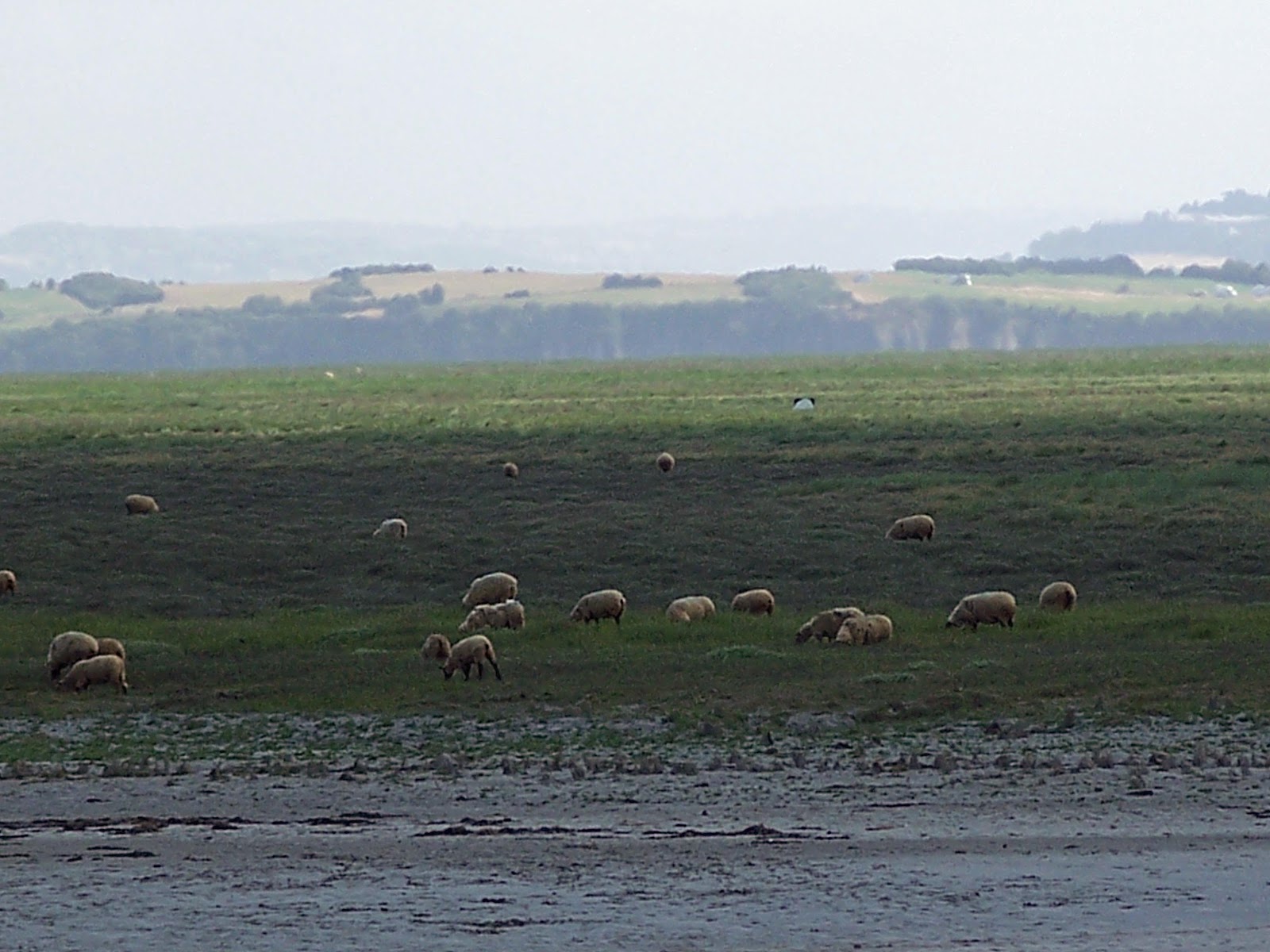
On either side of the causeway we saw les moutons de pré-salé en Baie du Mont-Saint-MIchel. Grazing sheep on the salt marshes is an ancient practice. Writs from the 12th century granted the Benedictine monks of Le Mont the privilege of using the surrounding lands in this manner. These sheep are a special breed called le grévin and are descended from English sheep from the Suffolk region.
Sharon Kay Penman's blog entry about our tour of Mont St-Michel and visit to Le Mans can be found here: LINK


