Showing posts with label Héloïse. Show all posts

Saturday, June 9, 2012

Paris: Musée de Cluny

Monday, 6 June, 2011

Destination #2:  Musée de Cluny, officially Musée National du Moyen Age Thermes de Cluny


I take a special delight in visiting museums whose edifices are as interesting as the collections they house. The Musée de Cluny is one such place.

Back when Paris was Lutetia, the area was divided into two sections. The Cité, located on what we known today as the Île de la Cité, was connected to the banks of the Seine on either side by wooden bridges. The open suburbs stretching up Mont Sainte-Geneviéve (now topped by the Panthéon) were populated by villas and vineyards. The Seine was not bounded by concrete embankments and spread over a much wider area, extending into flood plains that stretched as far as what would become the Benedictine Abbey of St-Germain-des-Prés in the 6th century. 
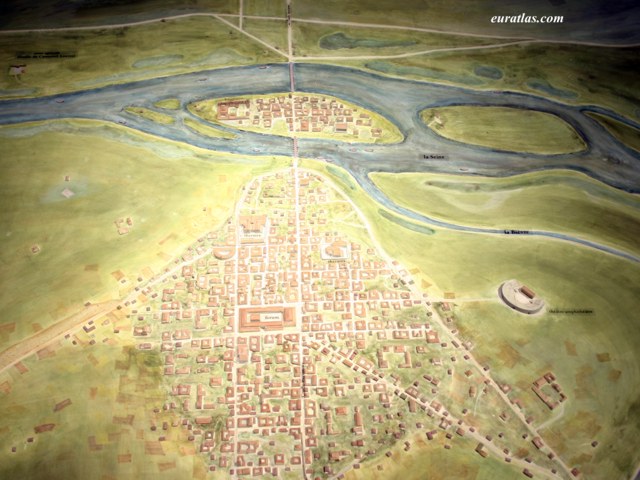
Representation of the Gallo-Roman city of Lutetia, from euratlas.com

Lutetia's aqueduct supplied three public baths. It can be hard to imagine the scale of these Thermae from the current ruins, which represent only about a third of the extent of the baths. It was a dynamic complex that continued to be expanded upon to meet the needs of the public, right up until its destruction by invading barbarians in the middle of the 3rd century.


Exterior shots of Roman ruins married to modern museum. Photos by John Phillips

The complex lay in ruins for roughly a thousand years until the Cluniac monks decided to establish a presence in the growing academic center of Paris in the 13th century. The reformed Benedictine order of Cluny was established in the 10th century by a predecessor of Eleanor's, William I of Aquitaine. In 1334 the order built a townhouse for its abbots abutting the ruins of the Roman Thermae, known thereafter as the Hotel de Cluny. It underwent modifications in the 16th century. Today it is one of the few examples of an intact late-medieval residence in Paris.
Cour d'Honneur of Hôtel de Cluny. Drawn by Gaucherel, steel engraving by Lemaitre, 1845

The building eventually passed into private ownership and an amateur historian named Alexandre Du Sommerard moved in sometime in the 1820s with his ever-expanding collection of medieval objets d'art. His collection soon became famous. It was popularly hoped that a permanent museum would be created, patterned after the Musée des Monuments Française founded by another amateur collector, Alexandre Lenoir (whom I wish I could like more for his preservation efforts but whose treatment of the reputed remains of Abélard and Héloïse left quite a lot to be desired; see my other  blog for details). 


When Du Sommerard died, his house combined with the Thermae become national property. The Cluny museum officially opened in 1844.

Over the years the collection has become more specific and refined, spanning the Roman Empire (28 BCE - 5 CE), Romanesque (1000-1250 CE) and Gothic eras (1251-1500).  The combination of the Cluny house and Thermae allows for a unique exhibition environment that remains dynamic and responsive to public needs. The museum has benefited from consistently responsible curatorship, an example being its closure in 1939 so the exhibits could be moved to a secure place for the duration of WWII. Although the Cluny does not contain any artifacts specifically associated with Eleanor, it is well worth visiting for any medieval history buff due to its history, location, and diverse collection. 

We entered through the medieval-inspired gardens.  I don't remember this space from my previous visit for good reason: the gardens were designed in 2000 by Eric Ossart and Arnaud Mauriéres. The plantings include medicinal and kitchen gardens and a section with mille fleurs. Much as I like gardens, I have to admit to being less than impressed...I'm not sure what medieval era the designers were trying to evoke with modern deck fencing. I guess that's why it's described as 'medieval-inspired."


From there we passed into the cobble-stoned Cour d'Honneur courtyard, with its charming old well and Flamboyant Gothic architecture.

I was particularly taken with the scallop shell theme in the Cour d'Honneur. Paris was a medieval gathering point for pilgrimages to the Camino de Santiago in modern-day Spain. Today's pilgrim would be hard-pressed to follow the exact medieval routes from Paris, since they've been covered by modern highways or buildings. But the interested aficionado of Santiago pilgrimages (and I have to admit that I'm rather obsessed) can find scallop shells and other St James symbols in historic places like the Cluny. Their presence conveys a profound sense of the pervasiveness of Chemins de Saint-Jacques-de-Compostelle to medieval life. The Cluniac order established a series of way houses for pilgrims along the route to Galicia, and the abbot or other prelates residing at Hôtel de Cluny would have blessed pilgrims departing from Paris. 


Photo by John Phillips

Once inside, I was tickled to see a familiar friend waiting for me:


You can just see some of the traces of medieval polychromy decoration on this limestone statue of Saint Denis, who is dressed quite formally. He's probably heading out for a party.


Photo by John Phillips

Perhaps lovely Ariadne here is going to be at the same party? This was a beautifully carved piece of ivory from Constantinople dating to the 6th century...old enough that I can pretend that perhaps Eleanor saw it! 

There was truly an embarrassment of riches in the Cluny of alabaster reliefs, stained glass, choir stalls, and sculpture encompassing a span of some 1500 years. Add to that a marvelous setting incorporating Thermae walls, 16th century Gothic architecture and modern conveniences, and the eye didn't know where to rest.


Photo by John Phillips

And of course, there was the charming and irresistible bookstore!


Photo by John Phillips
Our group spent a lot of time in the Notre-Dame room, where we came face-to-face with those heads of the Kings of Judah that had lined the gallery of the great cathedral, then spent nearly two centuries buried underground until the building of a Metro stop unearthed them. Here are a few:


We couldn't stop staring at beautiful Adam here, circa 1260, who once graced the south transept facade at Notre Dame with Eve. He's been well re-constructed (heh heh) but at one time he also held an apple. Methinks he is over-compensating for his missing, uhm, apple by strategically wearing not just a fig leaf but an entire juvenile fig tree. 

Perhaps he'll party with Denis and Ariadne later?

Photo by John Phillips


There were fragments from Sainte-Chapelle, St-Denis, St-Genévieve, and St-Germaine-des-Prés throughout the museum.  

Photo by John Phillips


I particularly liked this head of the Queen of Sheba from one of the long-gone original portals of St-Denis. She dates to 1137-40 and is likely to have been something Eleanor would have seen when visiting St-Denis. I hope I can be forgiven for imagining the sculptor had Eleanor in mind as his model when he created this fierce, regal queen. But I must admit that her bulbous eyes have me a bit worried about the condition of her thyroid!


Photo by John Phillips

The piéce de résistance of the Cluny Museum is in the Rotunda of the Lady and the Unicorn. 

Photo by John Phillips


Discovered at Chateau de Boussac and acquired in 1882, these six tapestries were commissioned by the Le Viste family from Lyon. The pennants and armor bear the arms of the sponsor, Jean Le Viste, a powerful nobleman in the court of King Charles VII. The tapestries represent the mille-fleurs style, a popular medieval motif which refers to a background consisting of so many little flowers and plants. The five senses plus a sixth sense that eclipses them all, that of love and understanding and perspective, are represented. The room was kept very dark in order to preserve the extraordinary colors of these enormous silk and woolen tapestries. They were woven in Flanders in 1400s and lost to public accounting until the early 19th century. Novelist George Sand brought public attention to the tapestries in her works.

I have had framed postcards of these tapestries hanging in my home for twenty years and it was a thrill to see the real things again! Ranier Marie-Rilke described them precisely:  

....there are six tapestries; come, let us pass slowly in front of them But first o all take a step back and look at them, all together. Are they not tranquil? There is little variety in them. See that blue, oval island in all of them, floating over the soft red background, which is filled with flowers and inhabited by small animals busy with their own activities. There only, in the last panel, the island rises a little, as if it had become lighter. There is always a figure, a woman, wearing different attires, but it is always the same lady. Sometimes, there is beside her a smaller figure, a maidservant, and there are always heraldic creatures: large ones, on the island, which are part of the action. To the left, a lion, and to the right, in light hues, the unicorn; they carry the same banner high above them; three silver moons rising on a blue band on a red field.
The tapestries came to the Cluny in varying stages of neglect and deterioration and have been subject to regular restoration efforts since 1882. 

TOUCH
Photo by John Phillips
 TASTE
Photo by John Phillips

 SMELL

HEARING

SIGHT

À Mon Seul Désir
Photo by John Phillips


Scholarship related to the tapestries has shifted over the years from research into the commissioner of the works and location of the weaving, to more recent concerns about the meaning of the tapestries as related to and personifying themes in medieval literature.

A special 'Swords: Uses, Myths, and Symbols' exhibit included swords from the 5th to the 15th centuries. Joyeuse, the sword of Charlemagne described in the Song of Roland as changing color thirty times a day, had been moved from its customary home in the Louvre for this exhibit. I am saddened to report that I saw no color-changing swordplay that day.  In truth, the sword identified as that of Charlemagne is really a composite of various bits from the 10th to 13th centuries. It was used as a coronation sword for Kings of France from 1270 to 1824.

Photo by John Phillips


Our last stop before leaving the Cluny was a visit to the sublime Flamboyant Gothic chapel. After the death of her husband Louis XII, Francis I kept Mary Tudor at the Cluny to assure that she was not pregnant, as a child would have threatened his succession. To be extra safe, he married her off here to her knight-in-shining-armor, Charles Brandon Duke of Suffolk and Viscount Lisle. We were also told that one of the former owners of the Cluny was a physician who used this chapel as a dissection room!


Photo by John Phillips

One piece in the Cluny collection that I can't remember seeing but which would have special relevance to our group was a Limoges reliquary of St. Thomas Becket, dating to 1190-1200. Becket relics were quickly distributed all over Europe following his martyrdom and canonization, and at least fifty surviving Limoges reliquaries of this type were created to house the new saint's relics. Eleanor was kept colossally busy in the last dozen or so years of her life, which is when this reliquary dates to, and I'm pretty sure she had better things to do than visit random Becket shrines. While I doubt she ever saw this particular reliquary, one never knows! It's certainly exemplary of the type that existed in her lifetime, and I'm sorry none of us saw it.
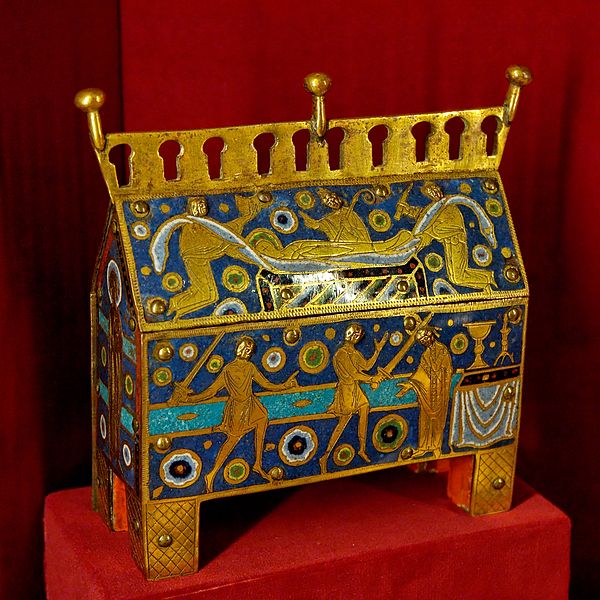

Photo from Wikipedia Commons

Next stop, lunch!  Then, the Louvre.

Friday, June 8, 2012

Paris: Cathédrale Notre Dame de Paris

Monday 6 June 2011.

Today was our first day of scheduled touring. Unfortunately it was every bit as overcast and drizzly as yesterday. We donned our most comfortable shoes, made sure we had portable rain gear, and set off walking with our guides for a day of Paris sightseeing with a medieval twist. This day will be divided into three separate posts for our main destinations, to prevent information overload!


Destination #1:  Cathédrale Notre Dame de Paris

Photo by Tammie Maloney

Cathédrale Notre Dame as we know it was not the first church built on this site. In 52 BCE, the Romans conquered the Parisii and settled the town of Lutetia, building a Temple of Jupiter to celebrate. They used stone blocks (discovered during a 1710 renovation of the crypt at Notre-Dame) to form a square pillar with a dedication from the "Boatmen of the Parisii territories" to Jupiter and the Roman Emperor Tiberius. This rediscovered pillar now resides in the Cluny Museum (which we'll visit later today).

In 528, King of the Franks Childebert I (one of the four sons of Clovis) built the first Christian church in Paris. It was initially dedicated to Saint Etienne but eventually became known as Notre-Dame. Archaeological excavations in the 20th century suggest that this Mérovingian house of worship was massive, with a five-aisle nave similar to that of the first Saint Peter’s in Rome. It was some 36 metres wide and at least 70 metres long. Its original foundations lie beneath the present-day cathedral. 

In 1163, Bishop of Paris Maurice de Sully demolished this Mérovingian basilica to Notre Dame, which had been much altered in the ensuing 650 years. He apparently felt it was not grand enough -- simply wouldn't do to serve as "the parish church of the kings of Europe."  Perhaps he felt the old-fashioned church needed to be updated in the new Gothic style.

I like to think he was also embarrassed that the cathedral of the city of Paris was inferior to Abbot Suger's magnificent Abbaye de St-Denis to the north of the city! Fortunately for us, Sully's competitive feelings eventually resulted in a masterpiece. He devoted his career and fortune to the construction of this cathedral.

Photo by John Phillips

The above view is from the Place du Parvis Notre-Dame. This was once truly the center of Paris, both literally and figuratively. The land around here was filled with other churches, chapels, businesses and residences, although all that was cleared when Sully began his 12th century building campaign.

The plaza was further enlarged during the Haussman era of Paris reconstruction. On the ground are the outlines of some of the old churches and streets that were demolished. There is also a brass star set into the ground right in front of the cathedral that was the "point zero" used to measure the distances of all roads leading to and from Paris.


Numerous architects worked on the site over the centuries, as modifications and repairs were completed. That's apparent to the naked eye, as one can see differing styles and even note the differing heights of the towers. The church is a limestone palimpsest, held together with the dried sweat of ten centuries worth of men who created and recreated a divine masterpiece.

This cathedral, like most churches, suffered during the Revolution. The building was re-dedicated to the Cult of Reason and later to the Cult of the Supreme Being. Lady Liberty replaced the Virgin Mary on several altars. And like other churches I'd visited, this cathedral even came to be used at one point as a food warehouse!

Most of the original early 13th century statuary and carvings were vandalized and destroyed by the mobs of the French Revolution, as the stone Kings of Judah who once fronted the building became representational stand-ins for the Kings of France. The Revolutionaries, frustrated by their inability to draw blood from stone, moved onto other large-scale acts of human destruction at the Place de la Concorde (but that's another story from another time).

It was the popularity of Victor Hugo's 1831 classic The Hunchback of Notre Dame that called attention to the sorry condition of the church and reminded people that it was one of France's national treasures. Restoration began in 1845, overseen by architects Jean-Baptiste-Antoine Lassus and the ubiquitous Eugene Viollet-le-Duc.

Our guide said that in 1977 the heads of the Kings of Judah and hundreds of other sculptural stone fragments were uncovered in the Chaussée d’Antin district (near the Opera Garnier and Galleries Lafayette department store) during the course of routine construction work. The Musée de Cluny was immediately contacted and told "We've found the heads of the Kings of Judah!" But since it happened to be April 1st, the Cluny contact initially thought the call was a prank! The Cluny website doesn't mention this story but does describe how after the Revolution the statues were purchased by a builder for scrap, with the heads resold and then 'buried with respect' in 1796, until rediscovered in 1977. April Fools joke or not, it's a great story and an amazing archaeological discovery. (We'll see the heads when we visit the Cluny, our next stop on the tour).


Photo by John Phillips

The cathedral was given a thorough cleaning in the late 20th century that highlighted the beauty of the front portal carvings. We spent a lot of time looking at those. 


Saint Anne's portal is the oldest of the three entrances, installed in 1200. The tympanum features the Majestic Virgin with Child that was allegedly made some fifty years earlier, dating it to use in the original Mérovingien cathedral. 

There is an angel on each side of the throne. On the left is the Bishop of Paris. On the right is a king of France, whom I like to think of as Eleanor's first husband Louis VII.

If it was indeed sculpted in 1150, it's quite possible I may be right about the model!


The center portal represents the Last Judgement. It is the newest of the three portals, dating to the 1220s.  Christ is shown in the center on this trumeau, in a teaching pose. He is standing on a pedestal sculpted with the liberal arts: Grammar, Logic, Rhetoric, Arithmetic, Music, Geometry, and Astronomy. 

I prefer this medieval way of classifying knowledge and working toward a holistic understanding: STEAM instead of STEM! However limited medieval understanding might have been compared to the modern era, it was not for want of the method of study but rather for the limits of knowledge about the known world.

This trumeau was removed in 1771 to make room for the canopy used to cover the Holy Sacrament during processions.

We have Viollet-le-Duc to thank for its restoration in mid-19th century.


I get a kick out of medieval Last Judgement representations and this one was especially fun to look at. The devil has such a delicious leer, and his minions are perfectly sleazy. The Saved who are grouped behind Saint Michel are suitably sanctimonious, whereas the Damned have the most chagrined looks. They're not at all remorseful, mind you, only sorry they've been caught!

They'll be plenty sorry once they get to Hell, though. Because: 


I spy a bishop, a monk, and a king being terrorized up in there!

The Portal of the Virgin depicts the life and ascension of Mary; a coronation scene; and an astrological calendar. The nine full-size statues on either side of the door were destroyed in the Revolution and restored in the 19th century by the workshop of Viollet-le-Duc. If they look newer, that's why.


My two favorite Parisian patron saints are represented: Denis, second to the left from the door, Geneviève third on the right from the door. Here's crazy thrill-seeking Denis holding his head, while my girl Geneviève stands looking calm, cool,serene and lovely. That's no mean feat, considering she's got a demon and an angel warring over her shoulders.


Eleanor divorced Louis in 1152, and was thus long gone from Paris by the time the cathedral we know today was started. She most certainly would have visited the original Mérovingien church, since it was considered the city cathedral as far back as the 10th century. She would have likely viewed the tympanum on today's Saint Anne portal.

Remains of the original cathedral and of the medieval streets and houses surrounding it can be viewed if one visits the Crypt Archéologique, a large excavated area under the Parvis Notre-Dame square in front of he cathedral. It was unfortunately closed today; had I known it would be inaccessible, I'd have added it to yesterday's walk! (Note to all tour operators (and tourists): always check closing times in advance when planning your itineraries).  Here are a few photos from a subsequent visit:


Time to enter the cathedral through these amazing doors. I had to take a (blurry) picture of the ornamental iron fretwork as I passed:


Once inside, the contrast between the darkness of the nave and the light streaming in from the transept windows and the chandeliers was breath-taking.


Photo by John Phillips

One tradition I cherish is the lighting a candle in memory of loved ones, which I did immediately upon entering the cathedral.

Photo by Tammie Maloney

More interior photos:


We enjoyed our tour of the cathedral but I think our most exciting medieval moment came when fellow tour member and scholar Malcolm Craig succeeded in finding the plaque honoring Eleanor and Henry's fourth son, Geoffrey II Duke of Brittany and Earl of Richmond. 

Geoffrey's untimely death in a joust occurred in 1186. He was close to his half-sister, Eleanor and Louis' daughter Marie of Champagne. She was reportedly present at the Requiem, and arranged Masses for the repose of his soul with whatever confraternity took care of such things. Malcolm finally found the marker in the ambulatory. 

We all stood around snapping photos of this memorial to a man who, had he lived, might well have been a wonderful king. He'd certainly have prevented the sad fates of his children, had history played out differently.

Although we did not visit the Notre-Dame treasury, it is notable for housing a reliquary that contains the reputed Crown of Thorns. This was the same crown that was offered to Saint Louis by the Latin Emperor of Constantinople in 1238 and eventually housed at the exquisite Sainte-Chapelle. Those were good years for the crown, as it was later threatened during the French Revolution and ended up being tossed around with State versus Church claiming possession. At least it survived! It was restored to the Church under the Concordat of 1801 and deposited at Notre-Dame, where it resides with a sliver of the True Cross and a nail from the Passion.

Some artifacts from the treasury of Notre Dame, from a later trip:


I find reliquaries to be amazing works of art (especially my favorite reliquary of all, the entire Sainte-Chapelle)! I am fascinated by the power of faith manifested in the veneration of vials of dried blood, bone, wood, and fabric scraps. An entire industry sprang up in the Christian world around the trade and manufacture of relics, capitalizing on man's desire to be closer to heaven. I think it truly doesn't matter in the end whether or not the relics are authentic artifacts. It was faith that made them powerful and offered comfort; believing made it so. 

I suppose that's the very nature of faith itself; belief is what keeps it alive, not carbon-dating. 

The rabbit's warren of streets surrounding Notre Dame beckoned, though we didn't have time to explore. Haussmann’s renovation of Paris in the Belle Epoque era has unmistakable charm, but that homogenizing building campaign destroyed so many ancient winding streets and buildings. In medieval times, access to the Cloître Notre-Dame was through four gates, all of which were closed at sunset. Entry was forbidden to anyone outside the community of canons -- especially to women! But the surrounding neighborhood was a vibrant one complete with shops and stalls, chapels and even cemeteries.

There are some architectural remains of this era. On near-by Rue de Ursins is the private chapel of Saint-Aignan,  where it is thought that the secret marriage of Peter Abélard and Héloïse d'Argenteuil took place (other sources claim it occurred at St-Julien-de-Pavre but I think the evidence that it took place at this private chapel which once belonged to Abélard's patron Etienne de Garlande is more compelling. See my post about that on my other blog: The Historical Dilettante).

Eleanor would certainly have known of the story of Abélard and Héloïse. Visiting this small chapel is reportedly difficult, and it was not on our agenda today. It is considered the second oldest building in Paris that dates to Eleanor's era; St-Germain-des-Pres is the oldest.

Also near-by along Le Quai aux Fleurs is a house on the reputed site where Canon Fulbert lived, he who was Héloïse's uncle and the man whose vengeance resulted in Abélard's misfortunes.

These little houses pictured below, squeezed in amongst newer ones, show the medieval charm of the area.


Photo by John Phillips

After a long morning, our little group stopped for a quick snack near-by, with a wonderful view!

Photo by Sherill Roberts
Au Revoir, Notre-Dame!


Our next stop: Musée de Cluny.