Showing posts with label William the Conquerer. Show all posts

Monday, October 22, 2012

Le Mans

Wednesday, 8 June, 2011

Next came another bus ride through the bucolic French countryside, this one about 91 miles from Mont St. Michel to the town of Le Mans.  Fortunately, the ride offered many opportunities to gaze upon charming les vaches Françaises!


I have a thing about cows, which actually started around the time I first visited France some 20 years ago.  France loves its cows, of which there are officially 20 million of 46 different breeds.  The most popular of the milk breeds are the Prim'Holstein, Montéliarde and Norman. The Charolais, Limousine and the charmingly-named Blonde d'Aquitaine breeds are bred for meat production.

France loves its cows so much that some beef breeders even share their wine with them. Personally, I think the American-based jazz band New Hot 5 best knows how to treat les vaches Françaises:


But enough about cows.

When people think of Le Mans at all they are likely to reference the 24 hour Le Mans Grand Prix d'Endurance, the oldest sports car endurance race in the world. But that's not what drew our group of medievaphiles to this charming town. Bordering the county of Anjou in the south and the Duchy of Normandy in the north, Le Mans as the principal city of Maine was the epi-center for 11th century battles between the Counts of Anjou and Dukes of Normandy. We were here to visit what remains of archaeological witnesses to Plantagenet history: Cité Plantagenê or Vieux Mans, a picturesque 15th century quarter of cobble streets and timbered houses.  

Chroniclers tell us that Eleanor's husband Henry loved Le Mans with all his heart. His parents married here (although that didn't turn out so well), and Henry and his brothers were baptized at the cathedral. Legend has it that Henry set Le Mans afire rather than allow it to fall into the hands of his rebelling son Richard and the French king Philippe Auguste. I have to admit that this emotionally-tinged historical explanation amused me, since the reality was that towns were regularly set ablaze rather than allowing to fall into the hands of enemies. Still, contemporary chroniclers claim that Henry was so embittered about losing his beloved city that he raged against God and denied the Almighty his soul. After Henry's flight from the city he fell ill and died, leaving the crown to Richard Couer de Lion. (No word on who got Henry's soul).

Our bus circled the perimeter of the Vieux Mans several times looking for parking, which gave us a great opportunity to view the amazing old Roman walls
. Le Mans lays claim to some of the best-preserved Roman Empire fortifications in the world. Eleanor and Henry would have been familiar with these walls, though not the more modern buildings built right into them! 


Built in 280 CE, the walls served defensive functions for the city. They extend 1300 yards along the Sarthe riverbank and include twelve towers, a gate and three posterns.  The walls are engineering marvels, constructed without solid foundations but with bases whose stability is assured as partially buried sub-structures 16 feet below the surface.  

Source: John Phillips

Le Mans has also preserved its Roman baths and much of the Roman city plan in the city center. I found the geometric patterns of the walls to be mesmerizing. Le Mans was called Vindunum in ancient times, and has in more recent centuries been known as the 'red city' because of the color of the bricks, stones and pink mortar of the Roman walls.


We finally arrived near Place et Escalier du Jet d'Eau in Place des Jacobins. The limestone staircase and fountain date to 1853 and frame an amazing view of Cathédrale St-Julien du Mans.


A church has stood on this spot as far back as the fifth century, but the cathedral we will visit today dates to the 11th century. 


The Romanesque nave and Gothic chancel reflect the different periods of its construction from 11th through the 15th centuries. But it all started in the 4th century when a Roman nobleman and consecrated bishop named Julien arrived to preach the Gospel at Le Mans. According to legend, water gushed forth during a drought when a praying Julien thrust his staff into the ground. The amazed citizenry embraced him and his faith (and no doubt his dousing skills). In gratitude, a newly-converted principal citizen of Le Mans donated part of his palace to serve as the first cathedral, dedicated to the Virgin and St Peter.  That Carolingian church was completely rebuilt in the 9th century, and again between 1060 and 1120.  In 1134, a year after Henry's birth and baptism, a major fire destroyed much of the town as well as the wooden-roofed nave, transept, and south tower of the cathedral. Reconstruction occurred slowly, and one might imagine building monies were curtailed due to Geoffrey's wars with Normandy and the Empress Maude's struggles to secure a crown in England.

Despite son Henry's gaze being held by a crown glistening across the Narrow Sea in England, he nonetheless kept this beloved city of Le Mans in his peripheral vision. Henry was a generous patron of the cathedral, especially following his father's burial there in 1151. The rebuilding he helped to finance included reinforced walls and the addition of these amazing flying buttresses:


These flying buttresses of the ambulatory are in a bifurcating or inverted Y-shape, and were poetically described in a guide book as forming a "spectacular bridge where the science of balance and light become entwined." They gave me an impression of anchoring the building to the ground, as if it would lift in flight without them.

The restored cathedral was consecrated in 1158. Little besides the exterior and the interior aisles remains of the cathedral in which Henry was baptized, and it has had subsequent additions. No doubt Eleanor visited here with him on her many travels throughout the region prior to their separation.


Source: Google Earth
We had some time to ourselves before our official tour started, so Wendy and I walked down Rue du Chateau and Rue Robert Triger (where we passed a Creole spice shop called Ti Case Creole). We stumbled upon an artisan boulanger-pâtisserie at Place St Vincent, a member of the Ronde des Pains network of independent bakeries, where we got fabulous quiche and pastries for lunch. Joined by another tour-mate, Lesley, we ate our lunch in the shade of the cathedral steps while waiting for the official tour to start.


Source: Wikipedia Commons
We passed this massive sandstone rock as we walked up Place Saint-Michel to the entrance of the cathedral. I remember taking note of it because I thought it an interesting juxtaposition of modern sculpture on medieval grounds.  It wasn't until later when reading the guidebook on the bus that we discovered that it is known as Le Menhir and is a standing stone of some 5000-7000 years of age! I don't think any of us realized how significant it was as no one took photos of it. The day's tour guide didn't even mention it.  

The layered red sandstone of the menhir has an intriguing surface, and it looks almost like a modern abstract sculpture of a woman. It's said that the stone represents either fertility or the center of the universe. Le Menhir has stood on this spot for centuries, watching over the spiritual lives of those who pass the cathedral. Legend says that St Julien topped it with a cross, thus preserving the stone from destruction. I like to think that Eleanor poked her finger in the center depression or "navel" of Le Menhir, said to bring good luck. Then again, given how fortune frowned upon her at times, perhaps Eleanor passed by the stone in ignorance just as we did.  

This is the very simple and severe western Romanesque facade of the cathedral, which dates to 1100 and is thus the same facade our Plantagenet historical characters would have looked upon. I liked to imagine Geoffrey and Maude gazing up at this facade on their wedding day. Then again, given her unwillingness to be married to teen-aged Geoffrey, I doubt Maude cared enough to pay notice to the church! Still, when they visited Le Mans, this is the facade that Eleanor and Henry would have seen...complete with ferocious lion guarding the entrance.

<----  Yes, that's a lion. 
 
Think about it; if you've never actually seen a lion, you might sculpt something like this creature to represent one. Because of the significance of the lions to the Plantagenet family, there are two of these redoubtable creatures on either side of the Romanesque doors on the west facade of St Julien's.

(Some lion-related heraldry trivia:  Henry I knighted Geoffrey, later Count of Anjou, and granted him a badge of gold lions on a blue background. His oldest son with Eleanor, Henry II, adopted two gold lions as part of his standard. Two lions on a red background are part of the arms of Normandy. Eleanor and Henry's second son, Richard Couer de Lion, added a third lion to the arms of England. They're all much more recognizably leonine).


Because of the fires that periodically forced reconstruction, and since cathedral-building techniques and styles evolved over time, St-Julien is a mix of various architectural styles. The nave is pure Roman while the choir is Flamboyant Gothic, much like what we saw at Mont-St-Michel earlier in the day

Expanded by authorization of Philippe Auguste in the 13th century, there are thirteen chapels radiating from the ambulatory.

Source: John Phillips

The chapel below was dedicated to St. Julien as well as to Le Mans bishops St. Laborius (4th century) and St. Aldric (9th century). 


The entire cathedral was once painted, as was the style of the time, but the paintings were stripped in the 19th century. The picture below is of the Lady or Chevet Chapel, which was undergoing repairs so we only had a tantalizing peek. On the ceiling are mid-1300 frescoes portraying 47 musician angels using 24 different instruments, including something called an eschaquier which was a stringed keyboard of which there are no surviving examples. 

Source: Nicole Benkert

The 13th century stained glass is exceptional. The walls in the choir are tinged pink from the celestial glow of the windows!

Source: Nicole Benkert


The two central panels in the window below are from the famous Ascension stained glass window, produced in the late 11th or early 12th century and thus dating to Eleanor's time. This is the oldest stained glass window preserved in a religious building. The Virgin and Apostles are watching Christ ascend into heaven.  Jesus must have risen too quickly to capture because that top panel is missing....


Two more photos of this lovely church by fellow tour-mate and compulsive photographer John Phillips:


As noted above, Eleanor's father-in-law Geoffrey Count of Anjou was buried in St-Julien's. The exact spot has been lost, but this enamel effigy was thought to have been hung on a wall above the tomb. 

Source: Wikipedia Commons

The enamel plaque has been moved to Musée Carré Plantagenêt elsewhere in Le Mans. I was terribly disappointed that we didn't have time to visit it and have included the above stock photo to console myself. The funerary plaque is 25'' × 13'' and made of enamel on gilt copper, a technique known as Limoges enamel, which originated around 1100 near Limoges, France. The enamel has been dated to the time of Geoffrey's death in 1150.  Supposedly a replica will be placed in the cathedral someday, but the original will remain in the local museum.

Exiting the cathedral, we walked around to view the royal entrance porch overlooking Place St-Michel, with a 12th century doorway beneath its portal and a tympanum representing a scene of the Apocalypse.  

Source: John Phillips

From there, we left St-Julien at Place St-Michel and walked down Rue de la Reine Bérengère to view the rest of the area. Cité Plantagenêt contains some 100 half-timbered houses from the 13th to 16th centuries.


According to our guide, if a building has many timber slats and/or a façade containing molded or carved work, it belonged to an aristocrat or person of means.

Source: John Phillips


Source: John Phillips

La Maison des Deux-Amis is a house was built by Jean Bernay, a wealthy merchant of the 15th century. 


Source: Nicole Benkert
The carving at right that sits between the joined double facade led people to assume that the building was a medieval duplex shared by two friends, hence its name.

Sharon Kay Penman commented that people often forget or don't know how very colorful the Middle Ages were, and we enjoying imagining the bright colors on the houses in the Cité Plantagenêt.  Work continues in the area to restore original medieval colors to the buildings.


Above is Square Dubois, and the Rue de Pilar Rouge, named for the large house on the corner.  This square sits above a massive tunnel carved in the 1870s in order to connect Le Mans with main roads, open up development to the west and north of town, and grant easier access to the city centre.  We drove through the beautifully decorated tunnel on Rue Wilbur Wright several times trying to get our bearings when we came into Le Mans, not aware that all this was directly above us!


Seven remaining houses in La Cité Plantagenêt have pillars known as ‘corniers’.  They functioned as shop signs and landmarks so one could find one’s way in the absence of street numbering.  

Source: John Phillips
This is the cornier at the best known of those houses, Maison du Pilier Rouge.  The large stones in front of it and other houses are meant to stop vehicles from scraping the medieval buildings. The pillars themselves would also have provided alcoves for pedestrians, who would have dodged behind them of harm's way of the horses, carriages, and wagons traversing the streets. 

 Another building with intact crozier:


Our last moments in Le Mans were spent gazing upon the outside of what was once the Palais de Comtes du Maine, now part of the city hall and thus not available for public visiting.  

Source: John Phillips

Our attention was called to the walls and the arched Romanesque windows, the only identifiable architectural remains of the Plantagenet palace where both Geoffrey Count of Anjou and his son Henry I were born, and where the wife of Richard I, Berengaria of Navarre, lived in her widowhood.


Much of the facade was reworked in the late 1700s, then again in the period between the two world wars. Sharon noted that in Henry's day there were two royal residence in Le Mans, an ancient castle near St-Julien's and the palace here at Place St-Piere. It was at this latter site that Eleanor and Henry would have stayed when visiting Le Mans.

We had a very little time to spend in Le Mans and our visit simply could not do the town's history justice. In addition to missing out on seeing Geoffrey's enamel, we had to skip a visit to another significant Plantagenet-related site, L’abbaye de la Piété Dieu de l’Épau on the eastern side of town.  Épau was founded as a Cistercian abbey in 1230 by Berengaria of Navarre, who died that same year.  She had been devoted during her long widowhood to charitable acts and is still revered as The Lady of Le Mans. The abbey she founded flourished for a century but burned to the ground in 1365, and the site of her actual burial was lost to history. Although rebuilt, Épau was dissolved during La Révolution, passed into private ownership, and was requisitioned by the Germans during their occupation during WWII. No longer a functioning religious site, the abbey is a tourist site and open for visits. Restorative work began there in the 1950s and uncovered remains thought to be those of Berengaria in 1960. The skull showed signs of post-mortem injury and traces of metal, suggesting the forcible removal of a crown in a probable act of some past vandalism. The remains are universally accepted today as those of Berengaria and were reunited with and preserved beneath her restored recumbent stone gisant in the abbey chapter house. This stone effigy had been removed at some point by the early 19th century, relocated and preserved at Cathédrale St-Julien du Mans.


Source: Wikipedia Commons

In her book Queens in Stone and Silver, art historian Kathleen Nolan suggests that the book Berengaria holds in this funeral sculpture "...in some way references that of her mother-in-law, who treated her very badly after the death of Richard I."  While it is true that Eleanor did not intervene in Berengaria's protracted battle for her dower rights and lands, I'm not sure what coded message Berengaria could be sending with such imagery! It was not unusual for gisants to include figures holding closed books in repose (as we'll discuss later, Eleanor's actively-reading gisant was quite unusual), but the almost mirror-image of the figure on Berengaria's book is indeed curious. If only stone could talk....

I have to admit that my reminiscences of Le Mans are tinged with regret for lost opportunities to more thoroughly explore the Vieux Mans, poke the belly button of Le Menhir, visit the museums and L’abbaye de l’Épau, and even to view the son et lumière free laser light show called La Nuit des Chimères. Given the wasted time that occurred later this evening, we could have well afforded to spend more time in this lovely town. Ah, regrets....

Some beautiful photos of Épau can be found at this LINK, and you can take a virtual tour of Le Mans at this blog LINK.

Next: Abbaye Royale de Fontevraud.

Tuesday, June 19, 2012

Falaise

Tuesday, 7 June, 2011

Subtitle to this blog entry:  The Toilet Travails of Traveling.

We were meant to leave Paris immediately after an early breakfast but the tour bus was over an hour late fighting its way through city traffic. I think that meant we were officially on French time. It was a wet and miserable morning so most of us were crammed into our hotel lobby. We occupied ourselves reading and chatting. I had thought to bring along the flowers my beloved had sent me but the peonies were wilting, as peonies quickly do. My lovely flowers weren't going to survive the trip so while we were waiting, I donated them to the lobby restroom and took one final photo. Adieu! 


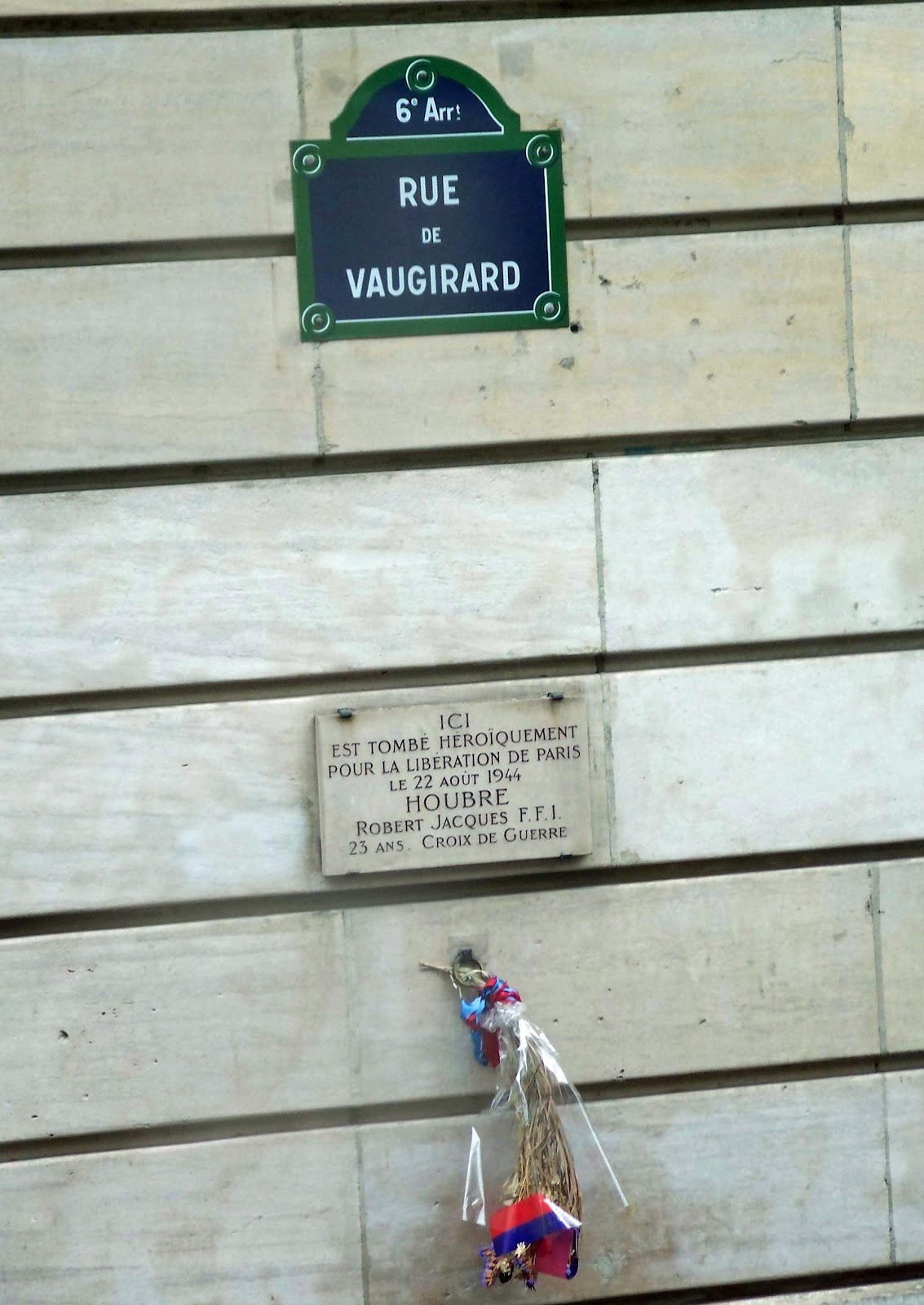
As we finally drove away, I spied from the bus window a commemorative plaque honoring a man named Robert Jacques Houbré, a Résistance fighter with the rank of Sergeant in the French Forces of the Interior (Forces Françaises de l'Intérieur, aka FFI). Houbré, age 43, was mortally wounded on August 22, 1944 on this spot at the corner of Boulevard Saint-Michel and Rue de Vaugirard, and he was awarded the Croix de Guerre posthumously. This isn't far from the major intersection of Blvds St-Germain and St-Michael, a corner notoriously known as the Carrefour de la Mort during the intense seven day battle to liberate Paris. Some of the fiercest fighting took place in this area. Parisians blocked their streets to the Germans by building homemade barricades, a tradition in times of strife dating back to the 16th century. Houbré's plaque is also around the corner and down the street a bit from the Palais du Sénat at the Jardins du Luxembourg, where desperate fighting to wrest control of Le Senate took place. Clearly Robert Jacques Houbré was in the thick of things, but I have not been able to trace the details of M. Houbré's story.

Someone must still know it though, because a floral arrangement had been left to honor his memory. I found myself wishing that I still had a peony left from my arrangement to add to it. I've long been fascinated by the small and large acts of heroism of everyday folks who participated in La Résistance française during World War II. This plaque prompted quiet reflection about that time as our bus got underway.

Robert Jacques Houbré memorial


The farther we drove out of Paris, the better the weather got. Wendy and I occupied ourselves with meandering chitchat. It was a long drive to Falaise, about 115 miles.

Necessity soon dictated that I was to be the one to inaugurate the bus loo, which was neatly concealed under a seat in the back stairwell. A succession of women (our tour group was comprised of 30 women and 3 men) followed me, and unfortunately it soon became obvious that there was, well, mechanical trouble. We were scolded for not discarding waste paper in its proper receptacle as the signs...in French...clearly told us we were to do. Pity someone in the party who could actually decipher French toilet instructions hadn't used the loo first!

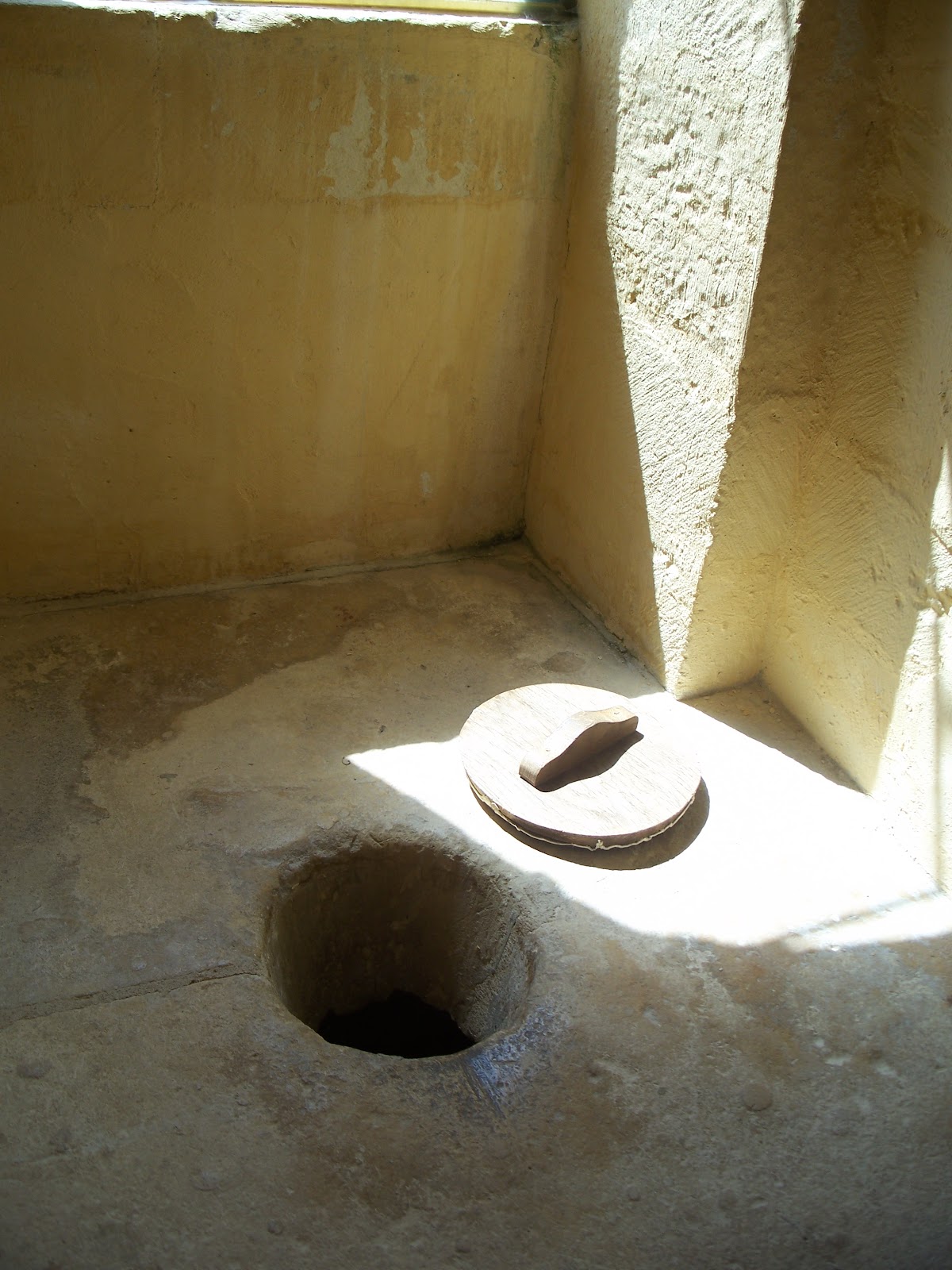
To add insult to indignity, when our bus pulled over at a rest stop the only loos available were Turkish squatters. I'd come across these twice before, in Egypt and outside of Saint-Benoît-sur-Loire Abbey near Orléans. I didn't think I'd find one at a roadside rest stop in Normandy, but it makes sense given the low maintenance involved. There was much appalled muttering from our group over this contrivance. I later learned that Googling 'squatter toilet' provides much fascinating trivia regarding the history and usage of these devices, including instructional videos. The best piece of advice: "Use your hand sanitizer and remind yourself that travel is all about broadening your horizons."

Obligatory rest stop photo:


I was vastly amused while waiting at this pit stop to spy our driver leaving the bus gingerly carrying a large tree branch complete with leaves, which he'd apparently used as a plunger to attempt rudimentary toilet repair.

One does what one must, and makes do.

Driving through the Val d'Ante valley,  by mid-afternoon we had our first sighting from the bus window of the fortress of Falaise. It rose majestically out of the limestone and sandstone hillsides.  I think everyone on the bus gasped in unison.

Photo by Susan Taksa O'Dee


This fortress at Falaise occupies the site of the castle built by William the Conquerer and later greatly expanded by Eleanor's Henry. Proof of human presence in this area dates back to 60000 years BCE and fortifications on the rocks have existed since the Carolingian era (mid 10th century). The original castle was built by Richard I, Sans Peur (great-grandfather of William the Conquerer and 4x great grandfather of Henry II) and was one of the very first stone castles ever built in Normandy. Nothing substantial remains of that first castle.

The tall tower to the right is the Talbot Tower (built by Philippe Auguste, who had a thing for towers) and the Great Keep. Henry I built the keep over the first ancestral castle in the style of those built in England by his father, William the Conqueror.

It was time for lunch but as it was the French countryside, all restaurants were closed in mid-afternoon. I'd been wondering if that would be the case, based on previous experiences with this phenomenon. In smaller towns and villages of France, you can pretty much count on everything closing for lunch and not reopening until mid-afternoon -- which was right when we'd arrived in Falaise. Some of us wandered through Place Guillaume le Conquérant to Rue du Camp Ferme where we found a small marché and stocked up on croissants, cheeses and fruit (and begged the proprietress to let us clog, I mean use, her small bathroom). We took lots of photos along the way as we then made our way up to the castle.

Photo by John Phillips showing the whole of Place Guillaume le Conquérant, Hotel de Ville in background, chateau looming off to the right.

In the year 911, Viking chief Rollo signed a peace treaty with the King of Franks which created the Duchy of Normandy, and in honor of that event and to promote tourism Normandy was celebrating its 1100th anniversary in 2011. These banners were all over Falaise.


The creation of the dukedom of Normandy (the land of the north) ushered in a new political scene. The town of Falaise became one of the first cities of the new duchy. Fast forward a millennium and two-thirds of the town was destroyed by Allied bombing in 1944 during World War II. Some older charming buildings like these still remain, though not from Eleanor's time!


Falaise was a center of commerce in Eleanor's time due to linen, hemp and woolen drapery, leatherwork, and farming in the surrounding countryside. Today it has about 8000 residents.


Also in the town square was Eglise de la Trinité. The original church was built around the year 840, and thus would have been known by Eleanor. It was destroyed during the siege of Falaise by Philippe Auguste in 1204 when he wrested control away from Eleanor and Henry's youngest son, John. The present church dates from the 1400-1500s:


We were drawn to this statue of William the Conqueror on a very big horse. It was sculpted by Louis Rochet in 1851, and two decades later statues representing the preceding six dukes of Normandy were added to the base. Those other six were Rollo, William I Longue Épée (Longsword), Richard I Sans Peur (The Fearless), Richard II le Bon (The Good), Richard III, and Robert le Magnifique (the Magnificent,  and father of William). The first three men were more likely known as Counts of Rouen since Richard I was the first official Duke of Normandy. Eglise de la Trinité is in the background in this photo.

Guillaume le Conquérant, dit également Guillaume le Bâtard, Guillaume II de Normandie et enfin Guillaume Ier d’Angleterre.

William was born in 1028 at Falaise Castle. He was the illegitimate son of the 6th Duke of Normandy Robert le Magnifique (also known as le Diable or the Devil for presumably killing his brother). His mother Herleve (most often called Arlette) was the daughter of Fulbert of Falaise. Before his conquest of England, William was known as The Bastard because of the illegitimacy of his birth. Despite those regrettable circumstances, he was named heir to Normandy by his father. William had to deal with all manner of challenges to his birthright but had secured it by the time he was 19. He married his distant cousin Mathilda of Flanders in 1053, and they had ten children. In 1066, William took advantage of a dispute over the succession of the English throne, crossed the Channel, and invaded at Hastings. After a fierce battle lasting nine hours, William defeated Harold Godwinson. He marched to London and was crowned Christmas Day 1066 in Westminster Abbey, the first documented coronation held there. (Harold Godwinson may have been crowned in Westminster earlier that year, making him the first, but there's no contemporary evidence to support this so I'm going with the Bastard on this one).

Eleanor's second husband Henry was the great-grandson of William.  That legacy loomed large over the Plantagenets, who considered themselves Norman and not English. Falaise is only 20 miles south of Caen, which was one of the places I dearly wished we could have visited in order to pay our respects at the burial sites of William the Conquerer and his consort Matilda of Flanders.

This monument to testosterone inspired Wendy to organize the future Bastard Tour of France and England. We're still waiting on the complete itinerary (Caen is one of the stops for sure) but in the meantime some of us adopted a name for ourselves after admiring this statue: The Bastard Babes.


We finally tore ourselves away from Bill the Bastard's sculpted manliness and headed to Château de Falaise, Château Guillaume le Conquérant, gazing at the outer ramparts as we walked up the hill.  

Photo by Malcolm Craig

When Eleanor's youngest son John lost Normandy to France's Philippe Auguste, Falaise fell during the Siege of Château-Gaillard in 1204. Once it was his, Philippe added the many semi-circular towers and the Talbot Tower. I told you he had a thing for towers, which served to defensively flank the curtain walls. The castle fell from French control during the Hundred Years' War in 1418, and was occupied by the English for 32 years until recaptured by King Charles VII.

During the Wars of Religion in the late 1500s, Falaise was held by Catholics who refused to acknowledge the sovereignty of the King Henri IV (remember that we previously discussed his skull). Henry IV laid siege to the castle from near-by Mount Myrrha and breached the ramparts with cannon. That was the end of an era for Falaise Castle, as it was no longer significant defensively.

In the 18th century Château de Falaise passed into private hands and underwent many alterations so it could function as an aristocratic residence. Over time the castle moats and ditches were filled. Amazingly it escaped destruction during the Revolution. The castle was officially classified as a Historical Monument in 1840, and the first restoration effort took place in 1863 by a student of Viollet-le-Duc. 


These youngsters were leaving after a field trip and had paused for a photo op. I could just imagine my own 7 year old son up there with them. Feeling briefly maternally melancholic, I headed to the castle itself. 


The center forebuilding which houses the reception and gift shop was constructed in 1996 by architect Bruno Decaris, who undertook an ambitious campaign of restoration beginning in 1986. He restored the Talbot Tower and the keeps, and built this structure to evoke the feel of classic forebuildings of Anglo-Norman keeps. Decaris used all modern materials in the parts of the castle where there were no traces of original materials, choosing to do so in order to evoke but not mimic the missing features. The forebuilding was controversial because the choice of modern grey concrete in a building of this size was criticized for disrupting the cohesive look of the castle grounds. However controversial, the building is in keeping with the UNESCO guidelines for architectural interventions to historical edifices. There would have been a drawbridge here, which is evoked by the suspended metal footbridge.

Inside we found a model of the early castle showing how it looked in Eleanor's time.


Henry built the lower keep with later additions by sons Richard and John during their reigns.

Sharon Kay Penman told us that Falaise was one of Henry's favorite castles and an important base of operations for him. We know for sure that Henry and Eleanor held their Christmas court at Falaise castle in 1159. A room on the upper floor of the Lower Keep, with these odd IKEA-like thrones, is meant to evoke the Great Hall where the court was held. It's an awfully small room for that purpose. Eleanor is depicted to the left in this photo of the Great Hall.


Sharon thought it very likely that Henry held Eleanor prisoner at Falaise after the family rebellion of 1173, before whisking her off for her long confinement in England.

We came across a fun display of the hierarchy of power and privilege in the Middle Ages, from Roi down to the lowly paysans et serfs. This hierarchy directly corresponds with how comfortable one's life would be. Falaise had many of these modern educational elements and judging by the rapt attention of the visiting children, it was all quite effective.


Photo by John Phillips

The visiting children no doubt enjoyed seeing this medieval garderobe. Mine would have, at any rate, and no doubt would have staged a posed photo op.


We walked around the grounds of Falaise and tried to imagine a younger Eleanor and Henry here in happier days. The view from the walls of the surrounding landscape was breath-taking and I imagined it to be a vista untouched by time, a scene not unlike what Eleanor might have seen when she stayed at Falaise.


Unmodified archer loop and/or ventilation slit to the left, probably circa 13th century. Modified archer loop with cannon holes to the right; the holes were added by the English occupiers in the 15th century to accommodate firearms.


Peeking from the upper bailey to the town of Falaise below.


Photo by Susan Taksa O'Dee


I have to admit that some of architect Bruno Decaris' 'evocative' modern materials gave me pause. For instance, this grating was used for flooring outside the keep and was easily one hundred feet above ground. It made me shriek with horror when I first realized what I was standing on, startling my fellow tour members. Sorry about that, folks!

After that, I decided not to venture to the top of Talbot Tower and settled for admiring it from a distance. Philippe Auguste's Tour Talbot is similar in design to the towers that he built for his arsenal at the medieval Louvre, which we saw yesterday. The tower is 115 feet tall with a diameter of 49 feet. It had six levels with wooden ceilings and stone-ribbed vaults. Light and ventilation were provided by slits; the large windows we see today were added during the 14th and 15th centuries. A well dug in the depths provided fresh water, and heavy loads could be winched up to each level through an internal opening.  The tower was not a party room; its purpose was purely defensive.

Great resource to learn more about Château Guillaume le Conquérant can be found at this website: LINK.

The second phase of modern renovation, from 1998-2003, was focused on restoring the upper rampart and courtyard of the castle. The third phase, evident by the ubiquitous scaffolding that we'd passed on our way up to the castle, is aimed at restoring the defensive character through further work on the ramparts, enclosure towers, and ditch.


I applaud all efforts at historical preservation. Restoration is a noble and welcome endeavor. But there is still something compelling about a ruin.


As we straggled back to our bus, Tee and I spied this charming chocolatier and of course a visit and some purchases occurred. Our loot helped pass the time on the next leg of our journey.

From Falaise, we crossed part of the area known as the Suisse Normande (Norman Switzerland) on our way to Mont St-Michel. I squealed internally every time we passed these vache charolaise!


Photo by Nicole Benkert

Next stop: Mont-St-Michel.

Sharon Kay Penman's blog entry about our tour of Falaise and subsequent arrival at Mont St-Michel can be found here:  LINK